
Listen to this article
Estimated 4 minutes
The audio version of this article is generated by AI-based technology. Mispronunciations can occur. We are working with our partners to continually review and improve the results.
There is an immediate political test looming for Prime Minister Mark Carney and his government as early as Monday — one that has not been on the political radar federally for more than a decade.
And it’s one that does not seem to be front and centre of the federal agenda yet.
This week has so far seen the expansion of an LNG plant on the West Coast and the referral of a high-speed rail strategy in Alberta to the Major Projects Office. It is widely expected the West Coast pipeline will be designated a project of national interest to speed the approval process along.
The prime minister is banking on these projects to grow the Canadian economy, but also help deal with the very real political challenges in the West. That includes, of course, the Oct. 19 Alberta referendum on whether the province should start a process to leave Canada.
WATCH | PQ entering majority territory, polls show:
PQ enters majority territory in latest election polls
Qc125 polling analyst Philippe J. Fournier breaks down provincial polling one week out from the election with CBC News Montreal at 6 guest host Sudha Krishnan.
But before that, Quebec will choose a new government. Public opinion polling shows it is likely that the Parti Québécois will win, with the party now closing in on majority territory.
The last time Quebec had a sovereignist government was 2014 when Premier Pauline Marois’s PQ was voted out after less than two years in office. But there was little to no talk of a referendum from that government. In fact, you have to go all the way back to the last Quebec election I covered, in 2003, when Bernard Landry tried to pick up the mantle of Lucien Bouchard and promised a referendum if he had the “mortal certainty” he would win it.
Landry lost that election to Quebec Liberal Leader Jean Charest.
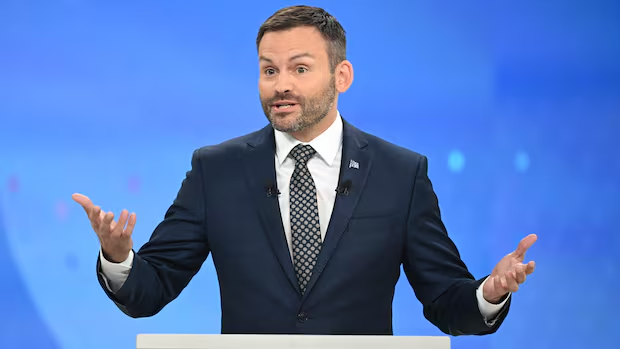
The current PQ leader, Paul St-Pierre Plamondon, has promised not to hold a referendum until after Donald Trump is no longer president, citing the volatility of that administration and how it could impact results.
But federal leaders should not mistake that decision for lack of commitment to the sovereignist cause. In fact, St-Pierre Plamondon says he remains optimistic despite what most polls show, namely that only 30 per cent of Quebecers are interested in a referendum at all.
 St-Pierre Plamondon’s lead in the polls has expanded in recent days. (Jacques Boissinot/The Canadian Press)
In the last debate of the campaign, St-Pierre Plamondon pointed to something former premier and PQ leader Jacques Parizeau would say: “We shouldn’t be afraid of democracy.”
It is not just the real threat of a referendum — that will become a contentious issue should the Parti Québécois pull off a victory. Ottawa will also have to be prepared for a more aggressive stance from the PQ leader.
“I think it is difficult to find more evident declines and reversals than over the past 10 years,” St-Pierre Plamondon said in an editorial board interview this week with La Presse.
“It is not referendums that are to blame for the decline of French, the decline in our demands for health transfers and that of immigration, that has been sabotaged by the federal government.”
All premiers and provinces fight for their jurisdictions and to get more from Ottawa. But only one of them will make those demands elected with the mandate to hold a referendum on independence.
Case in point for what awaits Carney’s government: as premier, St-Pierre Plamondon has promised to get rid of an intergovernmental affairs minister. Instead he would have a minister of independence, tasked with making gains for Quebec.
In an era where working as Team Canada has been key to the response to the trade war with the United States, that team may now become fractured and more difficult to manage.
Polls suggest Carney’s popularity remains high across Canada, including in Quebec, which also happens to be his political power base — holding 44 of the 78 ridings.
But his ability to manage the country through a crisis and prove to Quebec it is a valued part of the federation without giving further fodder to a no longer dormant separatist movement is about to be tested in real time.