
Open this photo in gallery:
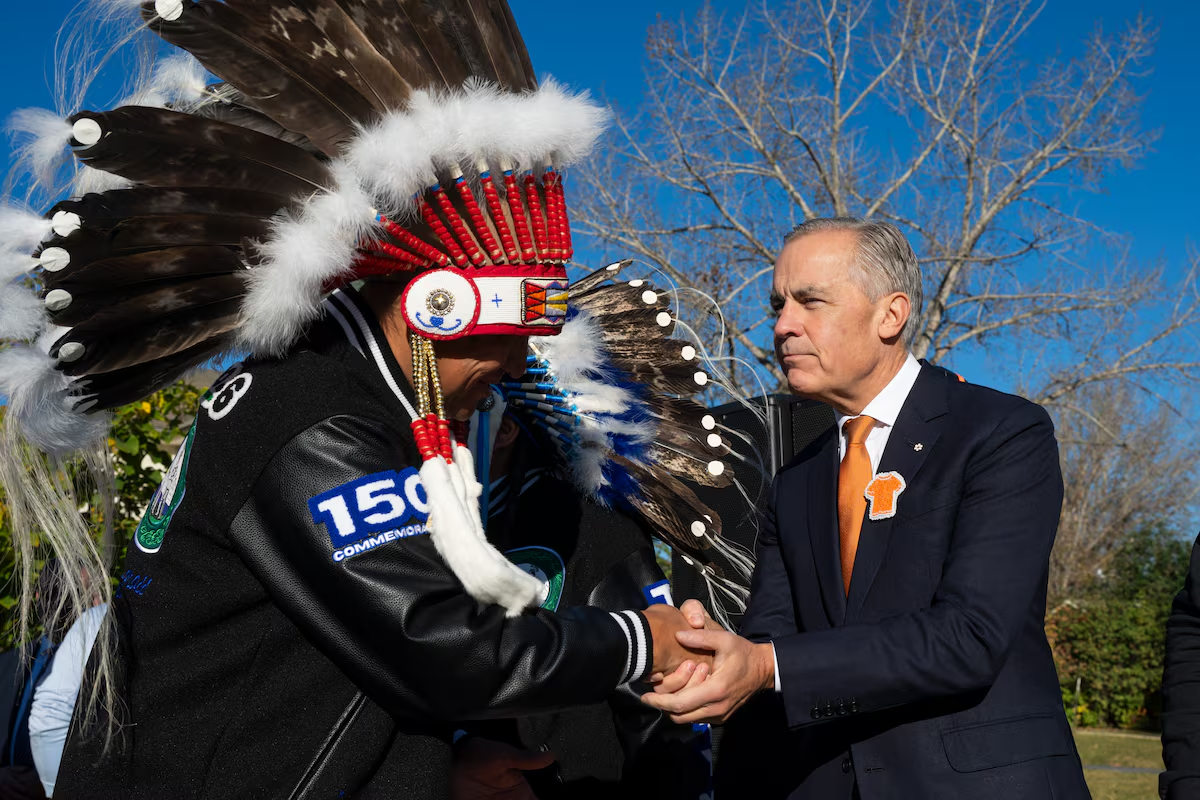
Prime Minister Mark Carney said the partnership involves ‘meaningful opportunities to develop, operate and own major infrastructure,’ and for Indigenous communities to share in the prosperity that’s created from those projects.John Ulan/The Canadian Press
Prime Minister Mark Carney vowed to create a true partnership with Indigenous people, including on operating and owning major infrastructure projects, as he marked the sixth annual National Truth and Reconciliation Day.
Mr. Carney’s comments at a commemorative event in Fort Edmonton Park Wednesday were made on the eve of an expected announcement to designate a West Coast oil pipeline as a project of national interest.
The pipeline is a key part of Mr. Carney’s suite of policy changes that aim to reset federal relations with Alberta and diversify Canadian exports away from the United States. But some First Nations have accused his government of a lack of meaningful consultation.
The Prime Minister, wearing an orange tie on what is known as “Orange Shirt Day,” addressed his government’s desire to build major projects across the country, but to do so sustainably.
“Sustainably means embedding Indigenous knowledge and leadership in our conservation efforts, and it means building in true partnership with Indigenous peoples,” Mr. Carney said.
New West Coast pipeline expected to be designated project of national interest by Thursday
He added that involves “meaningful opportunities to develop, operate and own major infrastructure, to share truly in the prosperity that’s created.”
“My point is, we are making some progress, but we know the work of reconciliation is far, far from finished,” Mr. Carney said.
“The wounds are still too deep, the gaps are still too wide. Reconciliation is a journey, not a destination. It’s an attitude, not an achievement. Our job is to move together as far and as fast down the path as we can.”
The Assembly of First Nations declined to comment on Mr. Carney’s remarks but said it would respond on Thursday.
In May, Mr. Carney’s government said it would designate the proposed pipeline a project of national interest under the Building Canada Act by Oct. 1. That process is being led by the federal Major Projects Office, headquartered in Calgary.
Indigenous leaders strike resolute tone as Canada marks sixth National Day for Truth and Reconciliation
One of the groups opposing the fast timeline for the process is the Coldwater Indian Band, in British Columbia. The group also opposed the Trans Mountain Expansion Project owing to concerns about risks to the community’s aquifer.
On behalf of the band, Vice-Chief Michael Smithers said in an e-mail earlier this week that there has been a lack of meaningful consultation between the community and the Major Projects Office about the new pipeline.
In his speech Wednesday, Mr. Carney called residential schools a “dark chapter” and said it’s the government’s responsibility to respond to the findings uncovered by the Truth and Reconciliation Commission, which documented the stories of residential-school survivors and the historical inequities faced by Indigenous people.
Beginning in the 1800s, more than 150,000 Indigenous children in Canada were sent to church-run residential schools, where abuse and malnutrition were rampant.
In 2015, the TRC concluded the schools were central to a state-backed policy of attempted cultural genocide.
Mr. Carney said that while the “gaps are still large,” the government is responding, including by improving opportunities in education to ensure children on reserve have access to high-quality learning that respects and embraces their culture.
Prime Minister Mark Carney said it’s important to reflect on a ‘dark chapter’ in Canada’s history and honour the children who survived residential schools and those who never made it home. He made the comment Wednesday on the National Day for Truth and Reconciliation at an event in Fort Edmonton Park.
The Canadian Press
He said the government is building homes for families on reserve and throughout the country, improving access to drinking water, as well as placing an emphasis on mental wellness, primary care and culturally relevant care for First Nations.
NDP MP Leah Gazan, her party’s critic for Indigenous affairs, said in an interview that Mr. Carney’s comments on a day dedicated to residential-school survivors, who were removed from their families in the name of “nation-building,” show “how out of touch this government [is], and how uncommitted this government is to true reconciliation.”
She pointed to the release Wednesday of a report from the Permanent Peoples’ Tribunal, a human-rights organization, that called on the government to rescind the Building Canada Act, which allows it to accelerate projects designated in the national interest. The report said the law “uses ‘projects of national interest’ to justify the persistent land dispossession of Indigenous Peoples.”
Ms. Gazan also noted that the government in its June legislation removed language stating that those living on First Nations have a “human right” to clean drinking water, instead focusing on furthering progress toward that goal.
“As an Indigenous person – but not even as an Indigenous person, as a human being – I feel deeply hurt by the ongoing human-rights violations of the Carney Liberal government,” said Ms. Gazan, a member of Wood Mountain Lakota Nation in Saskatchewan.
Conservative Leader Pierre Poilievre’s office did not respond to a request for comment Wednesday. But in a statement posted to X, he said residential schools “were a massive intrusion of government coercion imposed on Indigenous families.”
“On the National Day for Truth and Reconciliation, we honour these children, their families and their communities, and recommit to reconciliation built on self-determination, opportunity, and true partnership,” he wrote.
With a report from The Canadian Press