
Listen to this article
Estimated 3 minutes
The audio version of this article is generated by AI-based technology. Mispronunciations can occur. We are working with our partners to continually review and improve the results.
On Oct. 1 Canadian Space Agency (CSA) astronaut Joshua Kutyrk will blast off from Cape Canaveral, Fla., and he’s bringing some innovative Canadian tech with him.
Living and working in space is a dangerous job. Our bodies weren’t made for living in low gravity, and astronauts can experience a slew of different side effects.
That includes the potential to develop extremely dangerous blood clots, which has happened, though we don’t know to whom due to privacy concerns. And NASA is very interested in ensuring the safety of astronauts living on the orbiting laboratory.
“Over the years, we have spent a lot of time investigating what happens to the human body when humans go to space for weeks, months at a time. And there have been some medical concerns associated with formation of blood clots,” said Mathieu Caron, director of CSA’s astronaut office.
“That prompted NASA to look at different ways to properly quantify the risk, to understand, you know, are we close to a problem or not?”
 Canadian Space Agency astronaut Joshua Kutryk undergoes high resolution 3D imaging of his wrist as part of a study called TBone2. Here, Kutyrk is having images collected before his 6-month mission to the ISS which will be compared to data gathered after he returns to Earth. (Dr. Steven Boyd)
That’s why they’ve commissioned technology from Vancouver-based Response Biomedical.
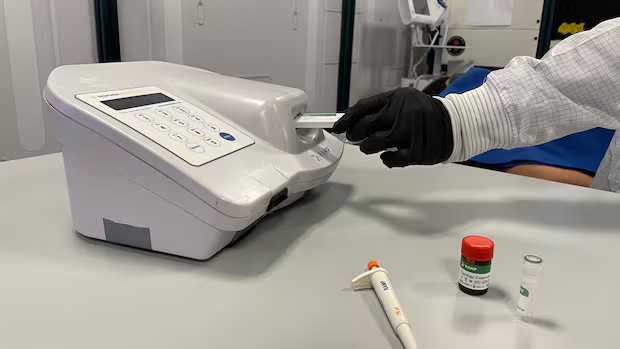
One instrument of particular interest to NASA was one that measures the D-dimer in blood, a protein fragment left over in the blood after a clot.
He said this is one of the most crucial pieces of information for flight surgeons on the ground. NASA chose CSA because of its experience with health and life science research on the space station, he said.
Called Acute Care Testing in Space (ACTIS), the device is taken from the company’s existing RAMP technology. These devices can not only look for blood clots but also look for evidence of heart attacks or testing for COVID-19, RSV and more.
The simple blood test can be done within minutes, making it far more efficient than others, said Taso Tsonis, CEO of Reponse Biomedical.
Used in remote communities
“It’s a great story of how our Canadian-developed platform is being used internationally now on the International Space Station, but our continued focus is here on Earth,” Tsonis said.
“And advancing testing to more reliable testing that’s portable and near a patient where you can get a result in about 15 minutes as opposed to waiting for hours for a critical test result.”
WATCH | Canadian astronaut Joshua Kutryk gets ready for ISS mission:
Canadian astronaut Joshua Kutryk gets ready for ISS mission
Joshua Kutryk is set to be the next Canadian astronaut in space and the first to participate in a joint NASA-SpaceX mission. Kutryk is set to leave for the International Space Station on Sept. 12.
That timeliness is also important to those living in remote communities here on Earth, where testing may be limited and time may be of the essence.
“A lot of times, health-care systems are burdened by either unnecessary treatment, unnecessary admissions, but also people who are not assessed quickly enough,” Tsonis said.
Tsonis said that he’s excited to think that, should Kutryk’s testing of the technology go well, ACTIS could perhaps travel farther than the ISS — perhaps to the moon or even Mars, as NASA plans for more human space exploration.
And both Caron and Tsonis said the fact that ACTIS was chosen for the ISS is a win for Canada.
“For us, it demonstrates the flexibility and the enduring value of our technology that we are part of an innovative journey, and especially in today’s climate,” Tsonis said. “Being a Canadian company operating solely in Canada.”