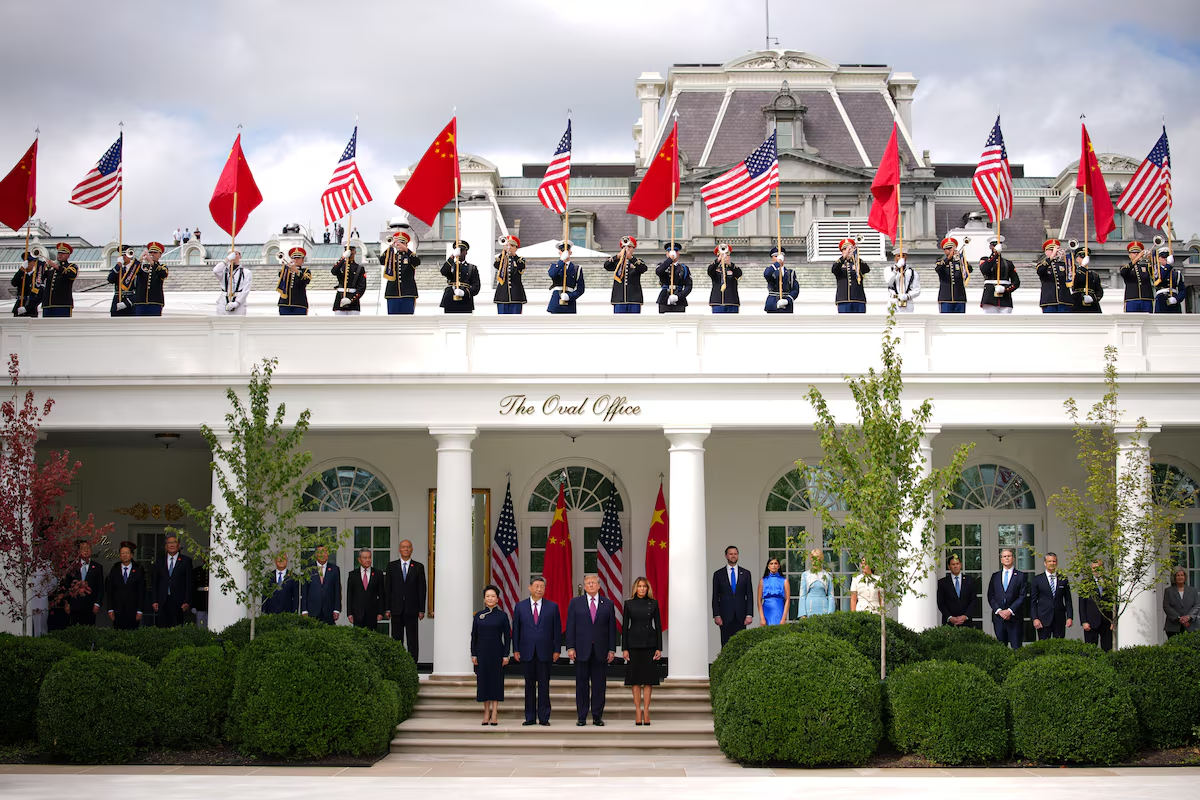

Good morning. U.S. President Donald Trump wanted to make a good impression during Chinese President Xi Jinping’s visit. More on that below, along with updates from the synagogue shooting in Belleville, Ont., and Kenneth Law’s sentencing hearing.
Open this photo in gallery:
China’s first lady Peng Liyuan, President Xi Jinping, U.S. President Donald Trump and first lady Melania Trump gathered in the Rose Garden of the White House on Thursday.Andrew Harnik/Getty Images
TOP STORIES
Both China and the U.S. seek stability
U.S. President Donald Trump hailed the “truly great friendship” he has forged with Xi Jinping as the Chinese leader began his highly anticipated state visit by pressing for the world’s two biggest economies to work more closely together to avoid friction as they compete.
Analysis: Trump was clearly out to impress, writes Asia correspondent James Griffiths. But for all the pomp and ceremony – including a supersonic bomber flyover, a brass band and troops dressed in Revolutionary War-era gear – the good vibes expressed by both men could not hide the fragility of the current rapprochement.
- Michael Kovrig: The U.S.-Canada trade war is really about what alignment means – and about China, too
- John Rapley: China and the U.S., the worst frenemies of the world economy
Sign up for Morning Update:
Reading this online? Start your morning with context and insight on the day’s biggest stories, in your inbox every weekday.
Open this photo in gallery:
Odelia and Neressa Quewezance, from left, leave the Court of King’s Bench in Yorkton, Sask., in 2023.Michael Bell/The Canadian Press
Indigenous sisters’ murder charge was likely a ‘miscarriage of justice’
Two Indigenous sisters who have maintained their innocence since they were convicted of murder more than 30 years ago will have their case heard by Saskatchewan’s Court of Appeal following a review by the federal Minister of Justice. Sean Fraser issued a statement that said an in-depth review had concluded that the 1994 convictions of Odelia and Neressa Quewezance were likely a “miscarriage of justice.”
The history: Neressa and Odelia were arrested and charged in the stabbing death of 70-year Joseph Dolff, a janitor at the local residential school the sisters attended in their home community of Keeseekoose First Nation, Sask. The sisters’ 15-year old male cousin, whose identity remains protected because he was a youth at the time, was charged with murder to which he pleaded guilty.
Open this photo in gallery:
The Sons of Jacob synagogue has served as the spiritual home for Jews across Belleville, Trenton, Prince Edward County, and the wider Quinte region since 1956.David LeClair/The Globe and Mail
Police say synagogue shooting was hate-motivated
The attack on a synagogue in Belleville, Ont., as worshippers were gathering to mark Yom Kippur, the holiest day on the Jewish calendar, was a hate-motivated crime, the city’s police chief confirmed at a press conference Thursday. The officers are the only thing that prevented a greater attack, Chief Murray Rodd said.
The details: Chief Rodd played a video that was captured at the scene of the attack. In it, the shooter, standing behind a parked car a few metres from Constable Jeff Smith, can be heard yelling “you are going to die for the Jews” before opening fire on the officer.
The politics: Jewish leaders and MPs say that tackling antisemitism and hate should be a priority and Ottawa should boost federal funding for community security.
Open this photo in gallery:
A makeshift memorial for the victims of a mass shooting at Tumbler Ridge Secondary School, Feb. 12.ALANA PATERSON/The New York Times
Details emerge about how Tumbler Ridge shooter used ChatGPT
Canadian officials are alarmed at the first public details of the Tumbler Ridge shooter’s interactions with ChatGPT that show OpenAI’s program provided tactical advice on how to maximize carnage and counselled her on how to bypass the tech giant’s own safeguards.
A quote: “This is far worse than we thought it was going to be, although I already imagined it to be pretty bad – there needs to be accountability for this,” said Niki Sharma, who has stepped away from her attorney general duties this week to run in B.C.’s election. She added that provincial lawyers had asked OpenAI to hand over the chat logs earlier this year and were rebuffed. “It’s shocking that this technology is out there.”
Open this photo in gallery:
The Bald Range wildfire in Summerland, B.C. caused a lot of damage in the summer.Aaron Hemens/The Globe and Mail
Canadians are in the dark about their wildfire risk
Wildfire hazard maps try to show longer-term trends in fire potential, tracking factors like weather and vegetation. Though some mapping is publicly available in B.C., there is a patchwork of incomplete data. And such information is virtually non-existent in the rest of the country, making the scale of danger largely invisible to most Canadians.
The risk: Without the information, communities continue to build new housing in high-hazard areas while critical mitigation efforts are frequently delayed. Experts warn that a failure by governments to make detailed hazard mapping publicly available has left towns and cities across the country more vulnerable to the threat of extreme wildfires.
The Take
If mainstream political leaders want to stem the tide of extremist parties, the answer is not to bend themselves toward the chimeral imaginings of their voters. It’s to aim squarely at the people at the top of those parties, and the hateful lies that give them a grip on power.
— Doug Saunders, international affairs columnist
It’s a mistake to think extremists are winning because mainstream parties failed, writes Doug Saunders.
The Shot
Open this photo in gallery:
Chef Alex Kim scoops two Korean-inspired pastes in a mixing bowl as part of the dressing for the endive and arugula salad at Five Sails Restaurant in Vancouver.Felicia Chang/The Globe and Mail
Alex Kim, chef and co-owner of Five Sails in Vancouver, knows a few things about taking the long way to delicious: fermentation, umami, and time as an ingredient.
The Wrap
What else we’re following
At home: The first phase of Kenneth Law’s sentencing hearing closed yesterday with alarming accounts of police and parents trying to intercept deadly packages he had shipped around the world.
Abroad: India’s ‘cockroach’ youth movement threatens protests if the country’s chief election officer doesn’t quit.
At the UN: Delegates walked out as Israeli Prime Minister Benjamin Netanyahu addressed United Nations defending his country’s actions in Gaza. Palestinian President Mahmoud Abbas spoke on prerecorded video after his visa was denied.
On Parliament: The Parliamentary Budget Office says the federal government’s plan to balance the operating budget is based on unclear and sometimes contradictory definitions.
A settlement: Two men who were switched at birth in a rural Manitoba hospital 71 years ago have each been compensated $250,000 by the province.
Receive: The first Canadian to get what is colloquially called a “heart in a box” says that he has received a second life.
Relax: Neurowellness is all the rage – for better and for worse. Can apps and devices really help us chill out?
Read: There are dozens of new fiction and non-fiction tiles from Emily St. John Mandel, Patrick deWitt and more. Here are 66 new books to read this fall.