
Open this photo in gallery:
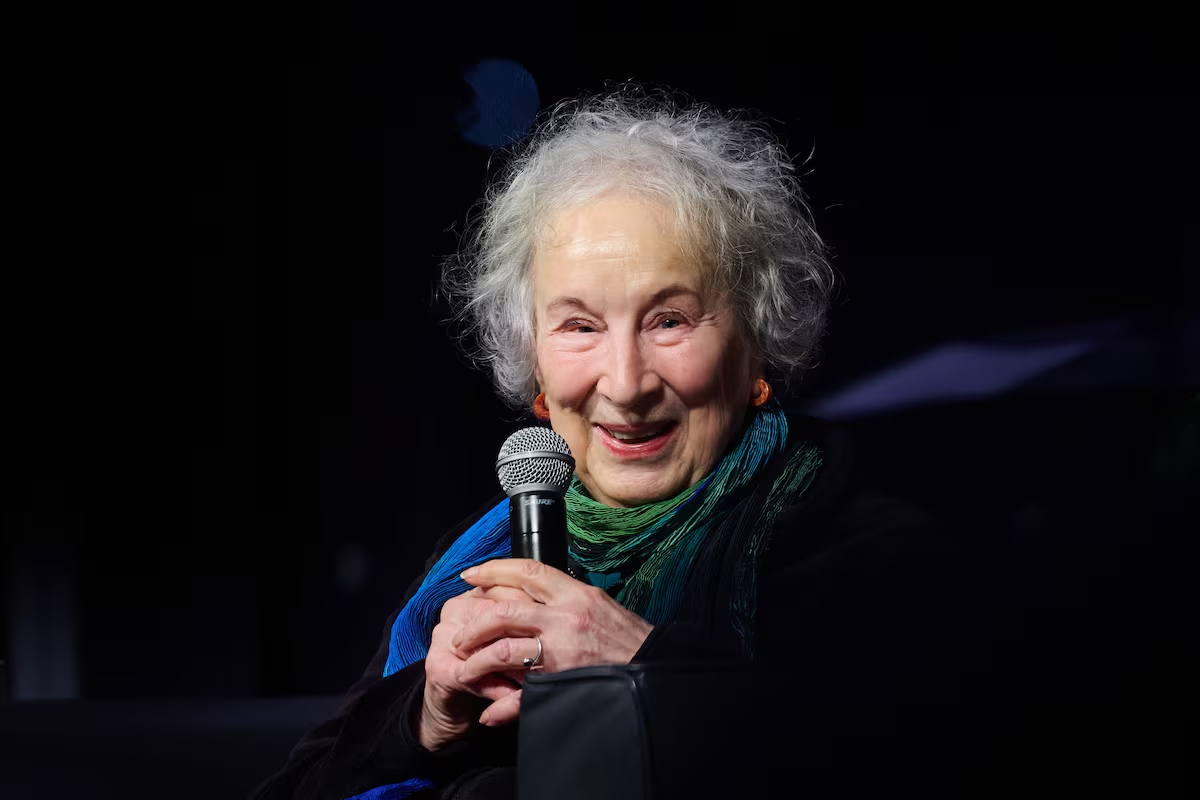
Margaret Atwood speaks at a Globe event in Toronto in 2025.Sammy Kogan/The Globe and Mail
Margaret Atwood has long been a hero to book lovers but they may soon be overtaken by a second, feathered fan club.
On Friday, Western University in London, Ont., announced a $1-million gift from Ms. Atwood to set up a research chair in bird science.
The donation will allow the university to add a new hire to its biology faculty with the goal of advancing scientific knowledge about birds and bird migration.
Within the field, Western is known for its Advanced Facility for Avian Research, with resources that include a wind tunnel for studying birds in flight under different conditions.
The university said the newly created position will be named the Graeme Gibson Chair in Avian Biology, after Ms. Atwood’s late partner.
Mr. Gibson, who died in 2019, was a novelist and a former president of PEN Canada. He was also an alumnus of Western and his experiences there served as an inspiration for his first novel, Five Legs, published in 1969. Its story unfolds as a university lecturer and a student travel to a funeral.
How Margaret Atwood and her family helped turn Pelee Island into a migratory bird research hub
In the middle of his life, Mr. Gibson became an avid bird enthusiast, particularly once he and Ms. Atwood began spending time on Pelee Island, a major stopping point for migrating birds. In 2005 he published The Bedside Book of Birds, a bestselling compendium of writings about birds and their relationship to people.
In an interview, Ms. Atwood said that Mr. Gibson would have been “surprised and tickled” to know that his name was being honoured at his alma mater, especially in connection with bird research.
She added that Mr. Gibson was not the type of birder who was preoccupied with checking off species on a list.
“He was somebody who entered into everything the bird was doing, where was it living and what was it eating,” she said. “He was an all around field naturalist type of person.”
Open this photo in gallery:
Margaret Atwood outside the Pelee Island Heritage Centre in May.Melissa Tait/The Globe and Mail
Earlier this month she attended the official opening of the Atwood-Gibson Bird Centre, a research facility that is part of the Pelee Island Bird Observatory. The observatory, which conducts bird banding and gathers data on migrating species, has been in operation for 22 years. Ms. Atwood provided financial support and helped raise additional funds for the $3.5-million centre, which gives researchers a place to stay on the island and expands the observatory’s program.
The centre and the new chair at Western are related, Ms. Atwood said. Both are meant to foster bird research across the country. Migrating birds, which account for the majority of Canadian species, are of particular interest. Many face a range of human-related threats as they make their annual journeys, including hazards such as glass windows and house cats to the larger scale effects of habitat loss and pollution.
More recently, climate change has become a new challenge for many bird populations because it can alter the timing and abundance of plant and insect populations on which they depend.
Chris Guglielmo, who directs Western’s Centre for Animals on the Move where the new research chair will be based, said the relative visibility of birds makes them ideal subjects for studying more subtle shifts in the environment.
“Some of the earliest evidence that climate change is really happening came from bird-banding records,” Dr. Guglielmo said.
In 2019, a study published in the journal Science estimated that bird populations in North America have declined by nearly three billion since 1970. The result was a clarion call for conservation groups looking to increase protections for species and for scientists seeking better data on bird movements to inform policy decisions.
Ms. Atwood said that her recent donations are intended to enable such work, which Mr. Gibson also actively supported during his life.
In Canada, science-related philanthropy is often directed toward medical research. Ms. Atwood said she was inclined to take a broader view.
“Yes, human beings are important, but so is everything else. Because without everything else we would not exist.”