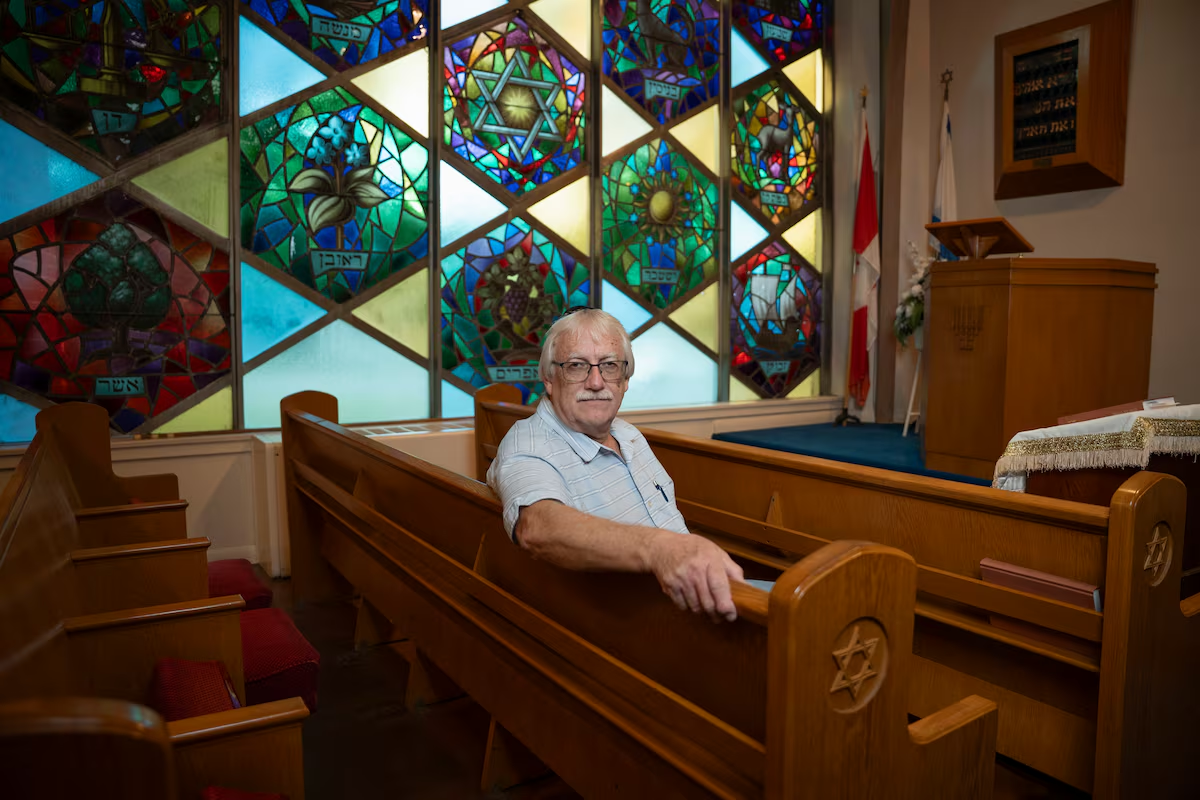
As the volunteer president of the only synagogue serving a rural stretch of mid-eastern Ontario, Norman Weddum is used to taking on a lot of job responsibilities. Fixing leaks in the roof. Mopping the floor. Mowing the lawn. Even cleaning the toilets if needed.
This week, he added a new, grim task to his to-do list: fix two dozen bullet holes in the large, technicolour stained glass window depicting the 12 Tribes of Israel, or the ancient lineage of the Jewish people.
“I need to find a craftsman who knows how to repair that type of stuff,” he told The Globe and Mail. “This place is a mess. I need to clean it up.”

Norman Weddum, volunteer president of the Sons of Jacob synagogue, ducked for cover during its recent Yom Kippur services when gunfire poured in from outside.
At sundown on Sunday, the small congregation of the Sons of Jacob Synagogue in Belleville, Ont., was settling in for Yom Kippur services when gunfire erupted outside. At first, Mr. Weddum thought it was firecrackers or a car backfiring, and went into the lobby to look at the street.
Realizing what was happening, he ran back inside, slammed the doors behind him and told everyone to get on the floor of the sanctuary. Bullets began flying over their heads as police engaged in the fierce gun battle with Sean Ward, a former member of the Canadian military, who had come prepared to carry out a mass-casualty attack, armed with multiple firearms, ammunition and gasoline, investigators said.
The gunman, who was caught on video shouting “you are going to die for the Jews,” was killed in the firefight and a Belleville Police officer, Constable Jeff Smith, was critically injured.
Three days later, board members of Sons of Jacob gathered here for the first time since the shooting, shared hugs and got back to the business of running their synagogue during what’s normally the holiest time in the Jewish calendar. Though shaken by questions about what would have happened if the gunman had breached their door, they say they will continue to gather to celebrate their faith, just as they always have.
“There has been some trauma from this. But we’re going to pick up the pieces and we’re going to start over and we’re going to carry on. We will not be stopped by this person, or anybody else,” Mr. Weddum said.
Mr. Weddum, semi-retired at 70 and managing the synagogue in between shifts as an usher at the local hockey rink, says the threat of violence has become a reality for Jewish organizations in 2026, even in the smallest of communities in Canada.
With no paid staff, there is little money in the Sons of Jacob budget to hire off-duty police or private security, but those things have become essential, he said. Constable Smith was on-duty Sunday and assigned to protect the building as part of a long-running partnership with the Belleville police.
While officers surveyed the crime scene on Monday, a police vehicle nearby had a windshield pocked with bullet holes. An officer stationed outside the synagogue was critically injured.
Sammy Kogan/The Globe and Mail
Sunday’s attack is a dramatic escalation of antisemitic incidents targeting Jewish people in Canada, and has fuelled calls for a national response.
More than two dozen reports of gunfire, arson, window-breaking and other types of vandalism have been documented at synagogues, Jewish schools and institutions across Canada in the past three years, according to the Centre for Israel and Jewish Affairs. While most of those have happened in larger urban centres, the Belleville shooting casts a spotlight on the vulnerability of the country’s smallest Jewish communities.
“We always have police protection,” Mr. Weddum said. “Every synagogue in North America on the high holidays has police protection. We’ve been doing it for years. Whenever there’s a large gathering of Jews in a synagogue, there’s police protection. That’s just a sign of the times.”
Open this photo in gallery:
‘Make no mistake, this was a targeted attack against the Jewish community,’ Chief Murray Rodd said Thursday as police confirmed that the shooting was hate-motivated.
On Thursday, Public Safety Minister Gary Anandasangaree said federal funds will be used to improve security at the synagogue, but didn’t elaborate. The synagogue has also started a $90,000 GoFundMe campaign to help rebuild and protect the building.
The members of Sons of Jacob, meanwhile, say they’re reflecting on their past this week, and the determination of previous generations of Jewish people who resettled in the Belleville area.
“When you’re Jewish, you look to the history of your people,” Shima Viggoda, Sons of Jacob’s vice-president, told The Globe. “The people who came here were Holocaust survivors. They escaped Czarist Russia. They came to make a better life in this country, just as every Jewish community across this country.”
Open this photo in gallery:
Sons of Jacob has been here for 70 years, though its congregation trace their roots farther back within Belleville.
Belleville’s tiny Jewish community has persevered for well over a century. In the late 1800s, this railway stop halfway between Toronto and Montreal attracted Jewish immigrants from Eastern Europe, who faced barriers in traditional professions and trades but found work as furriers and peddlers. In 1905, a handful of families began holding religious ceremonies at a rooming house for travelling Jewish workers, laying the early roots for the Sons of Jacob congregation, according to the synagogue’s own historical records.
By 1956, when the current synagogue opened on a leafy residential street, the area’s Jewish community included some of its most prominent merchants, but also plenty of blue-collar families. They raised the money to build their new place of worship in part through bingo games, hosted at an ice cream parlour where the main attraction was two domesticated bears.
At its peak, the Sons of Jacob had a thriving congregation of more than 55 families, with its own Hebrew school, rabbi and shochet, a specially trained kosher butcher. The synagogue was a bustling hub for fundraising dances, bazaars, lectures and Bar Mitzvah ceremonies.
As many younger people left for larger cities, however, the membership dwindled. For years, Sons of Jacob didn’t have enough congregants to hold regular weekly services. On Sunday night, there was only 25 people inside the building, even though they’d used their limited budget to fly in a rabbi from Israel, and waived fees to attend.
They say they’ll continue their work to revive their congregation.
“We’re resilient, that’s why we keep going. We have to fight,” said Mary Cohen, a longtime congregant who sits on the synagogue’s board. “There was a time when we couldn’t have services and we didn’t have the people. But again, we built ourselves up, and we are standing on our feet now.”
Open this photo in gallery:
The synagogue is closed to the public for now, but Mr. Weddum says it will be back soon.
Sunday’s shooting was not the first antisemitic incident experienced by members of the congregation. In 2023, a man smashed out the synagogue’s basement window in an act of vandalism some saw as targeted. As part of its history display, the congregation also has a letter to the editor published by a high school student in 2019, describing her experience with racism growing up Jewish in Prince Edward County.
There have been historical incidents here, too. In 1925, prominent businessman Harry Yanover, the son of Jewish immigrants from Poland, woke up to find a large cross burning on his front lawn, according to an account of Ku Klux Klan activity in the area by local historian Trevor Parsons.
Mr. Weddum said the synagogue will reopen its doors to the public soon, now that the building is no longer a crime scene. There’s still some unfinished business to follow Yom Kippur, the holy day of atonement when, according to the religious doctrine, God seals the fate of his people for the coming year, he said.
“For Jews, it’s kind of like, who’s going in the bad book? Who will not live through this year?” he said, pausing, then adding: “I guess we were all in the good book, because we survived.”

Attack in Belleville: More from The Globe and Mail
Political reaction
Veteran’s alleged role in Belleville synagogue attack could tarnish military, former top soldier fears
Tackling hate should be a priority, Jewish leaders and MPs say
Commentary
Steven Wernick: The Belleville attack was a warning shot for the antisemitic attacks Canada has let fester
Editorial: The courage needed to face down hatred