
Open this photo in gallery:
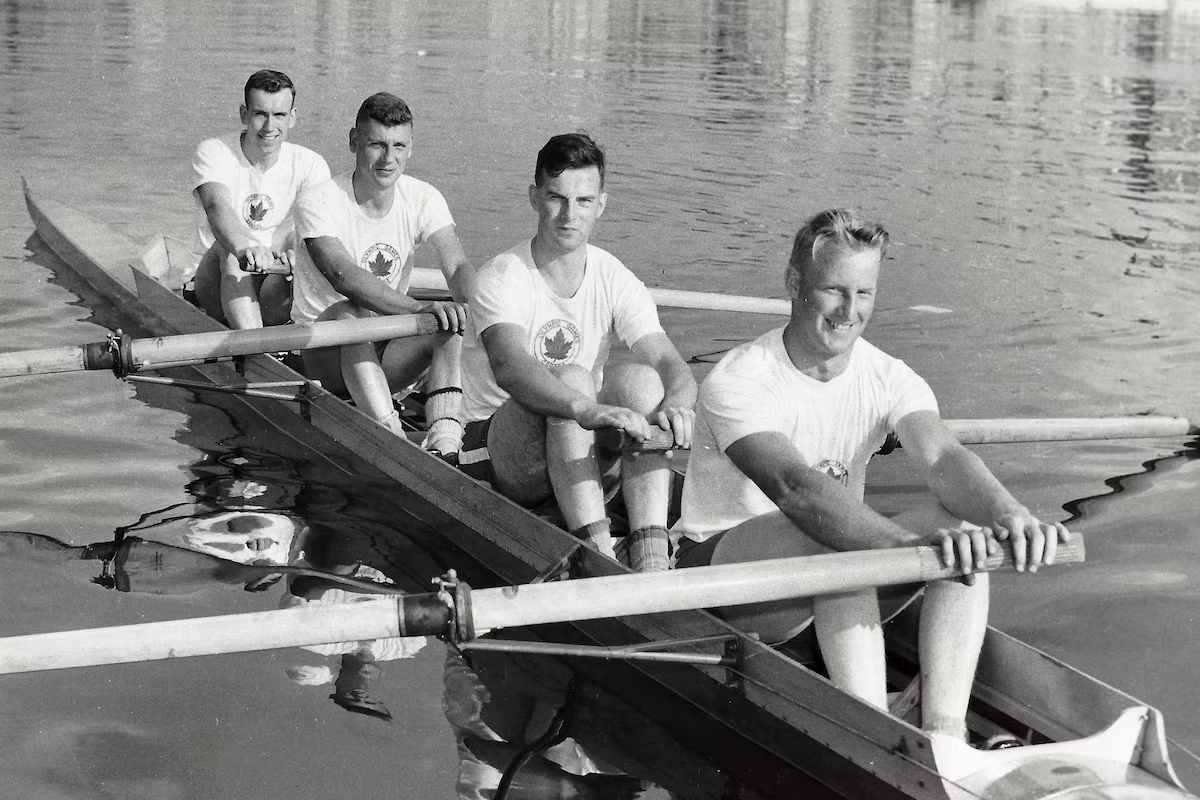
The Cinderella Four, from left to right Archie MacKinnon, Lorne Loomer, Walter d’Hondt and Don Arnold, in their Canadian strip on Lake Wendouree in Melbourne at the 1956 Olympics.Jason Beck/Supplied
Though the teenager had never once sat in a racing shell, Archie MacKinnon, a freshman electrical engineering student, tried out for the varsity rowing team when he arrived on campus.
He later said he “thought it would be easy to make” the team, guided by Frank Read, the University of British Columbia’s legendary coach.
As it turned out, he failed to win a spot among the coxed eights, the sport’s glamour boat. He and three other cuts were encouraged to continue as spares with the possibility one or two might be used as a substitute in case of illness or injury.
The unheralded youths trained in a shell for four without a coxswain. A year later, the novices shocked the sporting world by winning a gold medal at the 1956 Olympics in Australia.
The first-ever Olympic rowing championship for Canada helped launch a golden age for the sport on the West Coast, the effects of which linger to this day.
Mr. MacKinnon, who has died at the age of 89, was the last surviving member of a student crew forever remembered in lore as the Cinderella Four.
“They are the pioneering Olympic champions of Canadian rowing, one of the most important crews ever assembled in our country’s history,” said Jason Beck, curator of the B.C. Sports Hall of Fame and Museum, who is completing a book on the province’s rowers from that era.
“As the bowman, he was responsible for steering the shell straight with his foot while stroking his oar in time with his crewmates for 2,000 metres at a pace that would bury most normal humans.”
Open this photo in gallery:
Archie MacKinnon and the Cinderella Four shocked the sporting world by winning a gold medal at the 1956 Olympics in Australia.BC Sports Hall of Fame
Archibald Alan MacKinnon, who carried the name of his paternal grandfather, was born on Jan. 13, 1937, in Cranbrook, a small city in British Columbia’s East Kootenays region. He was the first of two sons born to the former Ivy Elsie Marshall and Charles Eric MacKinnon, an engineering graduate who took over the family’s foundry.
The father insisted his son study at the University of Toronto. A lean but muscular athlete, Archie, who stood six-foot-two (1.88 metres) and weighed 176 pounds (79.8 kilograms), instead chose Vancouver, where Mr. Read’s program showed great promise with an eights boat representing the university and the Vancouver Rowing Club. The coach’s eights had upset a heavily favoured Thames Rowing Club on the Vedder Canal in B.C.’s Fraser Valley to claim the gold medal at the 1954 British Empire and Commonwealth Games. That unexpected victory led Prince Philip, who was in attendance, to invite them to the famed Henley Royal Regatta in England the following year. The Canadians defeated the Soviets before narrowly losing the 1955 Grand Challenge Cup to an American crew.
The coach was a hard-nosed, tongue-lashing disciplinarian, a hotelier accustomed to barking orders to his staff. The rowers trained along Vancouver’s working waterfront, where driftwood and freighters were occasional hazards. Without a coxswain, it was Mr. MacKinnon’s duty in the bow to steer and avoid debris.
“It was a tremendous strain on him during our training sessions avoiding all the logs and drift in Coal Harbour,” assistant coach John Warren told a reporter in 1956.
Mr. Read only offered instruction to the eights boat, so those in the four boat often had to quickly row over to get within earshot.
Gruelling two-hour sessions on the water beginning at dawn in even the wettest weather were followed by studies on campus, and further rowing in the evening. The four lived in spartan quarters at the rowing club. The men eschewed dating and a social life to dedicate themselves to training.
In summer, the four young men worked as labourers, handling jackhammers and wielding axes to help cut a path through rugged terrain for a pipeline.
The crew showed such dedication to their training that Mr. Read decided to bring them along to the Canadian Olympic rowing trials in 1956. “They have worked terribly hard for months,” the coach said. When the unknown quartet arrived at the Royal Canadian Henley course at Port Dalhousie, Ont., an Ontario coach haughtily told Mr. MacKinnon not to interfere with the undefeated fours from the Brockville Rowing Club. After the western upstarts humiliated the favourites by 10 lengths, Mr. MacKinnon sought out the rival coach to ask, “Did we give them enough space?”
In the final, the Vancouver boat crushed their opponents, completing the 2,000-metre course in 6 minutes, 23.1 seconds, nearly 13 seconds faster than the Olympic record set in 1928 by a British foursome. (One of those British rowers, John Lander, had been in Hong Kong on business when the Japanese invaded in 1941. He immediately volunteered and was killed in action on Christmas Day, the final day of the Battle of Hong Kong. He was 34.) In an earlier heat, the Vancouver four had performed even better, besting the Olympic mark by an astonishing 31 seconds in what was their first competitive race in Eastern Canada.
Both the fours and eights qualified for the Olympics to be held in Melbourne four months later. But the success of the four freshmen – Don Arnold at stroke, Walter d’Hondt at No. 3, Lorne Loomer at No. 2, and Mr. MacKinnon at bow – meant funds had to be raised to cover the cost of sending them overseas.
A last-minute appeal for money, led by popular Vancouver mayor Fred Hume, raised $6,000.
Open this photo in gallery:
UBC Totem Yearbook, features both the 1956 UBC-Vancouver Rowing Club eight and four along with coach Frank Read and coxswain Carl Ogawa. Archie MacKinnon is front row, second from right.Jason Beck/Supplied
The Olympic regatta was held on windswept Lake Wendouree, a man-made basin about 120 kilometres west of the host city. The Canadian crew easily advanced to the finals only to have disaster strike as they washed out on their first stroke, a rookie mistake in which the oars pop out of the water before completing a stroke. In an instant, they were in last place.
They needed to call on their superb conditioning. They hunted down the other boats with each stroke, Mr. Arnold calling for a series of “hard 10s,” reaching a peak rate of 36 strokes a minute at the midway point when they overtook the French to grab the lead. They held off a late challenge from a U.S. crew from the Detroit Boat Club to win by five lengths.
The jubilant quartet then cheered on the Canadian eights boat, which took a silver medal after being defeated by an American boat.
After the disappointment of failing to make the eights months earlier, Mr. MacKinnon and his crew made history of their own.
The four returned to Vancouver as conquering heroes. At the airport, lieutenant-governor Frank Ross presented each with a signet ring, while the mayor gave each a gold watch with an inscription including their name, reading “from the citizens of British Columbia in tribute to a magnificent performance at the 16th Olympiad.” The mayor raised funds for the gift after premier W.A.C. Bennett refused to pay for them.
After being whisked downtown from the airport, the athletes were paraded by a 50-vehicle procession led by university cheerleaders and the firefighters’ band to the Vancouver Rowing Club for a reception.
Later, when Mr. MacKinnon finally returned to his hometown, 500 well-wishers gathered at the arena as the mayor presented him with a travelling case and a gold plaque.
With several of the eights crew graduating, Mr. MacKinnon and his three mates at last won coveted spots in what is known in the sport as the heavyweight boat.
In 1958, he was part of the crew to win a British Empire and Commonwealth Games gold medal on windswept Llyn Padarn in Wales. The Canadians defeated the Australians by three-quarters of a length, followed by England and Scotland. They received their medals from Prince Philip and cheers from a small but hardy crowd of 1,500, who endured bone-chilling winds.
Two years later, on Lake Albano near Rome, Mr. MacKinnon sat in the No. 3 seat with Mr. Arnold at No. 2 and Mr. d’Hondt at No. 7 (with Mr. Loomer serving as a spare) as the Canadians finished three-quarters of a length behind a German team. The Canadian boat also included future Canadian federal cabinet minister David Anderson. The silver was Canada’s only medal at the 1960 Summer Olympics.
Open this photo in gallery:
Archie MacKinnon, second from the left, with other crewmates from the 1960 eights: David Anderson, Mr. MacKinnon, Nelson Kuhn and Donald Arnold.BC Sports Hall of Fame
After graduating with a degree in electrical engineering, Mr. MacKinnon later earned a master’s in business administration from York University’s Schulich School of Business. In Toronto, he worked for Ford and General Electric before becoming a vice-president of CDC Ventures Inc., a venture capital subsidiary of the Canada Development Corporation.
He moved to Calgary in 1983, where he built a career in venture capital and investment banking as president and CEO of Alta-Can Telecom Inc., followed by four decades as head of Sutter Hill Capital Corporation, which focused on the energy and telecommunications industries.
Mr. MacKinnon and his Cinderella crew have been inducted into Canada’s Sports Hall of Fame (1957), the Canadian Olympic Hall of Fame (1958), the B.C. Sports Hall of Fame (1966), UBC Sports Hall of Fame (1993) and the Canadian Rowing Hall of Fame (2018). He has also been additionally enshrined in the B.C. and UBC halls for his participation in the 1960 Olympics boat.
Mr. MacKinnon died of esophageal cancer at Foothills Hospital in Calgary on Aug. 28. He leaves Judy, his wife of 47 years. A first marriage ended in divorce. He was predeceased by a younger brother, Paul Marshall MacKinnon, who died in 2000 of melanoma. He was also predeceased by his former Cinderella Four crewmates, as Mr. Loomer died in 2017, while Mr. Arnold and Mr. d’Hondt both died in 2021.
Their unexpected Olympic gold medal helped to move the centre of Canadian rowing from Ontario to the West Coast, where generations of rowers have continued to find success on the world’s watery stages.
Mr. MacKinnon was humble about his sporting success. His résumé did not include his status as a two-time Olympian. His second wife had been with him for two years before learning of his achievements.
“His mother was visiting and asked about the status of his medals,” Judy MacKinnon said. “I thought, ‘Was he in the military?’”
Last year, Mr. MacKinnon had an emotional reunion when he visited the B.C. Sports Hall of Fame in Vancouver. His rowing shell from the 1956 Olympics is on permanent display in the Hall of Champions. Nearly seven decades had passed since Mr. MacKinnon and his friends had raced in the shell, crafted by the famed boatbuilder George Pocock.
The shell, which the team named the J.M. Warren after their assistant coach, is on its side on a wall so visitors can peer inside to see such features as the foot stretchers into which the oarsmen’s feet are strapped. It is stationary now, but four young men once sat inside it to glide with serene power toward Olympic glory.
You can find more obituaries from The Globe and Mail here.
To submit a memory about someone we have recently profiled on the Obituaries page, e-mail us at obit@globeandmail.com.