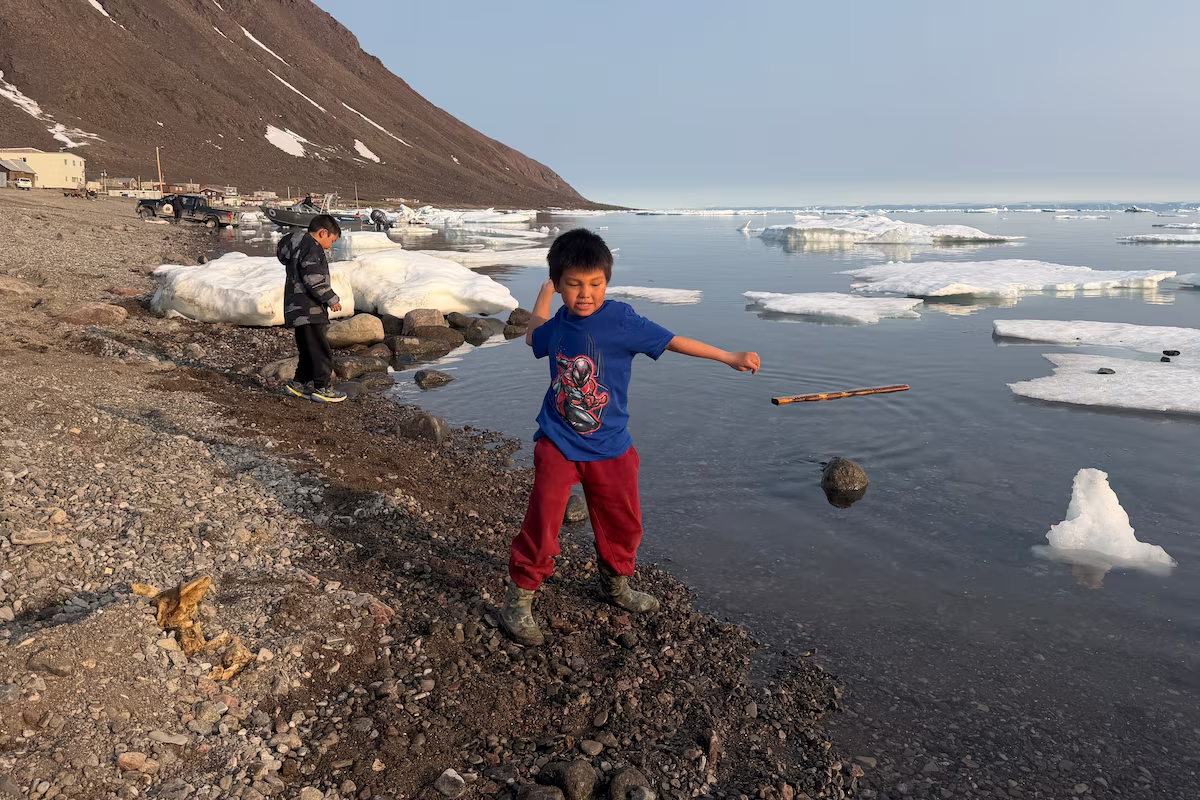
Canada’s northernmost community sits on a narrow shelf of land veined with streams that run down the slopes of Ellesmere Island into the waters of Jones Sound.
With a population of about 150, Grise Fiord depends on those streams for its drinking water, which it collects and stores in large silos. In late summer, when rainfall is sparse, the streams are fed by meltwater from the glacier above town.
The community’s Inuktitut name, Ausuittuq, means “the place that never thaws.” But now the glacier is retreating, taking a key component of the water supply with it.
“Glaciers everywhere have receded or disappeared. That one used to be so huge it would overhang along the edge,” says Larry Audlaluk, an elder who was a child when the Canadian government relocated his family in 1953 from northern Quebec to the hamlet, which is located 1,160 kilometres north of the Arctic Circle.
“Now you got to go somewhere high to look for it, or on the plane,” he says.
Open this photo in gallery:
Elder Larry Audlaluk lives below a shrinking glacier in Grise Fiord, Nunavut.Jenn Thornhill Verma/The Globe and Mail
Open this photo in gallery:
Behind the remains of a whale on the beach, Grise Fiord keeps its drinking water safe in tanks. The snow-covered gullies supply glacial meltwater in the summer.Jenn Thornhill Verma/The Globe and Mail
Unlike other Nunavut communities, Grise Fiord has no lake or other natural water source to fall back on when the streams run low. So, with support from Ottawa and the territorial government, the hamlet is building one. Construction is under way on a treatment plant and three storage tanks that will hold enough water to supply residents year round.
The work highlights an obvious fact: Climate change stopped being a hypothetical threat in Grise Fiord years ago. It is now a permanent reality – and Grise Fiord is hardly unique.
In a major new assessment released last month, federal scientists show how every part of Canada is already experiencing the effects of a warming climate, with Northern, coastal and Indigenous communities among the most vulnerable.
Grise Fiord is among the 13 case studies in the report of First Nations, Inuit or Métis communities that are on the front lines of climate change, already having to adapt.
“It just reinforces the fact that Canada is seeing, right now, the impacts of climate change in a very large way,” federal Environment Minister Julie Dabrusin told The Globe and Mail. And while the assessment focuses on the physical effects of climate change, rather than how to manage them, it underlines just how much work will be needed “to help communities to meet the challenges that we’re going to be facing,” she said.
Open this photo in gallery:
There was still ice in the bay off Grise Fiord in early August, the midnight sun season. Over all, the annual sea-ice cover has been shrinking across the Canadian Arctic.Jenn Thornhill Verma/The Globe and Mail
Those challenge will be the focus this week of Adaptation Canada 2026, a climate conference organized by Local Governments for Sustainability Canada. The organization includes more than 400 municipalities across the country and is part of a larger international network.
The gathering is an opportunity for participants representing government, science, industry and Indigenous groups to take stock of what lies ahead as the country continues to warm through this century – and how that will play out where it is most relevant to people: their local communities.
To that end, the newly issued federal report serves as both a warning and a guide. Much of it is related to shifts in the environment that are now considered inevitable.
Open this photo in gallery:
Grise Fiord may be far from the populous south, but climate change is a new reality in all parts of Canada, a federal report warns.Jenn Thornhill Verma/The Globe and Mail
In Grise Fiord, for example, glacier melt, permafrost thaw and sea level rise are certainties. These changes are unfolding already, slowly but surely, as a result of greenhouse gases emitted into the atmosphere.
The consequences, which include an eroding shoreline, will be felt for decades – or millennia, in the case of rising seas – and that won’t change even if temperatures are stabilized today.
Because of this, the town faces “multiple hazards converging at once,” said David Didier, an Arctic coastal scientist at the University of Quebec in Rimouski who has studied the situation at Grise Fiord.
Open this photo in gallery:
David Didier, untying his boat at Grise Fiord, has studied the effects of climate change in this area.Jenn Thornhill Verma/The Globe and Mail
Across Canada, communities can expect to be similarly challenged by a range of interacting effects all driven by a climate that is warmer than at any point on historical record.
To help address this, the federal report has a section on climate services whose purpose is “getting information in the hands of the people who need it, in a form that they can use,” said Chris Derksen, the report’s lead scientist who heads the government’s climate modelling research division.
Where the Meteorological Service of Canada issues forecasts and warnings, climate services handle the longer time scales, issuing climate data for a city planner or engineer. In addition to the national organization, the Canadian Centre for Climate Services, regional centres exist in British Columbia and Yukon, the Prairies, Ontario, Quebec and Atlantic Canada.
There is no such regional organization for the other Northern territories. Only one Arctic municipality, the hamlet of Ulukhaktok, received support from a countrywide $34.2-million climate-resilience fund announced last month. Other avenues exist for funding Northern infrastructure built for a changing climate – such as Grise Fiord’s new water plant – but Canada is still playing catch-up in the North as communities there try to prepare for what is coming.
None of this addresses the elephant in the room: While communities spend public resources to build resilience and manage the effects of climate change, it’s clear that Canada – along with the rest of the world – is not curbing greenhouse gas emissions to a level that will significantly reduce climate risks and their associated costs.
Ms. Dabrusin said the government remains committed to emissions reduction. Many of the conversations she was involved in at last week’s Canada Investment Summit in Toronto, she added, were about projects that would facilitate the switch to a low carbon future, including in the North. Still, she acknowledged the report paints a sobering portrait for decision-makers. “This sets a very stark piece about where we’re at and why we need to continue to take action.”
Canada’s climate future
Because of Canada’s northern latitude and other factors, climate change is causing the country to warm faster than the planet as a whole. While Earth is now about 1.4 degrees C warmer than it was 150 years ago, Canada is already 2.2 degrees warmer.

Canada is on track for a warmer future, but how hot it gets depends on what emissions policies are put in place today
Average warming in Canada (C) relative to 1850-1900
Shaded area:
90% confidence level
the globe and mail, Source: Canada’s Changing
Climate Report 2026

Canada is on track for a warmer future, but how hot it gets depends on what emissions policies are put in place today
Average warming in Canada (C) relative to 1850-1900
Shaded area:
90% confidence level
the globe and mail, Source: Canada’s Changing
Climate Report 2026

Canada is on track for a warmer future, but how hot it gets depends on
what emissions policies are put in place today
Average warming in Canada (C) relative to 1850-1900
Shaded area:
90% confidence level
the globe and mail, Source: Canada’s Changing Climate Report 2026
As the latest federal report on climate change makes clear, if current emissions policies continue, climate models project Canada is on track to be five degrees warmer (and still rising) by the end of this century. If emissions are not controlled, that number increases to seven degrees warmer.
Alternatively, if the world achieves a net zero emissions scenario, the temperature will rise about only one degree more (because of the carbon already released) and then level off.
Whichever path Canada follows, all scenarios will bring new challenges to communities dealing with the effects of a warmer atmosphere and more extreme weather.
In the next 15 years, “it’s virtually certain that we’ll experience another degree of warming,” Dr. Derksen said.
Eight climate threats Canadians must prepare for
Ahead of Adaptation Canada 2026, the national climate conference that opens on Sept. 21, The Globe and Mail asked climate scientists about the biggest environmental changes ahead and how certain they are about them.
The threats listed here are the most direct physical consequences of a warming atmosphere. These effects are not uniformly distributed, and their severity may vary depending on how rapidly the country warms, but all have been observed and are forcing communities to adapt.
The list is also not complete. Secondary effects – for example, the spread of insect-borne disease – are expected to worsen as temperatures rise.
“This is not a future problem,” Dr. Derksen said. “We’re living it now.”

Ocean heating
and acidification
the globe and mail, Source: Canada’s
Changing Climate Report 2026

Ocean heating
and acidification
the globe and mail, Source: Canada’s
Changing Climate Report 2026

Ocean heating
and acidification
the globe and mail, Source: Canada’s
Changing Climate Report 2026
Effect 1: Extreme heat
- Prognosis: Hot extremes are more intense and frequent
- Confidence level: High
Open this photo in gallery:
Misting stations on Vancouver’s Downtown Eastside offer some relief in heat waves, which are getting hotter and longer on average.Darryl Dyck/The Canadian Press
Canada’s hottest day of the year is predicted to warm by 2.6 degrees in the near term, and 3.1 to 6.2 degrees by century’s end depending on emissions.
“We have high confidence that the frequency and intensity of hot extremes in Canada have increased since the mid-20th century, and that human influence on the climate is the dominant driver,” said Alex Cannon, one of the report’s authors. “With additional global warming, hot extremes will intensify in every region of Canada.”
They will also seem more frequent. At four degrees of global warming, a heat extreme that used to arrive once a decade happens 6.7 times as often, while a once-in-50-year extreme happens 16.2 times as often. Heat stress, which combines temperature and humidity and is closer to what people experience, is rising too.
Under current policies, winter in much of Nunavut has a better-than-even chance of warming more than 10 degrees above pre-industrial levels by century’s end.
Effect 2: Heavy precipitation and storms
- Prognosis: Flash flooding becomes more frequent and intense
- Confidence level: High for flash flooding, low for hurricanes reaching Eastern Canada
Open this photo in gallery:
While the Sept. 2 storm that flooded this Toronto street was short, it was intense, a test of the city’s defences against extreme rainfall.Keito Newman/The Canadian Press
Heavier single-day and five-day downpours are projected for every region of Canada, along with the short-duration rainfall that overwhelms storm sewers – together driving more flash flooding. Atmospheric rivers – broad bands of airflow that carry vast quantities of water vapour – are expected to strengthen over the West Coast.
“Increases in the frequency and intensity of extreme rainfall will lead to more frequent and intense flash flooding,” report author Barrie Bonsal said. “These extremes will require adaptive measures and integrated water management approaches to ensure water security and resilience.”
River floods, however, show no consistent trend. North Atlantic storms have strengthened and carry more rain, but scientists have low confidence in how much has reached Eastern Canada, even after Hurricane Fiona in 2022. Compound effects are also likely on coastlines where sea level is already higher, with heavy rain arriving on top of storm surges.
Effect 3: Drought and water cycle
- Prognosis: Water arrives earlier, and there is less of it in summer
- Confidence level: High
Open this photo in gallery:
What was once a wetland is now a dry patch of grass in Ontario’s Wilmot Township, where locals have complained in recent years about depleted ground water.Nick Iwanyshyn/The Globe and Mail
Snowmelt, spring freshet (from heavy rains and melted snow) and groundwater recharge have all shifted to earlier in the year. Streamflow has risen in winter and spring while falling in summer in some regions.
“These changes are projected to continue and will alter the expected timing of freshwater supplies, particularly in the many snowmelt-fed basins across Canada that rely on this water source during the summer season,” Dr. Bonsal said.
That’s a problem for basins that depend on stored snow and ice through the dry months and for western watersheds where glaciers have already stopped contributing. Summer droughts are projected to grow longer, more frequent and more intense across central and southern Canada, though periodic drought has always occurred there and no long-term trend is detectable. Groundwater is expected to hold up better than surface water.
Effect 4: Wildfire
- Prognosis: Fire seasons are longer and extreme fire weather is more frequent
- Confidence level: High (medium for area burned)
Open this photo in gallery:
This summer’s wildfires in the B.C. Interior forced thousands from their homes.Darryl Dyck/The Canadian Press
Fire season has lengthened across most of the country and will continue with every increment of warming, though the observed trend in fire weather is clearest in Alberta and British Columbia.
“We have high confidence that, under more global warming, Canada will see further increases in the length of the fire season, the occurrence of extreme fire weather conditions and the total area burned,” said report author Megan Kirchmeier-Young.
The report assigns medium confidence to annual area burned having increased since the early 1980s. That’s because fire varies so much year to year that even an intense season such as 2023 cannot lift a short record above the noise. The projections are clearer: Area burned rises 46 per cent under net zero emissions by century’s end and 287 per cent if climate policies are rolled back.
Effect 5: Glaciers
- Prognosis: Losing mass under every emissions scenario
- Confidence level: Very high
Open this photo in gallery:
The glaciers of Ellesmere Island have flowed slowly for thousands of years, but their retreat in the 21st century has been swift.Gavin John/The Globe and Mail
Every glacier in Western Canada and the Canadian Arctic has thinned over the past 25 years, and reference glaciers have been losing mass since at least the 1960s, with the rate accelerating.
“Glaciers in both Western Canada and Arctic Canada are melting rapidly and will continue to thin and lose mass beyond the end of this century,” report author Lawrence Mudryk said.
In Western Canada, about 94 per cent of glacier mass is predicted to disappear under current policies. Even under a net zero scenario, three-quarters of the glaciers are gone.
Several western watersheds have already recorded declines in what glaciers contribute to summer streamflow, marking an irreversible loss of a critical source of freshwater. Meltwater from the Canadian Arctic, meanwhile, will remain among the largest glacier contributors to global sea level rise well beyond 2100.
Effect 6: Permafrost
- Prognosis: Warming and thawing, with the ground giving way
- Confidence level: Very high for thawing, low on where and when
Open this photo in gallery:
Even the sturdiest of northern buildings can tilt when the permafrost thaws. That’s what happened to this store in Nain, Labrador.Darren Calabrese/The Globe and Mail
Permafrost at monitored sites across Northern Canada has warmed and thawed since the 1980s, causing land to settle and slump, ponds to form and lakes to drain, putting buildings, roads and runways at risk.
“Permafrost warming and thaw has been occurring in Northern Canada for decades and is expected to continue while global temperatures continue to increase,” Dr. Mudryk said.
The thaw will continue even if the climate stabilizes because deep ground responds slowly to what happens above. What scientists cannot say is precisely how fast or where this will occur. Farther south, the number of days with seasonally frozen ground is falling too.
Effect 7: Sea level rise
- Prognosis: Rising, and continuing to rise for millennia
- Confidence level: Very high for the observed rise, high that Atlantic Canada and the western Arctic exceed the global average
Open this photo in gallery:
Îles-de-la-Madeleine, Que., is wary of rising sea levels as accelerating erosion eats away at the Quebec archipelago.Sebastien St-Jean/AFP via Getty Images
Global sea level has risen about 20 centimetres since 1900, and the rate has accelerated over the past three decades.
“Local sea level is projected to rise faster than the global average along parts of the Atlantic and western Arctic coastlines,” report author Thomas James said.
The Canadian picture is not uniform because the land is still adjusting to the weight of ice that left after the last glaciation. Where the land is sinking, in southern Atlantic Canada and the western Arctic, the sea level has climbed as much as 34 centimetres a century. Where the land is lifting faster than the ocean is rising, the waterline has dropped – the equivalent of 88 centimetres a century in western Hudson Bay.
Where the sea is rising, extreme high-water events will come more often, worsened by storm surges and waves that reach farther as sea ice retreats. The sea level keeps climbing for thousands of years even after warming stops.
Effect 8: Ocean heating and acidification
- Prognosis: Warming, acidifying and losing oxygen
- Confidence level: High for warming and marine heat waves, very high for acidification
Open this photo in gallery:
In warmer, more acidic oceans, clams are one of the species that suffer. Those conditions make it harder to collect and keep calcium for a sturdy shell.Jesse Winter/The Globe and Mail/The Globe and Mail
Summer sea surface temperatures have risen everywhere around Canada, most sharply in Atlantic Canada and Hudson Bay, by as much as 2.5 degrees.
“More frequent and intense marine heat waves have been observed in the Pacific and Atlantic oceans around Canada since the 1980s, and such events are expected to continue to increase because of human influence on the climate system,” report author Blair Greenan said.
Warmer, fresher surface water also layers more sharply over what lies beneath, reducing the mixing that carries nutrients up to where marine life feeds. The ocean absorbs roughly a quarter of the carbon dioxide humans release, making it more acidic while oxygen declines beneath the surface off the northeast Pacific, in the Gulf of St. Lawrence and on the Scotian Shelf.
“Acidification projected for the latter half of this century will strongly depend on the level of future CO2 emissions,” report author Roberta Hamme said.
This story is produced in partnership with the Pulitzer Center’s Ocean Reporting Network.
The climate crisis: More from The Globe and Mail
The Decibel podcast
The Arctic is getting warmer, fast. That’s a geopolitical challenge for Canada, and a potential threat to Inuit communities that risk becoming more remote and harder to feed. Journalist Jenn Thornhill Verma took The Decibel to Nunatsiavut, in northeastern Labrador, to see how elders are adapting. Subscribe for more episodes.
Where Canada stands
The world is cooling on carbon capture. Why is Canada still barrelling ahead in the oil sands?
As glaciers melt near mountains, risks multiply and Canada isn’t prepared, scientists warn
Okanagan fires offer a glimpse of a worsening wildfire crisis