
Open this photo in gallery:
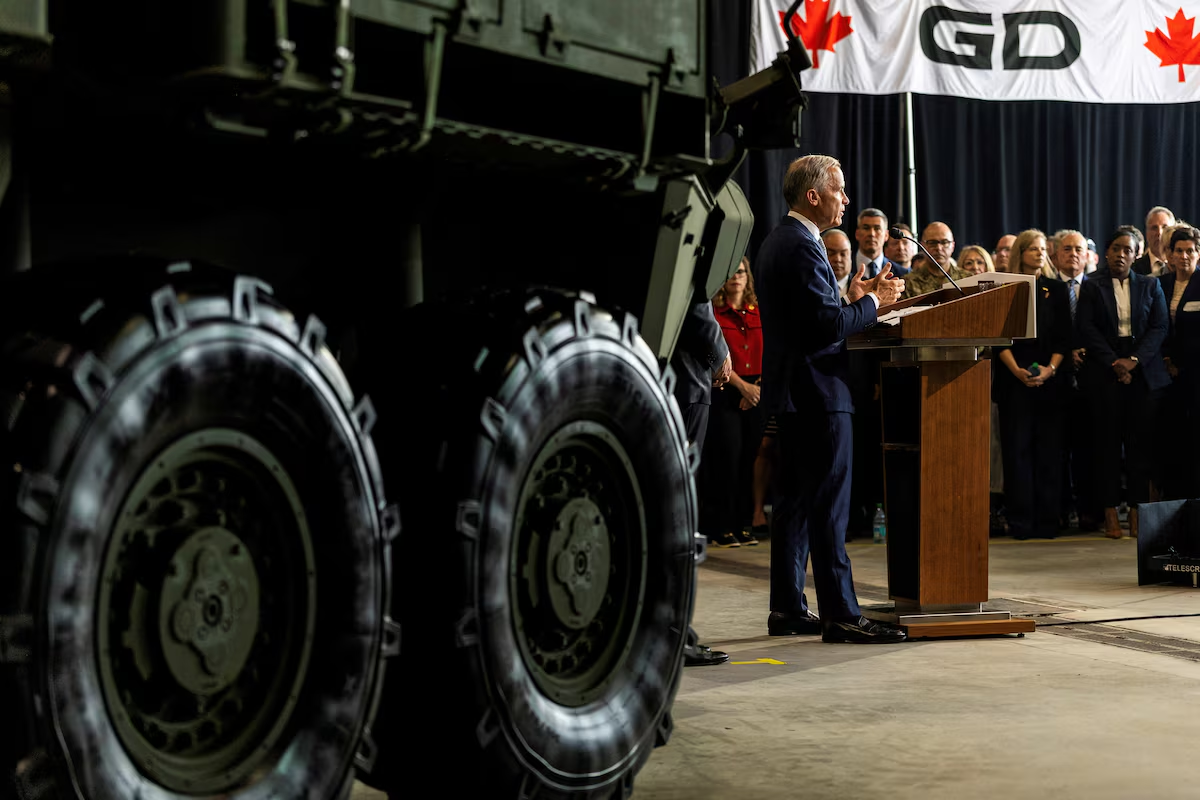
Prime Minister Mark Carney speaks at the General Dynamics defence manufacturing facility in London, Ont., in July. Despite the involvement of a handful of Canadian companies, Ottawa has offered little information about MAIple Stack’s function or importance.Carlos Osorio/Reuters
Canada is partnering with domestic artificial-intelligence technologies to enhance military operations, the Department of National Defence says, as the use of AI and data sovereignty become increasingly vital to national security and modern warfare.
Called the MAIple Stack, the initiative was launched last year, but few details have been released publicly about what it entails.
Through questions submitted to DND over the summer, The Globe and Mail has learned that MAIple Stack is bringing together a suite of sovereign AI technologies from Canadian companies for use in defence operations.
In a statement provided to The Globe, DND spokesperson Kened Sadiku said: “Ultimately, the initiative is intended to support [Canadian Armed Forces] personnel who operate in complex, data-rich environments, to improve situational awareness, and support faster, better-informed decision-making.”
He added that “Any companies that are involved with the MAIple Initiative at this time have been chosen through a lens of expanding Canada’s burgeoning sovereign AI ecosystem, ensuring partnerships with Canadian technology companies and alignment with the Defence Industrial Strategy.”
Ottawa awards first drone contracts worth up to $50-million through new marketplace
MAIple Stack represents a first step in assessing how the department, as well as the Forces, can implement future Canadian AI capabilities, he said.
AI is rapidly changing the way wars are fought. Militaries employing drones or sensors, for example, might use AI to help analyze and dissect the data collected by these devices. The technology is also being developed to speed up the pace of making decisions in military operations, as well as to create lifelike training simulations for soldiers away from the battlefield.
In recognition of this, the Armed Forces and DND released a 32-page AI Strategy in 2024 committing themselves to becoming “AI enabled” by 2030.
“The technology will not wait for us to act,” the strategy reads. “Falling behind now in our adoption of AI will risk the loss of our operational advantage.”
Despite the involvement of a handful of Canadian companies, Ottawa has offered little information about MAIple Stack’s function or importance. In response to a request for an interview about the initiative, the federal government initially agreed but later backed out, citing concerns over national security.
Opinion: In this new world, defence strategy is now economic strategy
Ottawa answered an initial list of questions sent by The Globe but did not respond to a second set asking for further details, such as funding or examples of use in operations.
In the 2026-27 DND departmental plan, with a $33.5-million “seed investment,” a “key initiative” around the use of sovereign AI technology is cited as being tested in military deployments.
The Globe reached out to a handful of Canadian companies working in AI and defence to ask about the initiative. However, they declined to speak about it and redirected questions to DND personnel such as Major Tyler Currie, an officer with the Canadian Armed Forces.
Maj. Currie did not respond to repeated requests for comment. However, when The Globe first reached out to him, it received an out-of-office reply redirecting queries on specific topics to various colleagues. This included inquiries about “MAIple Stack technologies,” that the reply listed as Canadian companies Cohere Inc., Anvil Intelligence Inc., H2 Analytics Inc., Larus Technologies Corporation and Tactiql Inc.
The use of AI by DND and the Armed Forces is not new. Many of the aforementioned companies have won contracts with Ottawa in recent years to help the country’s military with tasks such as collecting and analyzing data, or rapid decision-making.
CIBC commits $2-billion to help finance defence-related companies
It is unclear how the MAIple Stack initiative differs from or encompasses other work that these companies are already engaged in for the Forces.
The AI initiative is being introduced through a phased approach, which the federal government said includes experimentation, integration into its operations and “lessons learned.” Canadian defence tech companies have previously asked for more opportunities to test their products with the Forces and make changes based on feedback, rather than trying to fit a one-time set of criteria for procurements.
Over time, Mr. Sadiku said more technologies may be brought into MAIple Stack. He said that one of the goals of the program is to “explore complementary capabilities surrounding advanced analytics and data-management concepts.” He specified that it is not a “fixed, one-time project” and did not provide an end date when asked.
“The ecosystem is designed to evolve as the Canadian AI industry grows and diversifies its capabilities,” he wrote.