
Good morning. On the eve of Parliament’s return, Ottawa met once more with our close friends in Europe. More on that below, along with climate change in the Okanagan Valley and AI in the military.
Open this photo in gallery:
Prime Minister Mark Carney and French President Emmanuel Macron address media in Saint-Pierre on Sunday.LUDOVIC MARIN/AFP/Getty Images
TOP STORIES
Carney’s EU pivot comes close to home
Canada and France will start sharing space-launch systems and satellite data reception facilities, Prime Minister Mark Carney announced after a meeting with French President Emmanuel Macron on Saint-Pierre and Miquelon yesterday.
The big picture: Carney and Macron chose to meet on the archipelago of nearly 6,000 French citizens located 25 kilometres off Newfoundland’s Burin Peninsula as a show of solidarity and confirmation of sovereignty in the face of U.S. President Donald Trump’s aggression.
Up next: The two leaders are both headed to New York this week for United Nations General Assembly sessions.
Keep reading:
- Shannon Proudfoot: Canadian pride and rage in the face of tariff madness
- Andrew Coyne: We may look back on this as the week Canada began to take its fate into its own hands
- James Bradshaw: Carney’s investment summit attracted ‘all the right people.’ Will it bear fruit?
- Paul Waldie: Carney, other Western leaders pleased with deal between U.S., Denmark and Greenland
Open this photo in gallery:
Toronto police launched a series of raids in June in response to a shooting at the U.S. consulate in the city, as well as others on synagogues and local businesses.Sammy Kogan/The Canadian Press
Police probes thwarted by impenetrable phone
Investigations into a series of shootings in Toronto have been stymied because a key cellphone that was seized in connection with the case is running on a privacy-focused operating system and investigators have so far been unable to unlock the device, according to a police source.
The details: The phone operates on a little-known and highly secure operating system called GrapheneOS, reputed to be one of the most difficult systems to penetrate, the source said. It’s available for users to download and install for free, based on the Android Open Source Project. It was created by Toronto programmer Daniel Micay.
Open this photo in gallery:
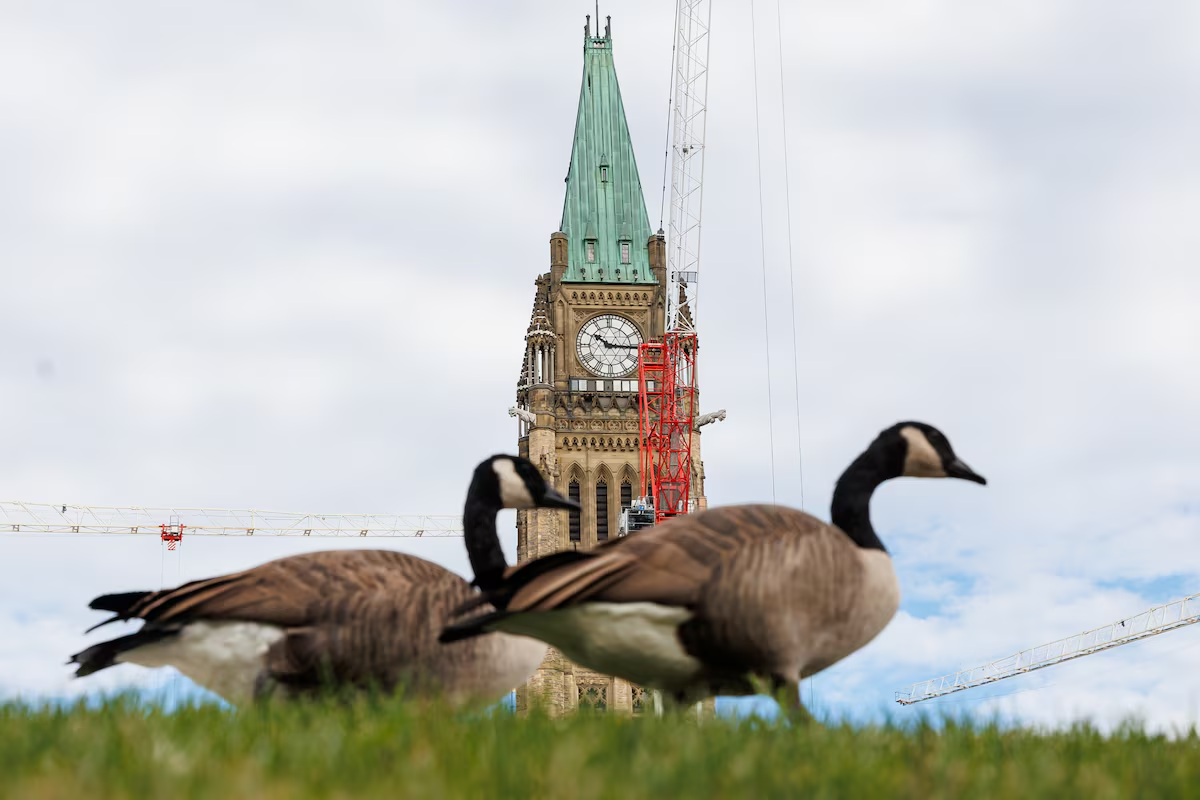
Canada geese walk across Parliament Hill on Sunday.Keito Newman/The Canadian Press
Parliament returns from summer break today
The federal government plans to kick off Monday’s return of parliamentary sittings with the introduction of major legislation targeting project approvals and Canada’s labour laws. The Canadian Labour Congress has already expressed concern with some of the proposals, which they say would limit bargaining power and encourage federal intervention to end strikes and lockouts.
What else: Another government bill that could be introduced will enable the extension of the federal gas tax break. MPs and senators will also debate several bills still making their way through Parliament, most notably the lawful access bill, C-22.
Open this photo in gallery:
Kerry-Lynne Findlay, who stepped down as B.C. Conservative Party leader, speaks in Vancouver on Thursday.Rich Lam/The Canadian Press
Findlay resigns as B.C. Conservative leader
Kerry-Lynne Findlay has resigned as leader of the Conservative Party of BC less than four months after taking the helm, ending a brief and tumultuous tenure beset by controversy, an exodus of MLAs and escalating internal opposition to her leadership.
The context: As of last night, 13 MLAs had departed since she became leader: 10 who quit, including Surrey-Serpentine River’s Linda Hepner, who left the party caucus earlier that day, and three whom Findlay removed. A 14th MLA, Reann Gasper, had given up her seat in Abbotsford-Mission to allow Findlay to run.
Open this photo in gallery:
Grape grower Kevin Rossion at his vineyard in Kaleden, B.C., earlier this month.Aaron Hemens/The Globe and Mail
Okanagan Valley mourns a summer of fire
After a summer of fire in B.C.’s Okanagan Valley, weary locals are rethinking their way of life – or choosing to leave. The very climate that once made the the valley fruitful is now beginning to undermine both its bounty and its appeal. Devastating events once considered exceptional are now simply part of the region’s new reality.
What’s next: The defining season of the region is becoming harder to count on. The valley is gaining heat but losing water, gaining growing days but losing certainty about what crops will actually make it through to harvest. But it’s more than smoke and wildfires: Deep freezes have wiped out entire peach, nectarine and cherry crops, and, in some cases, entire vineyards.
Open this photo in gallery:
The fall brings new Canadian art, music and shows to enjoy and appreciate.Illustration by Suvi Suitiala
Fall arts and culture preview
Our arts team has collected all the best entertainment for the season. Forget about the trade war by settling in with these TV shows and documentaries, or venture outside for these intriguing new movies coming to the big screen near you. Take a friend to a show on the stage or to see visual art exhibitions across the country. For the listeners, there are new albums and many concerts to catch.
Catch up: The Globe and Mail’s Toronto International Film Festival team presents the highs, lows and all the moments in between from the 51st edition of the festival, which wrapped up yesterday.
The Take
Undeniably, China is ascendant in the world. Among all the factors behind it, the most underrated one, and therefore the one from which we gain the most by understanding, is the internal one. This idea of global China must be understood as reflective of domestic insecurities.
— Ethan Lou, opinion editor in The Globe and Mail’s Report on Business
China’s scared, too: Behind every power, domestic insecurity lurks, Ethan Lou writes.
Chinese President Xi Jinping is set to visit the White House this week for the first time in a decade.
The Shot
Open this photo in gallery:
Kim (left) and Stephanie Chow pose with Kim’s cat Siegfried in Edmonton earlier this month.Amanda Erickson/The Globe and Mail
Kim Chow donated her kidney to a stranger, knowing it meant her older sister would receive one in exchange.
The Wrap
What else we’re following
At home: A blood test that detects brain injury could soon help survivors of intimate partner violence.
Abroad: The main Kremlin party retained its majority in Russia’s parliament after a carefully orchestrated balloting that excluded most opposition candidates.
Middle East: Iran and the United States exchanged new threats as Yemen’s Iran-backed Houthi group escalated attacks on Saudi Arabia.
Military: Canada is collaborating with domestic artificial-intelligence technologies to enhance military operations, as part of the MAIple Stack initiative launched last year.
Online: Here’s how to use The Globe’s Canadian digital brokerage ratings to suit your investments.
Offline: In the digital age, music listening parties offer opportunities for organic connection.