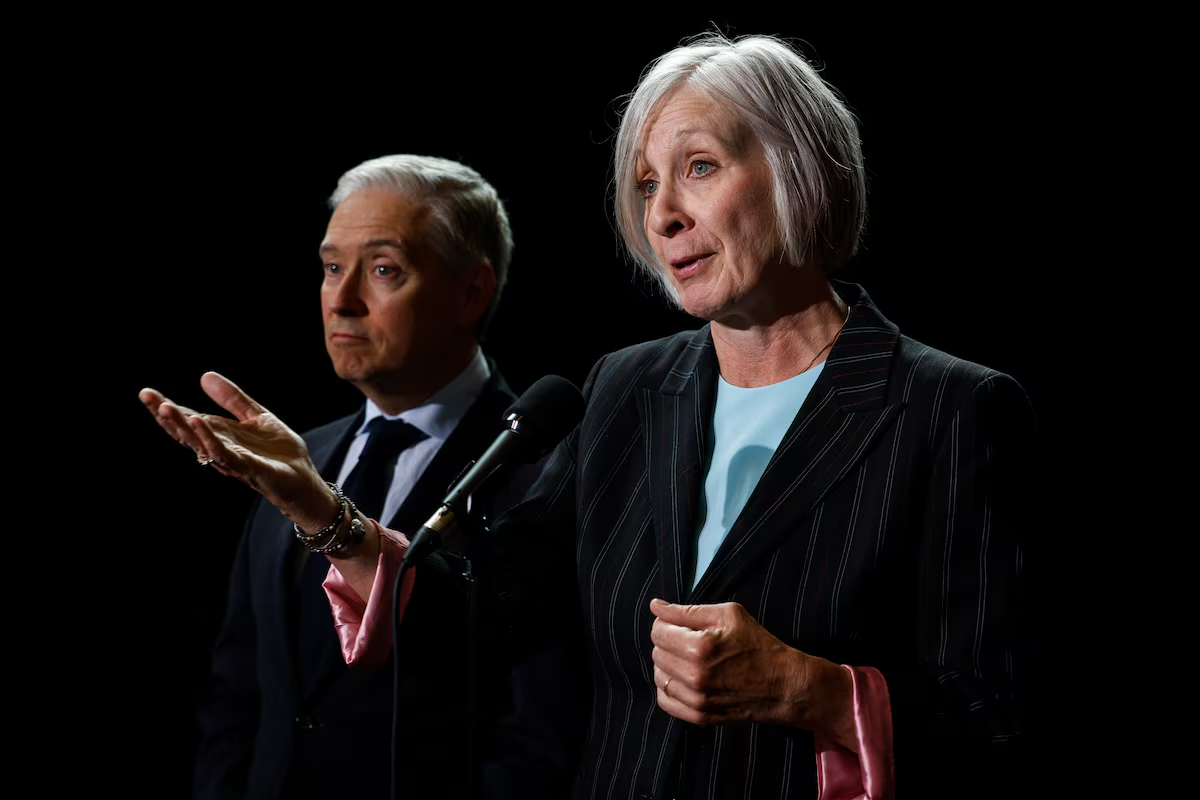

Open this photo in gallery:
Jobs Minister Patty Hajdu says parties are better off if they can solve problems themselves at the negotiating table.Jeff McIntosh/The Canadian Press
Jobs Minister Patty Hajdu says upcoming legislation will help reduce the number of times the federal government has to intervene in strikes.
Speaking to reporters on Parliament Hill Saturday, Hajdu did not provide many details about expected plans to amend the Canada Labour Code.
However, she said no government wants to intervene in a strike and that parties are better off if they can solve problems themselves at the negotiating table.
“The government already has the power to intervene,” she said. “The point is to reduce the times that the government is forced to solve the problem for employers and unions.”
Employers and unions have disagreed strongly on the use of Section 107 of the labour code, which has been used increasingly to curb work stoppages in key industries by referring disputes to the Canada Industrial Relations Board.
Fifteen months into his tenure as Prime Minister, Carney is drawing the ire of union heads
Employment and Social Development Canada said in a report earlier this month that employers and unions are divided over how much power Ottawa should have to intervene in labour disputes.
Transport Minister Steven MacKinnon told reporters Saturday that the legislation – which could be introduced in the House of Commons as early as next week – isn’t targeting the right to strike.
“What we want to do is make achieving collective agreements easier,” he said.
Bea Bruske, president of the Canadian Labour Congress, said in a statement that the right to strike is in the national interest.
“Canada’s economic security depends on workers having the power to bargain for better wages, working conditions and job security,” she said. “Any new power to prevent or shut down a legal strike, including before it begins, would weaken that power. Canada needs workers with our elbows up, not our hands tied.”
Derrick Hynes, CEO of Federally Regulated Employers–Transportation and Communications, said changes to the Canada Labour Code must include new tools to avoid “catastrophic” labour disruptions.
“The inclusion of a neutral, third-party special mediator who can provide a public report on bargaining and inform government actions would be a significant step forward,” he said.
Hynes added that in the rare circumstance where the impacts of a labour disruption on the Canadian economy are so extreme that they run counter to the national public interest, and an agreement is unlikely to be struck, cabinet must have the ability to impose binding arbitration “before the damage is done.”
Open this photo in gallery:
Prime Minister Mark Carney addresses caucus in Ottawa on Friday.Adrian Wyld/The Canadian Press
Prime Minister Mark Carney met with his Liberal caucus in Ottawa on Friday and Saturday as MPs prepare to return to the House of Commons next week.
Looking ahead to the fall sitting of Parliament, several MPs said Saturday that they expect the pace to be fast.
Speaking to reporters Saturday, Liberal MP Robert Oliphant said, “It’s Prime Minister Carney, it’ll be fast.”
Carney promises sweeping economic legislation, fast pace this fall during caucus meeting
Carney said Friday his government is focused on bringing down costs for Canadians and defending the country’s sovereignty, though he acknowledged some of those efforts are in their early stages.
“This is a crucial session of the House of Commons,” he told the caucus. “We are going to introduce some of the most consequential legislation not just of this government, but in decades.”
Carney said the government will introduce legislation this fall to streamline project reviews, to be known as the Building Canada Strong Act.
“For projects and supply chains, our standard will be simple – one project, one review, one year,” he said.
“If we’re going to say no, say no quickly. If we are going to say yes, say yes on time. When Canada decides a project should go ahead, that project will go ahead.”
The Liberal government is also set to release a new budget in the fall sitting.
This all comes against a backdrop of continued threats from U.S. President Donald Trump’s White House against Canada’s sovereignty and economy.
Carney and his negotiating team walked away from talks with the White House in August, saying that what was on the table was a bad deal for Canada. The trade conflict then escalated, with Trump imposing another volley of tariffs and threatening even more, while Canada imposed its own counter-tariffs.
Industry Minister Melanie Joly said Saturday she is meeting with several Democratic politicians.
Opinion: Carney to meet with leaders of France, Norway closer to home after whirlwind Euro trip
On Saturday, she discussed her recent trip to Chicago, where she met with Democratic Governor J.B. Pritzker. She said the goals of that trip were to work with him on how to eliminate tariffs and to speak with several companies.
Regardless of the outcome of the upcoming U.S. midterm elections, Joly believes – like Carney – that the trade relationship with the United States will never be the same as it was before.
“I think the prime minister is right when he says this represents a rupture,” she said in French. “I think we must always keep in mind that our Plan A is to build our country and ensure we attract investment here. And looking to Europe is important, but so is looking to Asia to reduce our dependence on the United States.”
Carney is set to attend the United Nations General Assembly next week. Canadian officials said earlier this week the General Assembly is large event and Carney and Trump could run into each other. They added that there are no meetings currently scheduled with members of the U.S. administration.
On Saturday, Carney did not give a clear answer when asked if he has any plans to meet with Trump in New York.