
Open this photo in gallery:
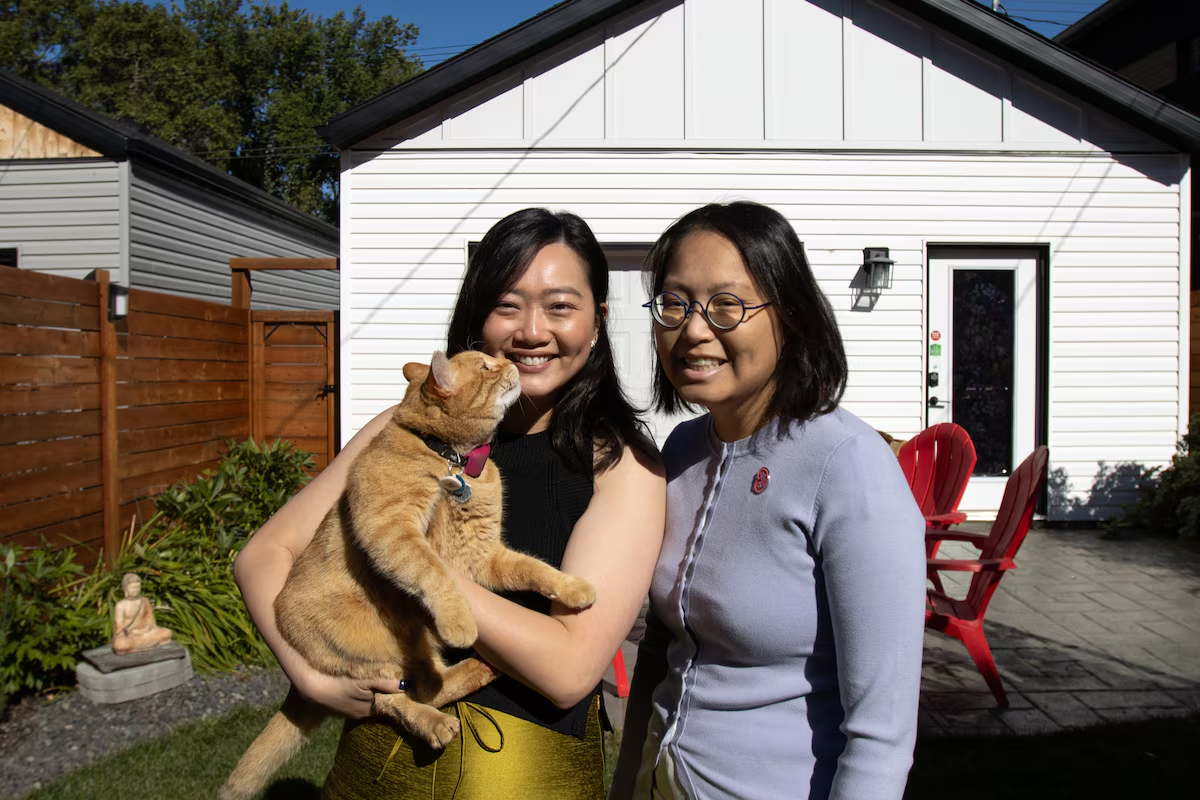
Kim Chow (left) and Stephanie (right) with Kim’s cat Siegfried in Edmonton, in September. The sisters participated in the Kidney Paired Donation Program after testing had determined that Kim could not donate her kidney to Stephanie.Amanda Erickson/The Globe and Mail
Kim Chow says it was not a difficult decision to donate her kidney to a stranger knowing it meant her older sister, Stephanie Chow, would receive one in exchange.
In late July, after months of testing and preparation, the sisters went under the knife in Edmonton’s University of Alberta Hospital. Kim’s surgery was first. Her kidney was removed, quickly placed on ice and airlifted to another province, completing one segment of a transplant chain that stretched across the country.
Five days later, another link was completed when Stephanie was wheeled into an operating room and received a kidney from a living donor outside of Alberta. She will never know who or where the organ came from.
The exchange was made possible through the Kidney Paired Donation Program run by Canadian Blood Services. The program matches potential donor-recipient pairs who are incompatible with each other, such as the Chow sisters, with other such pairs across the country. Patients in need get a healthy kidney – just from a stranger instead of a friend or family member.
Stephanie, 42, said the transplant has changed her life.
Before the surgery, she had been on peritoneal dialysis, a treatment for kidney failure that uses the inner lining of the abdomen to filter blood inside the body. She was diagnosed with an autoimmune disorder as a child that attacked her kidneys until they “crapped out” about two years ago.
“My life was very much determined by when I had to plug into the dialysis machine at night and what time I wanted to wake up. I couldn’t really go anywhere or travel anywhere because the machine I would have to carry, the supplies, is in abundance,” Stephanie said.
She continued: “This kidney is now giving me more flexibility. I feel like I have my life back.”
In Montreal, kidney donors and transplant recipients help put hesitant patients at ease
In 2025, nearly 3,200 organs were transplanted in Canada, 59 per cent of which were kidneys, according to data from the Canadian Institute for Health Information. As of Dec. 31 that year, 4,344 Canadians were on transplant wait-lists, a large proportion for a kidney.
The majority of transplants use organs from deceased donors, since a single body can provide multiple organs. Living donors can only safely give specific organs, such as one of their two kidneys, and must pass strict medical and psychological evaluations.
Stephanie is thankful for being part of the exchange program, not only because it cut down her wait time for a transplant, but because a kidney from a living donor lasts longer and generally provides better outcomes.
The sisters want to raise greater awareness about the program, hoping to help others in Stephanie’s position. “A lot of people have no idea this is an option,” she said.
The paired donation program offers three possible chains, explained transplant nephrologist Michel Paquet, who is a medical adviser to Canadian Blood Services. The first is a paired exchange, where two donor-recipient pairs, or four people, swap kidneys.
Then there is a “closed chain,” where the exchange happens between three or more pairs, usually maxing out at seven, and where the final donor gives a kidney to the first recipient, closing a self-contained loop. Finally, there is an “open chain,” where a sequence of transplants is sparked by an altruistic person who donates a kidney but is not connected to a transplant candidate.
Chains are created using a computerized algorithm and there are three match cycles each year, said Dr. Paquet, who is also the medical director of the living kidney donation program at the University of Montreal Hospital Centre. Since the program began in 2009 – first in Alberta, British Columbia and Ontario before expanding across Canada – it has led to more than 1,300 transplants, he added.
For the first decade, donors had to travel to the recipient’s city to have the surgery. But COVID-19 pushed the program to transport the organs between cities and provinces, helping to expand its reach. More than 400 organs have since been shipped across the country.
One challenge with the program is that the chains are fragile and can collapse if even one person can no longer donate or receive a kidney. However, Dr. Paquet said it’s “pretty rare” for people to simply back out. When that does happen, it’s more often related to medical issues.
Kim, 38, described the program as an exercise in humanity, where emotions are tangled into every decision of an emotionally and physically taxing process.
She began her journey to become a donor in spring 2024, undergoing countless tests – including blood work, urine samples, physical exams, medical questionnaires, X-rays and CT scans – before the surgery took place this summer.
Open this photo in gallery:
Although Kim had some concerns about the process, none were big enough to sway her from helping her sister.Amanda Erickson/The Globe and Mail
Kim was told that at any point she could back out. For her, that wasn’t an option.
“As a family member, you want to do everything within your power to help your loved one, right? So, even if for whatever reason things didn’t work out, I wanted to know that I had done everything that I could do to help her in that situation.”
Kim did have some worries, such as the long-term impact of having only one kidney and how difficult recovery would be, but none were big enough to sway her from helping her sister.
Postsurgery, their experiences have differed greatly. While a new kidney has given Stephanie a boost of energy and excitement for the future, Kim has been exhausted as her body adapts to having just one kidney. Over time, her organ will expand to take on the workload of two.
The sisters were close before, but the transplant process has brought them even closer together. And it has given Kim a new perspective on what Stephanie endured.
“I don’t think any of us realized exactly how tired she was and how her failing kidney was impacting her life the way that it was,” Kim said. “If she was even half as tired before her transplant as I was coming out of that surgery and healing, I have a lot more empathy for what she went through.”
Stephanie expects to be able to travel again in about a year, when her medical team is certain the donated kidney is performing as it should. She doesn’t know where she’ll go first – maybe Europe or Asia, potentially a river cruise.
It would be nice, she added, to go somewhere with her sister.