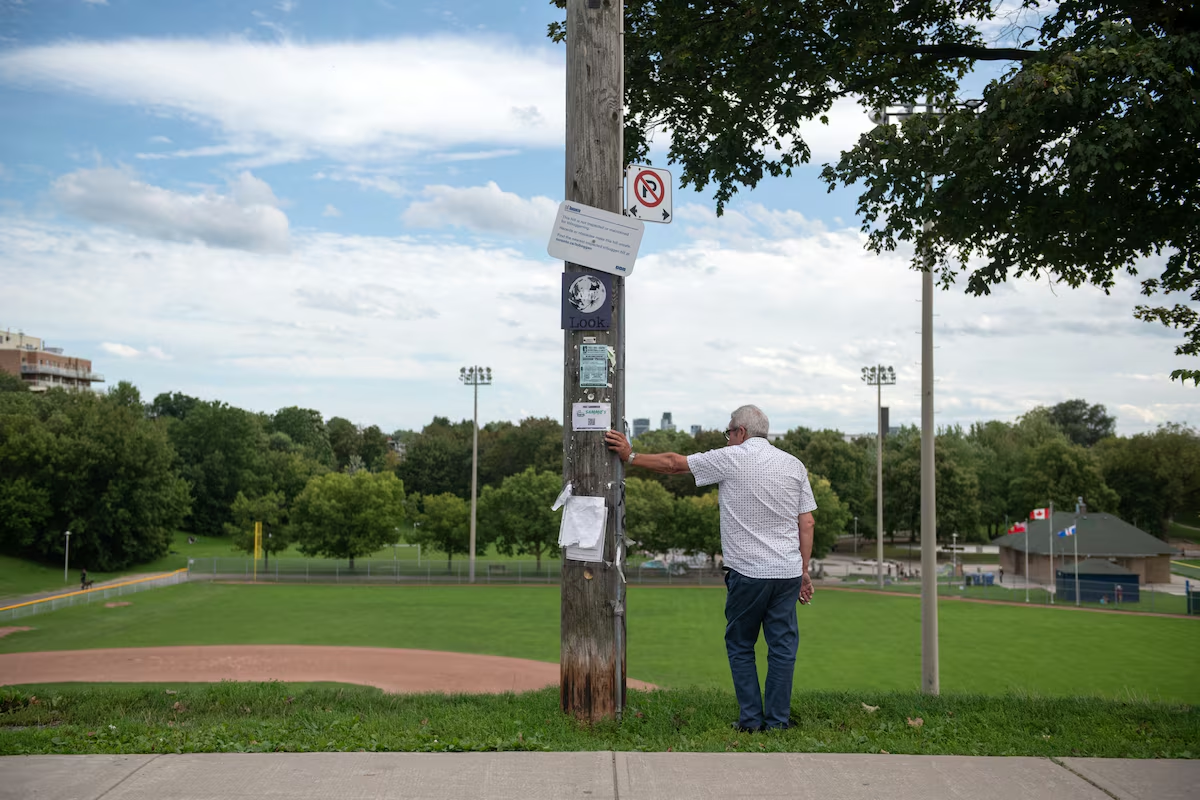

Open this photo in gallery:
Since Christie Pits became a park in the early 20th century, then named Willowvale Park, it has seen a subway go through its south side, and a pool and rink be added to its west.Galit Rodan/The Globe and Mail
Christie Pits is a melting pot of urban humanity. On an August Saturday there, hundreds of spectators watched the Toronto Maple Leafs baseball team get thrashed, lounging on the steep slopes above the diamond. To the south, down in the deep vale of the park, young people rested on the grass listening to reggaeton, while others sprawled on picnic tables or did kickturns on the skateboard ramps.
It was easy, on an evening like this, not to notice that the park is a mess.
Benches are broken. The main pedestrian path is crumbling into a sinkhole, as it has been for years. A picnic shelter and a century-old washroom building are shedding peeling paint.
As Toronto approaches a municipal election on Oct. 26, its Parks and Recreation division has no design vision. The division will spend $440-million this year on construction projects. But much of that money trickles out in piecemeal fixes and alterations that do not generate great places.
Take Christie Pits. This 8.9-hectare space at Bloor and Christie streets was once a sand and gravel pit, spanning the old Garrison Creek. It has been a park for a century and is among Toronto’s busiest. People come to play, work out, watch baseball, enjoy festivals and just hang out in a crowd. This intense activity demands careful co-ordination. But no dedicated manager watches over the park.
Open this photo in gallery:
A group of skateboarders hang out at the skatepark at Christie Pits Park in Toronto, Sep. 11.Galit Rodan/The Globe and Mail
And no plan shapes it. The city is planning or enacting seven different capital projects here. At least three more have been finished in recent years: Altered pathways, a new skate park and semicircular concrete pads billed as “lookouts.” Those lookouts, carved into the hill on the park’s south side, have brought about erosion, generating a zone of hard-packed mud. That’s not in the plan; it’s what happened.
Open this photo in gallery:
A woman practices handstands at Christie Pits Park.Galit Rodan/The Globe and Mail
In this chaos, basic amenities of a busy urban park are missing. There are few places to sit. There is little shade. There is no café or restaurant, where the thousand-plus people in the park on a busy day could get a sandwich or a coffee. Like most of the city’s downtown parks, it is chronically ignored.
The solution is clear. Major parks should each have a manager, and a comprehensive 20-year plan drawn up by excellent landscape architects. Not a shrub should be planted without reference to that design. This would offer a guideline: What kind of place is this? What do we want to happen here?
The mess has been building for decades. Since the Pits became a park in the early 20th century, then named Willowvale Park, it has seen a subway go through its south side, and a pool and rink be added to its west. A 1922 drawing by city parks engineer R.B. Evans shows curling paths typical of Victorian green space. Their remnants remain, a vision never fully realized.
Open this photo in gallery:
The men’s bathroom at Christie Pits Park.Galit Rodan/The Globe and Mail
A decade ago, Christie Pits almost got a new vision. Back then, Toronto’s new downtown plan included a brilliant parks and public realm strategy. In it, landscape architects PUBLIC WORK envisioned a specific “park district” here.
But that did not result in a design. Instead, stuff happened. The parks consultation department and a non-governmental organization conducted a “public life study” asking park users what they wanted to see. Dog owners said there should be more amenities for their pets.
Skateboarders were using the ice rink in the summer months and disturbing neighbours. So the city paved some grass to create a skate park. This brought activity; it also damaged the adjacent trees and removed a rare place to sit in the shade. And it works against the Parks and Recreation division’s goal of increasing green space – toward which the city will spend millions this year acquiring land and demolishing buildings.
But why is there no specific design for this place? Because Toronto Parks doesn’t really do design. Occasionally they create a “master plan,” which involves years of consultation and spits out vague principles. (Queen’s Park North has had two in 10 years.)
Open this photo in gallery:
People come to Christie Pits to play, work out, watch baseball, enjoy festivals and just hang out in a crowd.Galit Rodan/The Globe and Mail
Mostly the division has plans and “strategies” that apply to many sites at once, like the washrooms plan they announced a year ago. Playgrounds, pickleball – everything citywide is imagined from 10,000 feet up.
That is backward. When you deal with a place, especially a park, you need to get down in the dirt. Socially, economically, ecologically, there are tradeoffs and constraints. Solving those challenges is what landscape architects and architects do. It requires conscious choices and demands imagination.
Open this photo in gallery:
Parkgoers enter and exit via the path beside Domenico Field on the northeast corner of Christie Pits Park.Galit Rodan/The Globe and Mail
Instead Parks opts to solve issues bit by bit over time, with little or no input from design professionals. (Their staff includes a few landscape architects, whose power is limited.) Then politicians have their own ideas. Last year, city councillor Dianne Saxe proudly announced she and city staff had planted 22 new trees. Who decided where they should go? Who knows?
In this election year, change is possible. The general manager of Parks and Recreation, Terry Ricketts, is new to the job and hasn’t yet signalled a direction. The division’s “Facilities Plan” is in the middle of a review, ripe to be rewritten. The head of the powerful parks consultation unit has left for another job. And the head of capital projects is also leaving. To replace him, the city is looking for an engineer. The job posting says nothing about design or vision for public space.
That is unacceptable. Parks building should be led by a distinguished design professional who has a vision. Parks strategy and its biggest projects should get external design review and council debate. What are the priorities? How and where are we building great parks?
Toronto has seen in recent years that this is possible, as great landscape architects and the agency Waterfront Toronto gave the city Love Park and Biidaasige Park. City parks can’t all be masterpieces, but they shouldn’t be the pits.