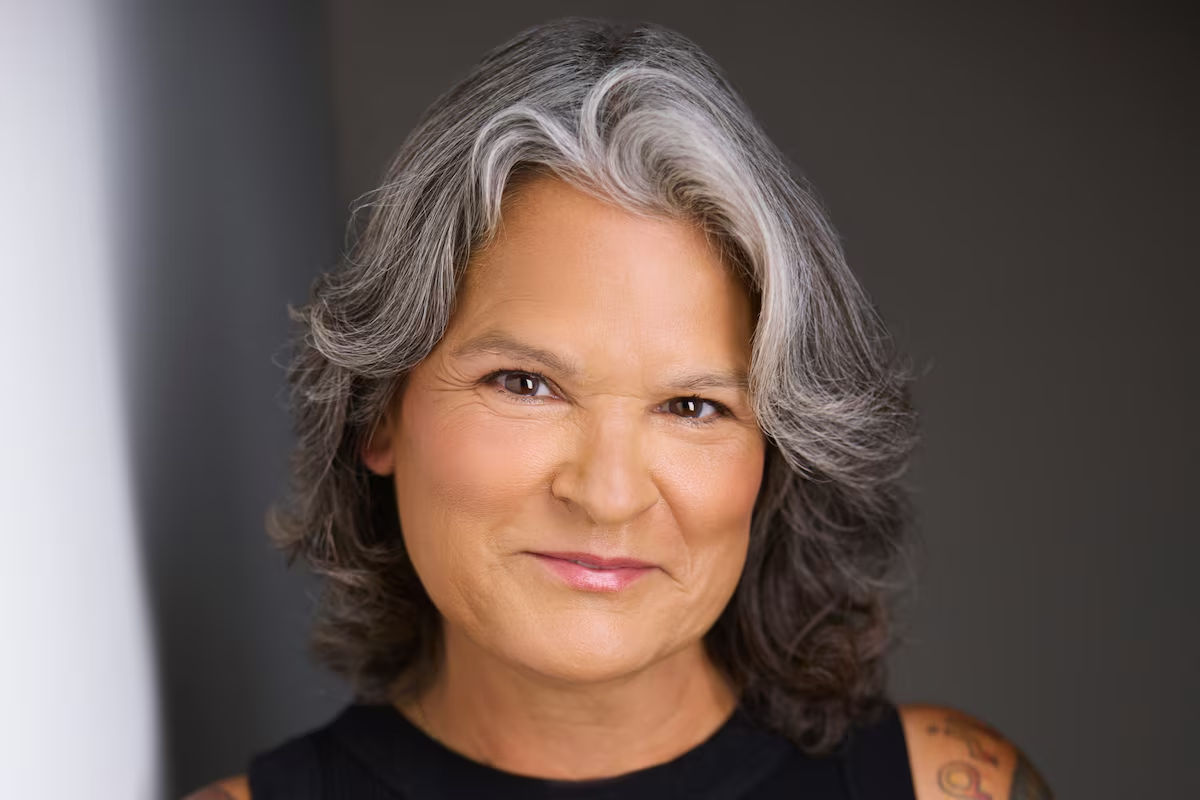

Open this photo in gallery:
Georgina Lightning was a woman ahead of her time when it came to storytelling, making one of the first feature films about the legacy of residential schools.Ryan Parker/Supplied
Georgina Lightning was the first North American Indigenous woman to write, direct, produce and star in a feature film. She was a woman ahead of her time when it came to storytelling. Her film Older Than America (2008), starring a young Bradley Cooper, was one of the first feature films ever made about the horrors of residential school. The film won multiple honours, most notably a best director prize for Ms. Lightning at the 2008 American Indian Motion Picture Awards.
The film was released two years before the Truth and Reconciliation Commission began its cross-country truth-gathering events and the wider public became aware of the atrocities against Indigenous children at those institutions.
On Sept. 5, Ms. Lightning was killed in an accident doing what she loved – filming. Ms. Lightning was working on her latest project about Indian relay horse racing. She was in Enoch Cree Nation, Alta., when a horse left the track, striking Ms. Lightning, who was in the media pit with a camera. Ms. Lightning’s neck was broken and she was not able to be revived, according to her close friend Jodi Calahoo-Stonehouse. Ms. Lightning was 63.
A citizen of Samson Cree Nation whose traditional name was White Bear Woman, Ms. Lightning was driven in her storytelling to change how Indigenous people were seen and heard, both in front of and behind the camera.
“I watched my mother break down so many barriers and fight for what she wanted,” said Crystle Lightning, Ms. Lightning’s only daughter.
She was born Georgina Lynn De Jong in Edmonton on July 4, 1963 to Bernice and George De Jong. Although Georgina suffered abuse at the hands of her father when she was young, family remained the most important thing to her. She was the middle child of three sisters and her love of family was instilled in her by her mother.
She had her first child at the age of 17, but her relationship with the child’s father did not last. She later married and had two more children, but left her husband after experiencing abuse.
Ms. Lightning was determined to make a better life for herself and her children. As a single mother, she moved to Los Angeles in the early 1990s to pursue a career in acting. She attended the American Academy of Dramatic Arts and was the only student with children. She became the valedictorian of her class. Her children: Cody, Crystle and William Lightning were all under the age of 10 at the time. Ms. De Jong, the children’s grandmother, moved to L.A. with the family.
Crystle Lightning recalls that her mother got her an agent when they arrived in L.A., and she landed her first big role as a teenager in the 1995 film 3 Ninjas: Knuckle Up. But she said her mother did not push her into the spotlight and gave her the opportunity to choose what she wanted to do when she turned 18.
“When I graduated high school, she had the talk with me: ‘You’re 18 now. What do you wanna do? Mama can’t be taking you to your auditions any more,’” Crystle Lightning said.
Open this photo in gallery:
Lightning returned home to Alberta in 2012.Ryan Parker/Supplied
However, the elder Ms. Lightning never stopped supporting her children and the pursuit of their dreams. But eventually Hollywood took a backseat to home, and in 2012 Georgina Lightning returned to Alberta where she continued her career and began building a film family in Edmonton. After her return, she acted in a dozen TV productions, including Blackstone, Trickster and Three Pines, as well as several films.
It was her dream to see that city become the Indigenous film capital of Turtle Island (North America), and she had been working toward that goal for several years, meeting with mayors, provincial ministers and members of the film community.
Ms. Lightning’s life journey is reflected in the films and television series she appeared in. In Older Than America, which she co-wrote with Christine K. Walker, Ms. Lightning was inspired by her own family’s story of relatives being forced to attend Indian residential institutions, the abuse they suffered and the resulting wounds that they carried with them.
Her father, George, a residential school survivor who didn’t talk about his childhood, died by suicide. This event led her on a quest to find out more about him, which in turn led her to researching residential schools.
When she returned to Alberta, she immediately met with Ms. Calahoo-Stonehouse, now an NDP Alberta MLA. At the time, Ms. Calahoo-Stonehouse was hosting and producing Acimowin, an Indigenous radio show on which Ms. Lightning appeared several times as a guest. So it was only natural that they became close friends, calling one another sister.
“She just left America with a broken heart and had some mental health, depression battles and came home for healing and wanted to film and share that journey of healing, of recovery and the reality of suicide in our community and in our lives,” Ms. Calahoo-Stonehouse said.
The resulting documentary project has been a decade-long journey. It began with the working title Fantasies of Flying, according to the Internet Movie Database (IMDb). It will now be renamed Grandmother’s Medicine and Crystle Lightning and Ms. Calahoo-Stonehouse will finish Georgina Lightning’s work.
The film looks at “where we’re at, what it’s taken to get us from the injury of the Indian residential school, and what it has taken to recover from genocide, which is Grandmother’s Medicine,” Ms. Calahoo-Stonehouse said.
On the Tuesday before her death, Ms. Lightning visited Ms. Calahoo-Stonehouse and made her friend promise to work with Crystle. They are currently working together as co-hosts of a film on climate change by the younger Ms. Lightning. Now, they will work together to finish her mother’s projects as well.
“You honour your family with the highest integrity by fulfilling their legacy. I’m very busy with my work but she’s my sister and we loved each other deeply and she was just as much there for me,” Ms. Calahoo-Stonehouse said.
That is who Ms. Lightning was; always there for her family and friends. No matter what she was working on herself, she found time to support, mentor and talk with people. Ms. Lightning even renovated Ms. Calahoo-Stonehouse’s kitchen during the pandemic.
“When I ran for national chief [of the Assembly of First Nations in 2021], she was over every day helping me and wearing a ‘Vote for Jodi’ shirt and hat. She’s been my biggest cheerleader,” Ms. Calahoo-Stonehouse said.
Open this photo in gallery:
Lightning in the series Three Pines, based on books by Louise Penny. The show prominently features a multi-episode storyline addressing the crisis of Missing and Murdered Indigenous Women and Girls.Amazon Prime
Elle-Máijá Tailfeathers agrees. Ms. Tailfeathers is also an actor, writer, director and producer who acted with Ms. Lightning on the TV series Three Pines.
“I remember this one particular day, I was struggling to hit an emotional beat I needed for the character. I was in the scene with Georgina. So it wasn’t her coverage, it was my coverage. My character knocked on her character’s door and had to deliver some challenging news. I struggled with the first couple of takes and then Georgina recognized that I was struggling. And I think it was the third take, I knocked on the door and she opened the door and she had tears streaming down her cheeks,” Ms. Tailfeathers said.
“And she was just in this deeply vulnerable open place as an actor, delivering what her character might be feeling. And it just ruptured me, it opened me right up and it brought me to where the character needed to be in the scene. It was just so generous of her to do that for me and for the story, because she wasn’t on camera.”
As a younger filmmaker, Ms. Tailfeathers looked up to Ms. Lightning and watched her work. When they met, the two became friends.
“I always felt she supported my career, she offered gentle and generous guidance. And she was just such a warm and bright soul, and so fierce as well,” Ms. Tailfeathers said.
That seems to be the consensus of the life Ms. Lightning led – she was generous. Even when she struggled with her own battles, she prayed for others’ health when she sundanced. She battled lymphoma cancer with traditional and Western medicines but had been in remission for the past year.
Yet, she seemed to know her time was limited. After Robert Redford’s death in September, 2025, Ms. Lightning posted on social media: “What’s up with these past few months? Creator has been calling on so many Heroes that included my mother Bernice – all this loss really makes you do a check in with yourself … Am I spending my time efficiently, effectively, because life is really so so short.”
When asked what Ms. Lightning’s legacy will be, Ms. Calahoo-Stonehouse and Ms. Tailfeathers agreed it would be her children – two of whom are formidable and talented actors.
Mr. Lightning’s film Smudge the Blades had its world premiere on Sept. 12 at the Toronto International Film Festival, while Crystle Lightning continues on with her musical Bear Grease, which she created with her husband, Henry Andrade, a rapper known as Red Cloud. She will also see to it that her mother’s final four projects will be completed, including the one on the Indian relay horse racing.
“But her legacy is also just her path of kindness that she forged and her path of just being fierce. She was this tiny woman, but she just carried so much spirit within that tiny body,” Ms. Tailfeathers said.
Crystle Lightning said she will remember her “fierce momma bear love” for her family, including her four grandchildren. And that is why she worked so hard to blaze trails, break down doors, and keep them open for others to walk through.
“It sounds so cliché, but like literally chasing your dreams down. Nothing’s gonna be handed to you. Nothing. Especially being an Indigenous woman in this industry, you have to just sometimes create your own opportunities because sometimes we won’t ever get the chance that we’re waiting for. That’s what she showed me.”
You can find more obituaries from The Globe and Mail here.
To submit a memory about someone we have recently profiled on the Obituaries page, e-mail us at obit@globeandmail.com.