
Open this photo in gallery:
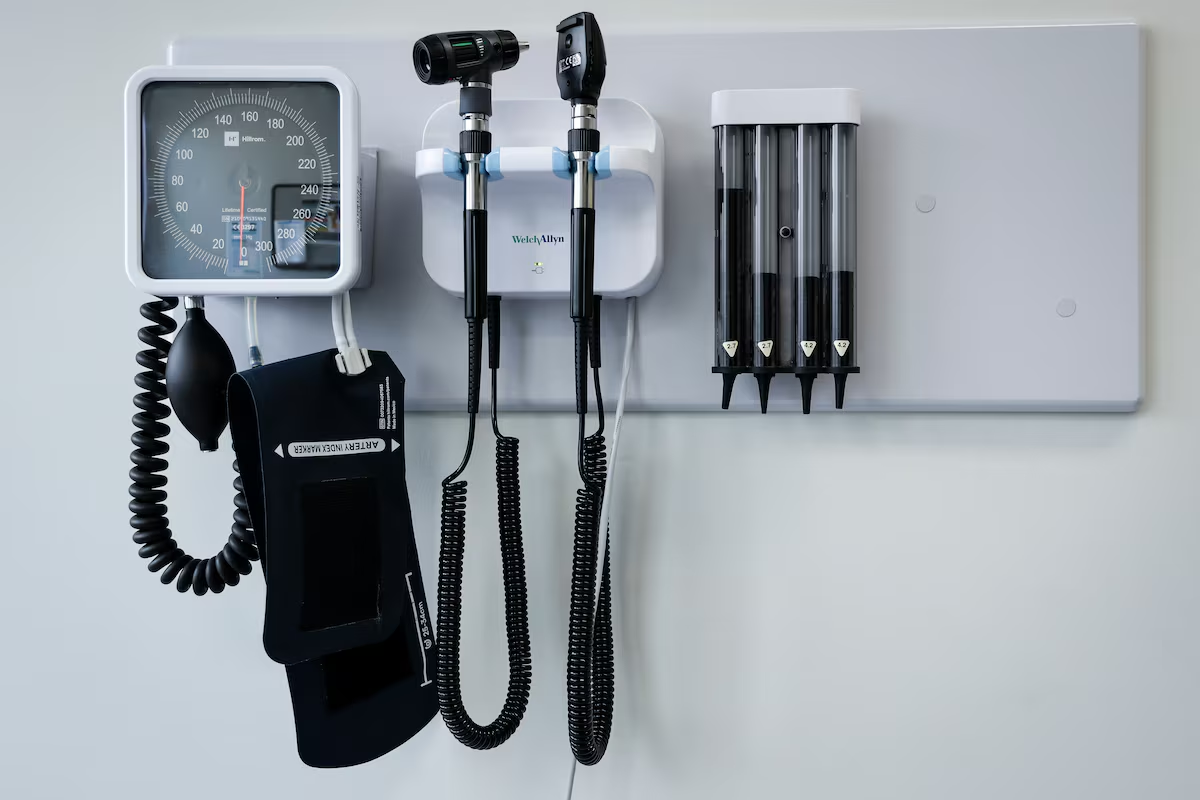
The provincial government said in January that the number of Ontarians without a primary-care provider had dropped to 1.98-million, down from an earlier estimate of 2.5 million as of 2023.Jeff McIntosh/The Canadian Press
Ontario family doctor residents can begin applying Thursday for a new grant that will pay their medical school tuition retroactively in exchange for practising comprehensive primary care anywhere in the province for at least five years.
Nolan Quinn, Ontario’s Minister of Colleges, Universities, Research Excellence and Security, will mark the opening of applications by announcing plans to spend a total of $220-million for about four years on tuition grants for more than 2,000 future family doctors – more than the government promised when the program was announced in principle two years ago.
The main goal of the program is to incentivize more of the physicians who train in family medicine to actually provide the type of office-based, cradle-to-grave primary care that is in short supply.
A study published in the Annals of Family Medicine in May, 2025 found that nearly 40 per cent of the 6,310 family doctors who entered the physician workforce in Ontario between 1993 and 2022 worked in other settings, including emergency rooms and clinics specializing in sports medicine, addiction treatment and cosmetic medicine.
“This is to ensure that the students, after finishing their studies, are going to be, [for] five years, practising as a comprehensive primary-care family medicine physician anywhere in Ontario, and that’s the ultimate goal of this program,” Mr. Quinn told The Globe and Mail in an interview ahead of a news conference in London Thursday.
A message to Canada’s new medical students: These are hard times, but not hopeless times
Ontario’s expansion of its learn-and-stay grant program – which is already available to nurses, paramedics and medical lab technicians who agree to work in high-needs areas – to family doctors is the latest example of a provincial government using carrots and sticks to convince young physicians to practice in ways that fill gaps in the public-health system.
What’s different in this case is the tuition grant doesn’t force doctors to work in small towns or rural areas, as other student loan forgiveness programs, including the federal one, do.
Ontario’s grant, which also covers books and supplies, is available to Ontario medical school graduates enrolled in a family medicine residency training program, who agree to practice comprehensive primary-care with a full roster of patients, even in a big city.
They have to have lived in Ontario for 12 consecutive months without being in full-time postsecondary studies – a rule that should reserve the grants for people from Ontario.
The province hasn’t said how many patients count as a full roster. Doctors who fail to fulfill the five-year commitment will see their grants converted to repayable loans.
The provincial government said in January that the number of Ontarians without a primary-care provider had dropped to 1.98-million, down from an earlier estimate of 2.5 million as of 2023.
Ontario and most other provinces have other ways of pushing doctors toward practising in regions desperate for physicians, although one such program was deemed illegal by a British Columbia court in a decision released last Friday.
B.C. Supreme Court Judge Matthew Kirchner ruled the province couldn’t force international medical graduates (IMGs) to work for two or three years in an underserved area in exchange for a residency training spot without mandating the provision, known as return of service, through a law or regulation. Terms are currently imposed through contracts with individual IMGs.
Family doctor study finds disparities in primary care across Canada
The case was brought by a group representing Canadians who graduated from medical schools abroad.
“I find that the imposition of the return of service obligation on those IMGs who match to an IMG residency position engages their liberty interest to decide where to live free from government interference,” Judge Kirchner wrote. “A person’s choice of where to live is a fundamentally personal decision which engages what it means to enjoy individual dignity and independence.”
The judge suspended his decision for 60 days to give the province time to respond.
B.C. Health Minister Ravi Kahlon told reporters Wednesday that his government will take whatever legal steps are necessary to preserve the return-of-service rule for IMGs.
“The bottom line is this: This program is too important,” he said. “We’re going to do whatever is required to make sure this program continues to function.”
As for Ontario’s newly expanded grant program, Tara Kiran, a family physician and researcher at St. Michael’s Hospital in Toronto, said it was “reasonable” for the province to cover tuition for all eligible family doctors, regardless of whether they practise in a big city or small town.
She was an author of the study that found many of Ontario’s family doctors work somewhere other than a primary-care office.
“Frankly, we’re short of family doctors pretty much everywhere in the province right now,” she said.