
Open this photo in gallery:
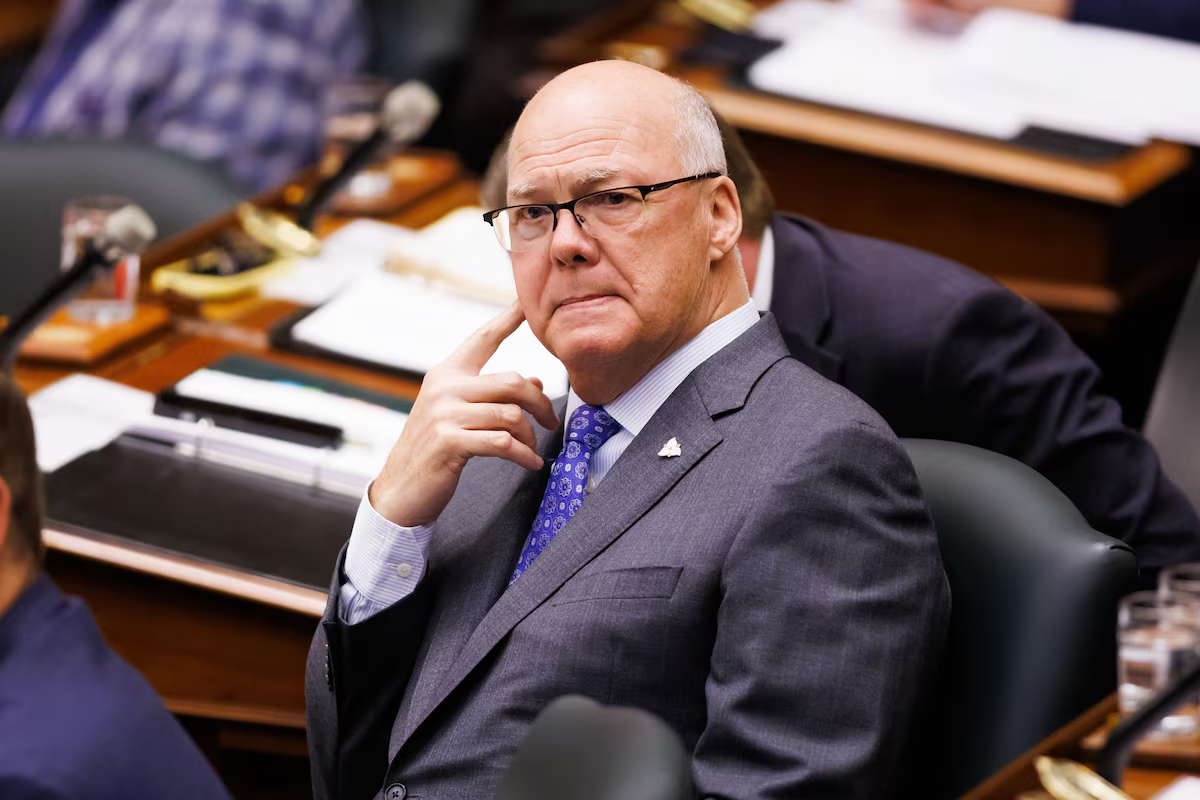
The province could reconsider funding for municipalities that don’t comply with Buy Ontario requirements, Municipal Affairs and Housing Minister Rob Flack said in a letter to municipal leaders.Cole Burston/The Canadian Press
Premier Doug Ford’s government is threatening to cut off funding to municipalities that don’t comply with new Buy Ontario rules, but cities say they are already choosing local products amid the trade war with the United States.
Meanwhile, Ontario’s Official Opposition accused Mr. Ford of ignoring his own procurement policies, and the group representing Ontario’s 444 municipalities said some of the new provincial directives come with added costs and complexities.
In a letter to municipal leaders released Wednesday, Ontario’s Minister of Municipal Affairs and Housing, Rob Flack, urged local leaders to closely review supply chains and coming purchases to “identify every opportunity to increase domestic procurement.”
The province last year passed a law requiring the public sector give preference to goods and services provided by companies based in Ontario or elsewhere in Canada, and added municipal requirements in April this year. That directive applies to purchases such as fleet vehicles, as well as capital infrastructure project procurements.
“Failure to comply with Buy Ontario requirements will force us to reconsider provincial funding made available to municipalities,” wrote Mr. Flack in the letter dated Sept. 15.
Sanofi inaugurates Toronto facility that will produce seasonal flu vaccines for Canadians
Asked Wednesday about the letter, Mr. Ford said he is reinforcing his expectation that municipalities prioritize domestic companies.
“It’s just reminding them that, buy Ontario first, buy anywhere else in Canada if you can’t buy it in Ontario. And it’s a shame that I even to have to put that out after you know saying it about 10 million times and you know – get with the program, buy Canadian,” Mr. Ford said at a press conference Wednesday at the opening of a new biomanufacturing facility in Toronto.
Riley Brockington, president of the Association of Municipalities of Ontario, said this is a period of “significant uncertainty” for the provincial economy. He said even before the new rules were in place, more than 98 per cent of municipal procurement for non-construction goods and services was from businesses with Canadian addresses.
The association said some of the new Buy Ontario rules are challenging for municipalities – including verifying domestic content and supply chains, and balancing domestic procurement requirements with value for money and project timelines.
“Municipalities now have several months of experience with the new requirements, and we are hearing from municipalities and industry that some of the rules are adding time, cost and complexity to procurement,” Mr. Brockington said in a statement.
“Working together to make the system clear, practical and workable will be critical to achieving our shared goal of strengthening Ontario’s economy.”
Opinion: Premiers now lead the charge in the trade war. Ottawa must recognize that
The effect of U.S. tariffs on municipalities has begun to dominate discussions at the local level, as cities are starting to look into how the trade war could blow holes in their budgets.
Many have already instituted their own buy local pledges, including Toronto Mayor Oliva Chow, who is running for re-election. Election day is Oct. 26.
Ms. Chow, appearing at the press conference Wednesday with Mr. Ford, said she is already prioritizing local purchases, noting all three levels of government came together earlier this year to announce new subway cars will be built in Thunder Bay.
“At this very uncertain, stressful time, in the global turbulence, disruptive trade conversation that’s happening, the Team Canada approach, working together united, we are stronger and we’re proving it right now,” she said.
Mr. Ford also talked up his working relationship with Ms. Chow, signalling support for the incumbent mayor he once predicted would be an “unmitigated disaster” for the city.
“I just want to say the mayor and I have a phenomenal relationship,” he said. “We’re going to continue supporting the mayor. She’s doing an incredible job. So, read between the lines.”
Tariffs have already emerged as a key issue in the Mississauga mayor’s race, where incumbent Mayor Carolyn Parrish is taking on Bonnie Crombie, who previously held the city’s top job for three terms.
Ms. Crombie said Wednesday it shouldn’t take a letter from the province to spur the city to act.
“Mississauga should not need a warning from Queen’s Park to use its purchasing power to support Ontario workers. Yet Mayor Parrish has failed to put forward a tariff response plan while local businesses face real uncertainty,” she said in a statement.
Ms. Parrish, meanwhile, defended her response and said the city has had a local procurement policy in place since U.S. tariffs were first imposed, with exceptions for items that are part of the United States-Canada-Mexico Agreement and not affected by tariffs.
“We adhere to this strategy to the best of our abilities. When the provincial government encourages municipalities to support local businesses, we agree 100 per cent. This is a fundamental approach that helps us to continue building Canada and Mississauga strong,” she said in a statement.
Ontario’s Official Opposition NDP, however, accused the provincial government of trying to distract from its own failures to prioritize local companies.
Ontario NDP Leader Marit Stiles said the Premier has given American companies – such as Staples, which now runs the provincial school supplies portal – priority over Canadian ones.
“It’s a bit rich for this Premier to be lecturing municipalities when he should be cleaning up his own house first,” she said in an interview, adding that Mr. Ford should recall the legislature – which isn’t set to resume until Oct. 27 – to fix the procurement rules.
The provincial government refuted Ms. Stiles’ criticisms and accused her of playing political games. Giulia Paikin, a spokesperson for Minister of Public and Business Service Delivery and Procurement Stephen Crawford, said Staples employs 11,000 people in more than 300 stores in Canada and was chosen through a competitive procurement.