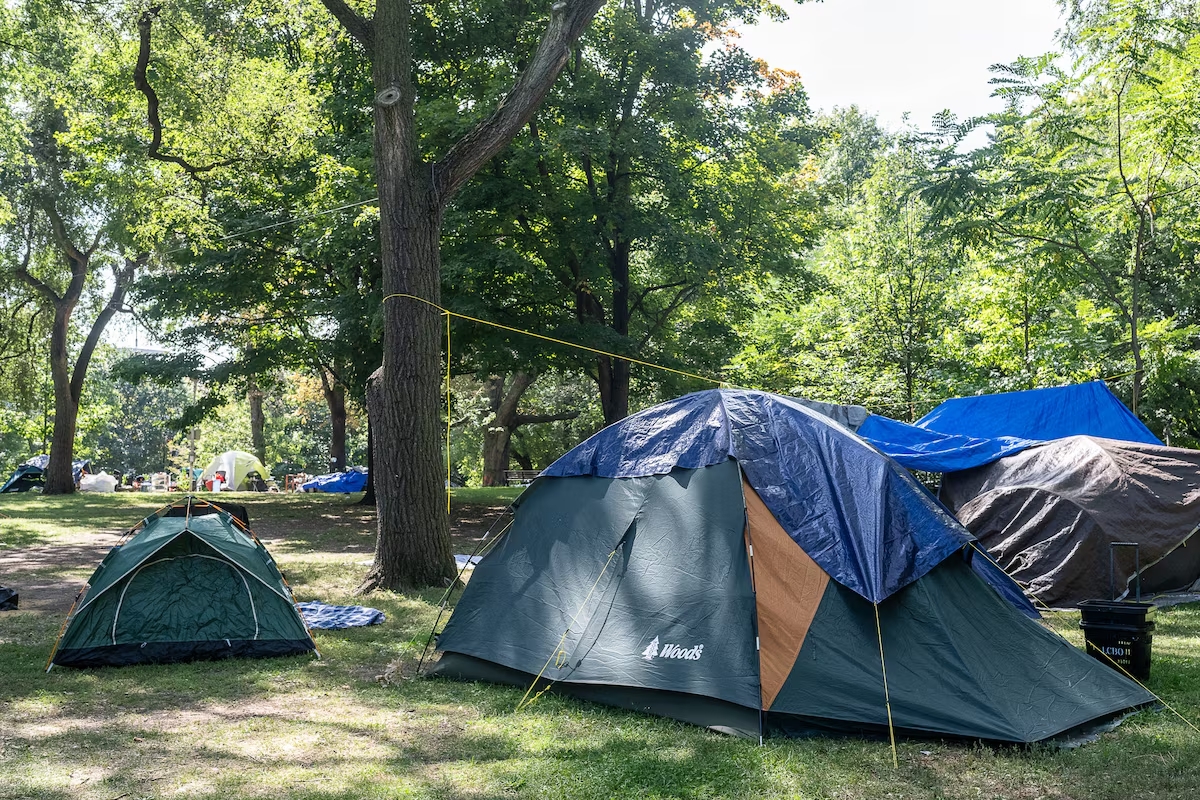

Open this photo in gallery:
A group of tents is seen in Dufferin Grove Park, in Toronto, last year.EDUARDO LIMA/The Globe and Mail
Ottawa should invest in intensive housing for Canadians with severe cognitive impairment, a small but uniquely visible and costly subgroup in the homeless population that no current housing model is designed to serve, a leading organization on homelessness argues.
The Canadian Alliance to End Homelessness, a national charity, has submitted a proposal on the issue to the federal government ahead of its coming budget.
Advocates, housing agencies and front-line clinicians say intensive housing could be the missing piece in Canada’s housing system for this medically complex and underserved segment of society.
Opinion: Older Canadians are the largest, fastest-growing homeless population. It’s a collective shame upon our country
In a policy proposal sent to Prime Minister Mark Carney’s government and provided to The Globe and Mail, the CAEH is lobbying Ottawa for a $2-billion investment to build 6,250 intensive units across the country catered to people who are chronically homeless with severe, permanent cognitive impairment.
The proposed model for intensive housing would be secure or semi-secure units with 24-7 staff, including nurses and health care aides, similar to a dementia unit.
Monty Ghosh, an inner-city physician in Alberta, said he often treats this highly vulnerable group of unhoused people who are living with severe, permanent cognitive impairment as a result of traumatic brain injuries, fetal alcohol spectrum disorder, trauma and substance use.
He said the cognitive impairment is so severe that they are unable to manage their own housing or safety but there is nowhere for them to go. They are stuck in a revolving door between hospitals, shelters and the criminal-justice system.
Dr. Ghosh, who worked with the CAEH on its proposal, estimates that between 20 and 30 per cent of the homeless population fits into this category.
Tim Richter, president of the organization, said intervening to house this medically complex population will not only support people in dire need of help but would reduce public-safety incidents – a lightning-rod issue for governments of all stripes.
“It’s unsettling if you see someone in the throes of this kind of disability on the train into work or unconscious on the side of the road,” said Mr. Richter. “We just need to make sure that there is a humane, effective and appropriate housing solution for them – and that’s not a jail.”
He said intensive housing for this population is an alternative to involuntary addictions treatment, which is gaining political traction across Canada and set to soon come into practice in Saskatchewan and Alberta. Just last month, Ontario’s Big City Mayors group asked the province to review existing mental health laws with the goal of expanding involuntary treatment.
Alexandra Flynn: Homelessness must be solved by every level of government
But Mr. Richter stressed that this population with irreversible cognitive impairment will not recover after involuntary intervention and would benefit from lifelong housing rather than a short stint in an involuntary treatment centre. He said these individuals should not be in a prison-like setting.
Intensive housing sites would also have on-site occupational therapy, physiotherapy and cognitive rehabilitation, in addition to addiction and mental-health supports when needed, according to the proposal. The model is mirrored after long-term care “not on psychiatric institutionalization” and its core goals are rehabilitation, stability and dignity.
It would not be appropriate for all Canadians experiencing homelessness, but for those who have not been able to stabilize in shelters or through other forms of housing and have no capacity for individual decision-making, it states.
Dr. Ghosh said he often has to send these patients back onto the streets.
“I discharge patients with dementia, Alzheimer’s, traumatic brain injury from motor-vehicle accidents to these long-term care facilities for lifetime support and yet I can’t discharge these individuals to those facilities,” said Dr. Ghosh.
He explained that it is also difficult to find these patients’ families, which leads to a lengthy public guardianship process.
The Carney Liberals have made housing a key commitment, recently announcing a $2.7 billion investment for 18 projects across Toronto. The Liberals have also created a federal Crown corporation, Build Canada Homes, to accelerate the construction of affordable housing across Canada.
Arianna Durgerian, press secretary to Canada’s Minister of Housing and Infrastructure, Gregor Robertson, declined to comment on the intensive housing proposal.
She said the federal government is focused on building up the supply of affordable and supportive housing and is working with other levels of government to do so.
Rising cost of low-end rental units driving increase in homelessness, report shows
Mr. Richter said building intensive housing would be expensive but is cheaper than ignoring the problem.
The proposal notes that people in this subgroup visit EDs and are admitted to hospital frequently, costing between $1,000 and $3,000 per emergency department visit and between $1,500 and $2,500 daily for a hospital admission.
“The downstream savings from stabilizing this population in appropriate residential care are substantial and accrue directly to provincial health, justice and social-service budgets,” the document states, before outlining an ethical obligation.
“Leaving people with the functional cognitive capacity of a young child to navigate street homelessness unprotected is an abdication of care.”
Sandra Clarkson, chief executive of the Calgary Drop-In Centre, one of the largest emergency shelters in North America, said the shelter system was never designed to serve this complex population but is the only place for these individuals to go.
She said intensive housing is badly needed and could help hundreds of people currently seeking shelter at the Drop-In.
“This is not a homelessness issue alone. It’s a health care, cognitive disability issue that is showing up in homelessness.”