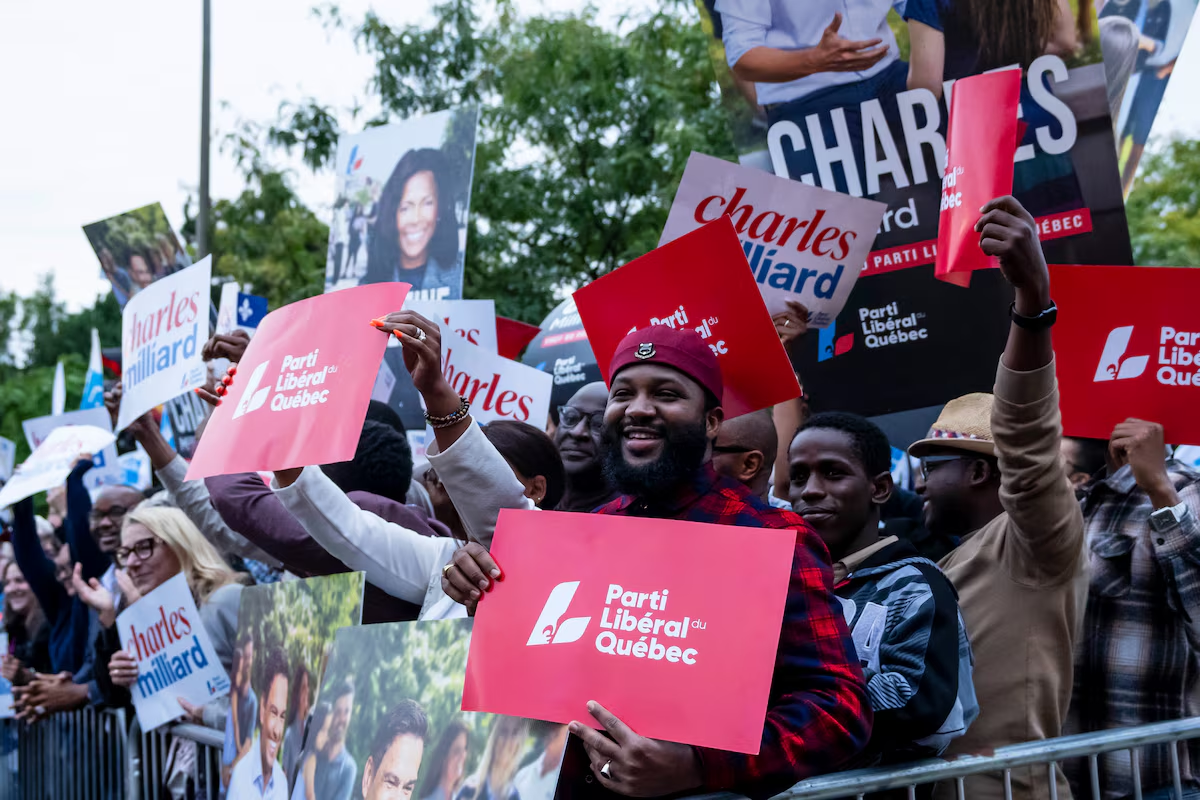

Open this photo in gallery:
Liberal Party of Quebec supporters outside an election debate in Montreal, on Tuesday.Christopher Katsarov/The Canadian Press
Quebec’s five main party leaders tried to sell themselves to voters Tuesday evening in the first debate of an election campaign that has thus far failed to move the needle.
The election is unfolding amid the escalating Canada-U.S. trade war, which dominated the first part of the campaign as the leaders tried to cast themselves as the best defenders of Quebec’s interests.
The Parti Québécois, which has been leading in the polls, has had to defend its promise to hold a third referendum on independence despite low support for sovereignty, especially in the face of threats from U.S. President Donald Trump.
Sovereignty referendum becomes the latest focus of Quebec election campaign
Identity politics fade to the background in Quebec ahead of October’s provincial election
The governing Coalition Avenir Québec has made a comeback under new leader Christine Fréchette, who has positioned herself as best-equipped to protect the province against Mr. Trump. In recent weeks, the party has emerged as the strongest threat to the PQ.
But with five parties dividing the electorate, polls have shown little movement in voting intentions since the early days of the campaign, suggesting a majority government is unlikely.
Election debates are major media events in Quebec. Three French-language debates are scheduled this week and next, which could shake up a campaign that has to date felt somewhat stagnant. There will be no English-language leaders’ debate ahead of the vote set for Oct. 5.
Here are five things that stood out from TVA’s Face-à-Face.
PQ Leader avoids talk of sovereignty
Parti Québécois Leader Paul St-Pierre Plamondon didn’t mention his promise to hold an independence referendum in a third mandate until he was asked about it in the last third of the two-hear debate. Instead, he began the evening by declaring that he has the “best economic team” and stressed that a PQ government would represent change after eight years under the Coalition Avenir Québec.
Support for sovereignty is polling around 30 per cent in Quebec, and shortly before the campaign, Mr. St-Pierre Plamondon promised he would not hold a referendum until after Mr. Trump leaves the White House.
When the subject of sovereignty did come up, Mr. St-Pierre Plamondon defended his position, saying Quebeckers “have a right to our continued existence.”
But his opponents were quick to seize on a perceived weakness, with Ms. Fréchette poking fun at the PQ’s plan for an independent Quebec to have its own currency, army and space agency. “Come back down to earth and start working on the real priorities,” she said.
Fréchette under attack
Though she is not the frontrunner in the campaign, Ms. Fréchette was the chief target of her main rivals throughout the event.
Mr. St-Pierre Plamondon did his best to tie Ms. Fréchette to the financial scandals that have plagued the Coalition Avenir Québec, including a $270-million investment in the battery company Northvolt that was lost when plans for a Quebec plant collapsed.
“If we want to help the people of Quebec, we can’t waste their money as if it were Monopoly money,” he said.
Liberal Leader Charles Milliard, who is competing with the CAQ for non-sovereigntist votes, also took aim at Ms. Fréchette, demanding to know whether she personally supports sovereignty – a question she has consistently refused to answer.
“It’s disgraceful,” he said. “I am the only federalist here tonight.”
CAQ Leader seeks to dodge her party’s legacy
Ms. Fréchette kicked off the debate by addressing Quebeckers who “want change” after her government’s eight years in power.
“To make it clear: I’m not François Legault,” she said, referring to the former premier who resigned earlier this year after his support collapsed.
“I’m Christine Fréchette, and I’m here with my own approach.”
But Mr. St-Pierre Plamondon tried his best to saddle Ms. Fréchette with her party’s baggage, saying Quebec “can’t afford 12 years of the CAQ government.”
Smaller parties face off on left and right
While the three major party leaders attacked each other, Conservative Leader Éric Duhaime and Ruba Ghazal, co-spokesperson of the left-leaning Québec Solidaire, pitched policies they hoped would set them apart.
The Conservative Leader, who is hoping to win seats in the National Assembly for the first time, promised “historic” tax cuts, more private health care and an end to Quebec’s carbon price.
Mr. Duhaime, who is hoping for the balance of power in a minority government, cast himself as a “watchdog for Quebec taxpayers” in the provincial legislature.
Meanwhile, Ms. Ghazal touted a tax hike on households earning more than $25 million that she says could bring in $5 billion in revenue, and a plan to run public grocery stores.
Debate descends into chaos at times
The Face-à-Face has a unique format featuring a series of one-on-one debates between different leaders. But in the few instances of open debate between the five leaders, the event often descended into an unintelligible cacophony.
Those moments were perhaps the most apt metaphor for this election campaign, which features five parties that are all likely to win seats on Oct. 5. Recent surveys show the PQ, CAQ and Liberals polling within a few points of each other, with no party receiving more than 30 per cent support.
In such a crowded field, it remains to be seen whether the three debates will build momentum for any of the five leaders.