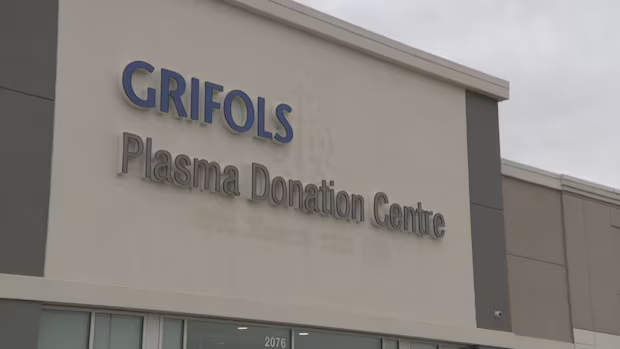
Health Canada inspection documents reveal a person who said they’d had sexual contact with someone who tested positive for HIV was allowed to give plasma twice at a for-profit donation centre in Regina.
An inspection exit report obtained by CBC details multiple deficiencies that led federal regulators to find the Grifols paid plasma centre in Regina non-compliant following an inspection that began Jan. 13 of this year.
That includes documenting “multiple times” when people who had punctures and bruising on their veins were allowed to give plasma, without any documented additional assessment of the donor’s suitability.
The report said after the donor answered “yes” to the HIV question during screening, they should have been banned from giving plasma indefinitely. However, the answer was subsequently changed to “no” by a Grifols physician substitute in training, according to the Health Canada report, dated Feb. 20.
The report said there was no documentation explaining whether that assessment was reviewed by a qualified trainer, despite the physician substitute being in training.
It’s unclear from the report whether the person was, in fact, HIV positive or why the answer was switched to “no”.
 Dr. Jacalyn Duffin, a hematologist, says it’s common to find problems in ‘inspecting and checking on the potential suppliers’ in paid plasma donation. (Kas Roussy/CBC)
The inspection report also detailed another instance where a person was able to donate without fully completing their questionnaire, and another where a person was allowed to donate despite disclosing multiple medications that would make them ineligible.
Dr. Jacalyn Duffin, a hematologist and professor emeritus of the history of medicine at Queen’s University, said the report’s findings are disappointing.
“It concerns me to know that there might not be sufficient controls in selections of the donors,” she said. “The whole business speaks of a kind of sloppiness.”
‘Significant findings’: internal audit
CBC also obtained a 2025 internal audit of the Regina location conducted by Grifols — a for-profit global health-care company that specializes in producing plasma medicines. It runs over a dozen plasma collection centres across the country, but has temporarily paused its plasma collection in Canada.
The audit said “multiple significant findings were observed” that would require “increased regional oversight” at the centre, according to the 19-page audit report, dated Sept. 11, 2025.
It found plasma collected from a donor who was HIV-reactive — meaning potentially, but not definitely, HIV-positive — was not properly documented as discarded. The audit said the person in charge of handling the discarded plasma was in training and not aware of the procedures.
The plasma was rejected by a supervisor, so there was no risk, the audit stated.
It is not clear if the HIV-reactive donor was the same donor mentioned in the Health Canada inspection who said they’d had sexual contact with an HIV-positive person.
The audit also found no one informed public health officials, as required, after someone’s donation had indicators of hepatitis B. The report said the previous policy was to only inform public health in the case of a confirmed positive, but that will be revised to include indeterminate results.
Other major deficiencies were noted, including biowaste stored in a hallway while waiting for pickup. The audit also found staff failed to properly disinfect venipuncture sites ahead of a procedure in some instances.
Plasma safety not compromised: Grifols
In response to questions about the Health Canada document, a spokesperson for Grifols said it has a multilayered system that goes beyond the initial donor interviews to ensure the safety of the plasma collected.
“At no point” was “donor safety or the quality and safety of plasma collected at our Regina centre — or at any of our other Canadian centres” compromised, the spokesperson wrote in a Sept. 15 emailed statement.
In an updated statement sent by Grifols following publication of this story, the company said that since Jan. 2026 no donors at Canadian collection centres have been confirmed positive for HIV or hepatitis B.
Two donors were confirmed positive for hepatitis C and another two showed indicators of the viral infection. In 2025, one donor was confirmed positive for HIV, the spokesperson wrote in a Sept. 16 emailed statement.
The number of confirmed positive donors in Canada “remains very low” and are below Grifols established alert limits, they said.
The spokesperson said any positive donation is removed before large scale processing begins. They said during screening they check people for any visible marks on their arms. If there is bruising they are referred to a physician.
Each donation undergoes multiple rigorous tests to ensure the safety of the plasma after it is collected and before large-scale processing begins, the spokesperson wrote.
Dr. Graham Sher, the longtime CEO of Canadian Blood Services — which manages the country’s blood and plasma supply — said there are quality gaps at Grifols that “no one is disputing.”
But the fact Health Canada allowed the company to continue to operate shows there were no critical defects occurring, he said, stressing the safety of the product collected by Grifols.
“At no circumstance would Canadian Blood Services continue business with a vendor of any sort if the product we were getting from them was putting patients in harm’s way,” he said.
 Dr. Graham Sher, the CEO of Canadian Blood Services, says the fact Health Canada allowed Grifols to continue to operate shows there were no critical defects occurring. (Brian Morris/CBC)
Grifols signed an agreement with Canadian Blood Services in 2022 that allowed the company to open paid plasma collection centres in Canada, in order to meet national targets for plasma supply.
Plasma is used to make a number of medications, such as immunoglobulin, to treat multiple different diseases. Plasma transfusions can be used in urgent situations to treat conditions like liver failure.
Sher said there is context missing in the Health Canada report, including Grifols’s response to the agency’s concerns and the regulator’s satisfaction with those answers.
“At no point did any product get collected from this donor [who answered ‘yes’ to the HIV-contact question] that would have been compromised and make its way into the system,” he said.
“When a single finding is reported absent the full context, then it does suggest there is risk that doesn’t exist.”
Sher also said given the current geopolitical climate, it’s important for Canada to be self-sufficient in plasma collection and avoid having to import from countries like the United States.
Grifols, which is based in Spain, has been under scrutiny following the deaths of two people in the past year after they gave plasma at clinics in Winnipeg.
Rodiyat Alabede, 22, died of cardiac arrhythmia due to dilated cardiomegaly — an enlarged heart — on Oct. 25, after she collapsed while giving plasma at the Grifols donation centre on Taylor Avenue. Little is known about the second person, who died in January from a heart attack complication after donating at Grifols’s Innovation Drive location.
Health Canada has previously said no connection has been found between the deaths and the plasma donation process.
Grifols now has full ownership of Canadian operations
The Regina location is one of four Canadian locations run by the company that have been found non-compliant by federal regulators in the past year.
The Taylor Avenue centre in Winnipeg was found non-compliant in August, after Health Canada found multiple deficiencies during an inspection.
Grifols announced its Canadian pause on paid plasma collection on Aug. 13, the same day the Winnipeg non-compliance report was released.
 A spokesperson for Grifols said the company has acquired full ownership of its plasma donation operations in Canada, giving it more control over ‘quality, safety and compliance standards.’ (CBC)
Hematologist Duffin said it is common to find these problems in paid plasma donation.
“If a company is in business to make money … they might cut corners in inspecting and checking on the potential suppliers of the plasma,” she said.
A spokesperson for Grifols said the company acquired full ownership of its Canadian operations as of Sept. 1. Previously, it had 50.1 per cent ownership, as part of its deal with the for-profit company Canadian Plasma Resources. This meant the governance structure and contractual arrangements limited Grifols’ ability to direct and control the operations of its Canadian plasma centres, the spokesperson said.
Full ownership will allow Grifols to “strengthen operational oversight” and ensure “quality, safety and compliance standards,” the spokesperson wrote.
The plasma collection pause in Canada will continue to allow the company to “implement its own quality standards,” the spokesperson said.
Katherine Lanteigne, a safe-blood advocate who is acting as a representative for the family of Rodiyat Alabede — the 22-year-old who died in Winnipeg last year — said the federal health minister needs to assure Canadians the blood system is being protected.
 Rodiyat Alabede, 22, died on Oct. 25, 2025, after giving plasma at the Grifols Plasma Donation Centre location on Taylor Avenue in Winnipeg. (GoFundMe)
In an emailed statement, she said “the systemic safety violations” revealed in the reports “warrant an immediate suspension of Grifols operating licence,” in order to allow for an investigation.
A spokesperson for Health Canada, which regulates all plasma and blood collection in Canada, said the agency could not respond to CBC’s questions by deadline.