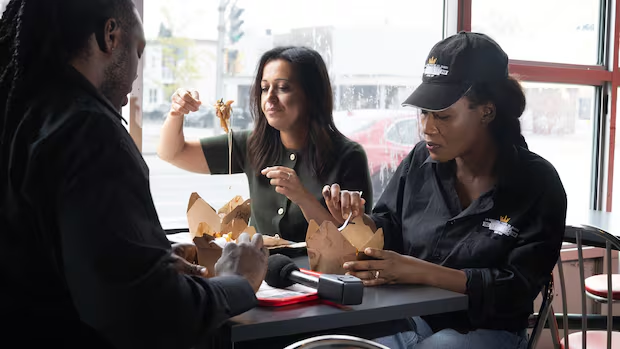
Days into Quebec’s election campaign, Ruba Ghazal stepped off the Québec Solidaire campaign bus in Rouyn-Noranda, Que,. and headed into Chez Morasse, a restaurant known for its poutine.
The party’s co-spokesperson ordered a large portion and made her way toward a table, where she was to sit with the restaurant managers and the local QS candidate, France Marion.
But she didn’t head straight there.
Along the way, Ghazal stopped to chat with customers. She answered questions from a group of teenagers, explaining why people should vote for her party: “Combatting high cost of living… housing issues,” she said,” to have better education for you.”
She eventually sat down, took a big first bite of poutine and declared, “J’adore.”
For Antonine Yaccarini, a political analyst, these kinds of stops are part of the choreography of an election campaign.
“Politicians love to be seen eating a poutine, speaking with voters and citizens in a more casual context,” she said.
LISTEN | What’s behind Quebec party leaders’ poutine pit stops?:
This is Quebec13:38A poutine, a hot dog and a political dream: Quebec’s foodie election stops
It’s a longstanding tradition for aspiring politicians to visit iconic Quebec snack shacks while on the campaign trail to be pictured with some greasy food… What’s up with that? We called up Charles-Alexandre Théorêt, food columnist with Radio-Canada’s Ça Promet, and author of Maudite Poutine!, for a look at this election rite of passage.
Ghazal is not the only party leader to make a poutine stop during this campaign.
A day later, the leader of Coalition Avenir Québec, Christine Fréchette, visited Ti-Oui Snack Bar in Saint-Raymond, where she spoke with customers and served up the province’s iconic dish.
Poutine and casse-croûtes are deeply associated with Quebec culture, Yaccarini said, and can help politicians project an image of accessibility. But the strategy can sometimes backfire.
 CAQ Leader Christine Fréchette visited Ti-Oui Snack Bar in Saint-Raymond where she talked to customers and served them poutine. (FaceBook/Christine Fréchette)
They are ‘just like us’
There is strategy behind those seemingly spontaneous moments.
Campaign teams choose restaurants and other stops based partly on where they can reach targeted ridings, Yaccarini said. They also look for locations that can provide attractive photographs and video.
And because Quebec’s provincial elections are generally held in the fall, many campaign activities take place outdoors, she said, making festivals, public markets and casse-croûtes natural stops along the campaign trail.
In an interview with CBC’s Quebec AM, food columnist and author Charles-Alexandre Théorêt described an election campaign as essentially a “seduction operation.”
Food, he said, allows politicians to show voters that they are “just like us.”
The politics of the hotdog
The use of food to shape a politician’s image is hardly new.
One of Théorêt’s favourite examples dates back to 1975, when Quebec Premier Robert Bourassa appeared on the cover of the French edition of Maclean’s magazine munching on a foot-long hotdog.
The cover portrayed Bourassa as the “new” hotdog-eating premier.
 Quebec Premier Robert Bourassa on the cover of Maclean’s magazine holding a hotdog in 1975. (Maclean’s)
The image was later used by then prime minister Pierre Elliott Trudeau to poke fun at Bourassa. At a meeting with journalists, Trudeau reportedly joked that he had brought his own lunch because, apparently, all Bourassa ate was hotdogs.
Théorêt says that event illustrates how food can be used not only to connect politicians with voters, but also to characterize their opponents.
Photo op sometimes backfires
But the risks of a culinary campaign stunt are still evident today.
During the 2025 federal election campaign, Conservative Leader Pierre Poilievre visited a Winnipeg pizzeria and attempted to make a pizza. However, as he turned toward the oven, the pizza partially slid off the peel, prompting Poilievre to catch it with his hand as toppings dropped to the floor.
Théorêt says for supporters, it could be seen as a funny, relatable moment. But for critics, “it offered an entirely different interpretation: if a politician cannot handle a pizza, perhaps they cannot handle running a country,” he said.
 Conservative Leader Pierre Poilievre dropped a pizza during his 2025 photo-op campaign in Winnipeg. (John Woods/Canadian Press)
There was also a lesson in cultural details during the same campaign.
During a visit in Shawinigan, Que., Liberal Leader Mark Carney was asked about the sound made by fresh cheese curds. He answered “squish, squish.” Quebecers know the expected answer: “squeak, squeak.”
Théorêt says it was a small mistake, but one that demonstrated how seemingly insignificant details can reveal whether a politician is familiar with the culture of the people they are trying to court.
Sending a message — authentically
Perhaps the clearest example of food’s connection to Quebec identity is poutine itself.
Théorêt says it has become such an iconic Quebec dish that one would naturally expect the leader of the Parti Québécois to embrace it.
But in 2024, PQ Leader Paul St-Pierre Plamondon admitted during an interview with Urbania’s Hugo Meunier that he is not particularly fond of the dish.
 During an interview in 2024, PQ Leader Paul St-Pierre Plamondon, centre, admitted he is not fond of poutine. (Pier-Olivier Busque/Radio Canada)
Meunier called it “scandalous,” but Plamondon argued he doesn’t want to pretend to be into poutine just because he’s the leader of the PQ.
But Yaccarini says campaigning is largely about image: candidates want to send voters the message that they enjoy the same things they do.
However she warns, “if the voters feel like this is fake or staged, only for the sake of a photo op, it won’t reach any goal.”