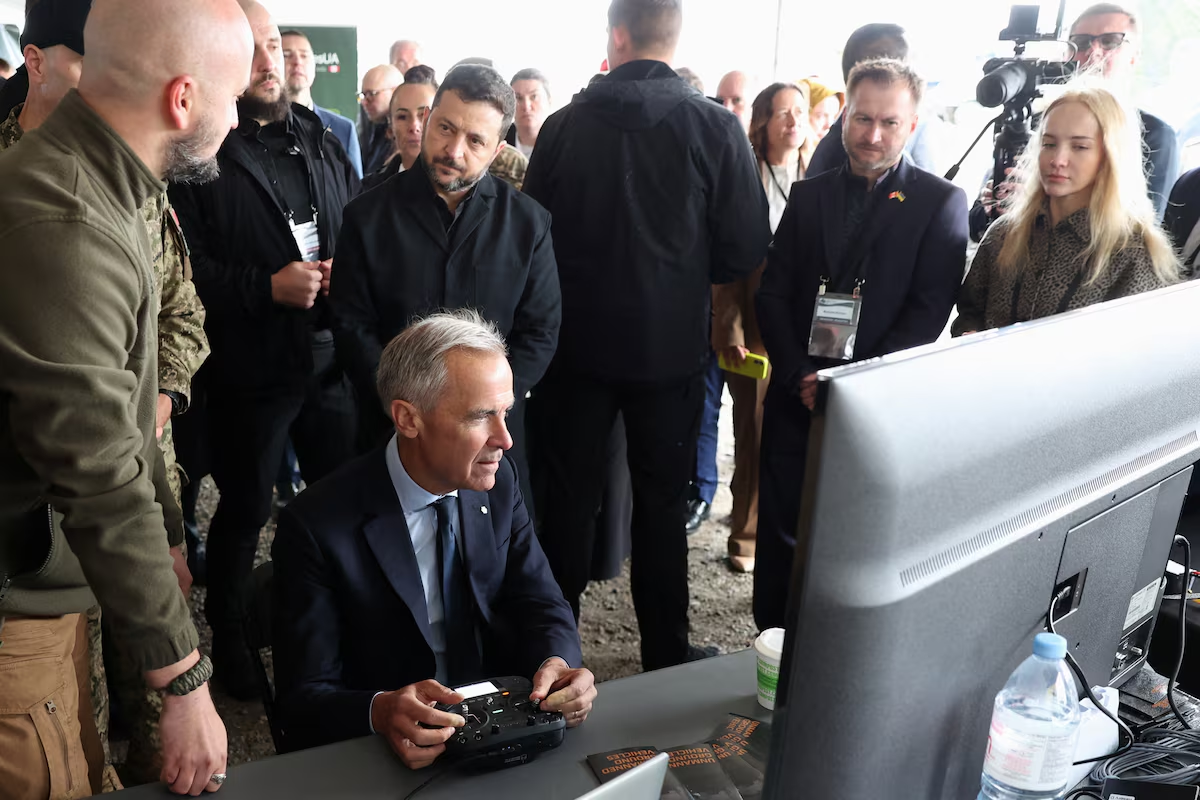

Open this photo in gallery:
Prime Minister Mark Carney and Ukraine’s President Volodymyr Zelensky visit the Southern Alberta Institute of Technology in Calgary on Thursday.Ahmed Zakot/Reuters
Ottawa has awarded the first contracts worth up to $50-million to Canadian companies through its new drone marketplace, as it works to achieve a national objective of producing two million drones a year.
The first six companies to receive contracts through the marketplace, officially titled the Defence Drone Initiative, were announced on Thursday amid a flurry of other drone-related statements made by Prime Minister Mark Carney during a joint press conference with Ukrainian President Volodymyr Zelensky.
“I have to confess that our armed forces currently have about 2,000 drones in our infantry,” Mr. Carney said to Mr. Zelensky at the event in Calgary.
“In the years to come, we will need millions.”
The timeline for when the federal government wants Canada to be producing two million drones a year is unclear.
Ukrainian President Volodomyr Zelensky met with Canadian Prime Minister Mark Carney ahead of a Liberal cabinet meeting in Alberta. Carney says the meeting will focus on the countries’ shared priorities, including deepening defence, economic and energy co-operation.
The Canadian Press
This initial group of six Canadian companies was picked from a pool of approximately 400 who qualified as suppliers through the marketplace’s first intake. They include New Brunswick-based AVSS, Quebec-based Beonyx and Volatus Aerospace, Ontario-based Objexis AI and Twenty20 Insight Inc., and Saskatchewan-based Draganfly.
Each of these companies bid for one of two up to $25-million contracts for either low-cost tactical intelligence, surveillance and reconnaissance drones, or uncrewed ground vehicles for logistics and complex terrain.
To start, the companies must deliver an initial order by March 1.
In the case of the low-cost surveillance drone, that’s 100 drones with a price per unit of $5,000 or less. For the uncrewed ground vehicles, that’s two complete systems, including the ground vehicle itself as well as components such as ground control stations, spare parts, operator training and more.
Once the government receives these initial orders, they will be distributed to military members to test and provide feedback. Then, Ottawa will have the option to procure an additional up to 4,900 drones and up to 10 uncrewed ground vehicles, with the $25-million contracts split between companies.
Canada is behind in the global drone race. But not for long
The plan is for the full order of those low-cost drones, for example, to be delivered within the next 12 months, said Lieutenant-Colonel Nick Verreault, head of the Canadian Armed Forces’ Joint Uncrewed Systems Office.
This thinking in days and months is markedly different than the slow-moving defence procurement cycle that Canadian industry has long lamented for its bureaucracy and failure to deliver contracts in a timely fashion.
The Defence Drone Initiative was launched on July 23. About three weeks later, on Aug. 14, applications to join the marketplace closed (after the website crashed multiple times owing to hundreds of companies trying to submit their bids).
Following a couple of weeks of quiet, a steady trickle of announcements from companies boasting their acceptance into the marketplace began trickling out. Every single province and territory was represented in this initial pool of almost 400 suppliers, with the lion’s share coming from Ontario, Quebec, B.C., Alberta and Nova Scotia. More suppliers will be added in time.
Then, on Aug. 26, the first requests for proposals were posted by Ottawa. The catch? Companies had barely five working days to submit their bids.
These weren’t small submissions either. Glen Lynch, chief executive officer at Volatus, said his company’s submission was more than 240 pages. “We had a team of people working almost around the clock,” he said on Thursday, after submissions opened the week prior.
“We received questions on our submissions on Friday. We had until Saturday night to respond, and we received confirmation on the first agreement yesterday. I have never ever seen any government move at this speed.”
Opinion: In this new world, defence strategy is now economic strategy
Josh Ogden, CEO at AVSS, said not only the speed but also the number of procurement opportunities for Canadian drone companies at home right now is noteworthy.
“From a drone tech perspective, the government is making us do a lot of paperwork,” he said.
“But then, for them to execute on one of them this quickly, they set a tone of ‘No, yeah, do the paperwork, there are carrots at the end of it.’”
As a result, in part, of the speed at which the marketplace is getting off the ground, some of the initial contracts have been awarded to Canadian companies that are partnering with companies from other countries to offer established technologies.
Volatus’s bid, for example, featured a system that it will deliver in partnership with a British company that it was already working with.
“We’ll ultimately be assembling the larger amounts in our facility in Canada, but we’re able to kick it off immediately because it’s already a mature technology,” Mr. Lynch said.
These kinds of partnerships are critical to get the marketplace up and running, delivering systems and contributing to the build out of a domestic supply chain in Canada, Lt.-Col. Verreault said . In some cases, waiting to award contracts until there are enough Canadian-designed systems available, “may take awhile,” he said.
“So, in the meantime, the Canadian Armed Forces gets an immediate solution, and Canadian industry gets to learn how to manufacture and how these systems are designed,” he said.
AVSS is one of the three companies selected that offers a predominantly Canadian-made system. Mr. Ogden said he’s happy to see the federal government noting the distinction between Canadian companies that are manufacturing systems domestically and those that are partnering with allies on licensing and production.
“The transparency on who won, who is building and who is using allied partners in selling, that transparency is great,” he said.
CIBC commits $2-billion to help finance defence-related companies
This partnership model is being applied across much of Canada’s uncrewed systems production and procurement right now. For example, on Thursday, Canada and Ukraine forged a long-term partnership to jointly produce uncrewed systems, counterdrone technologies, and priority munitions, merging Ukrainian experience with Canadian manufacturing and technology.
Another example is the deep precision strike system that Canada is looking to buy from another country initially and later develop in-house.
The next time companies will be able to apply to enter the Defence Drone Initiative will be in October, with qualified suppliers announced in November. Ottawa will continue to accept applications to the pool once every three months for the first year.
More requests for proposals will also be published through the marketplace in the coming weeks to months. A new one for uncrewed surface vehicles that can be used for underwater mine detection was posted on Thursday.