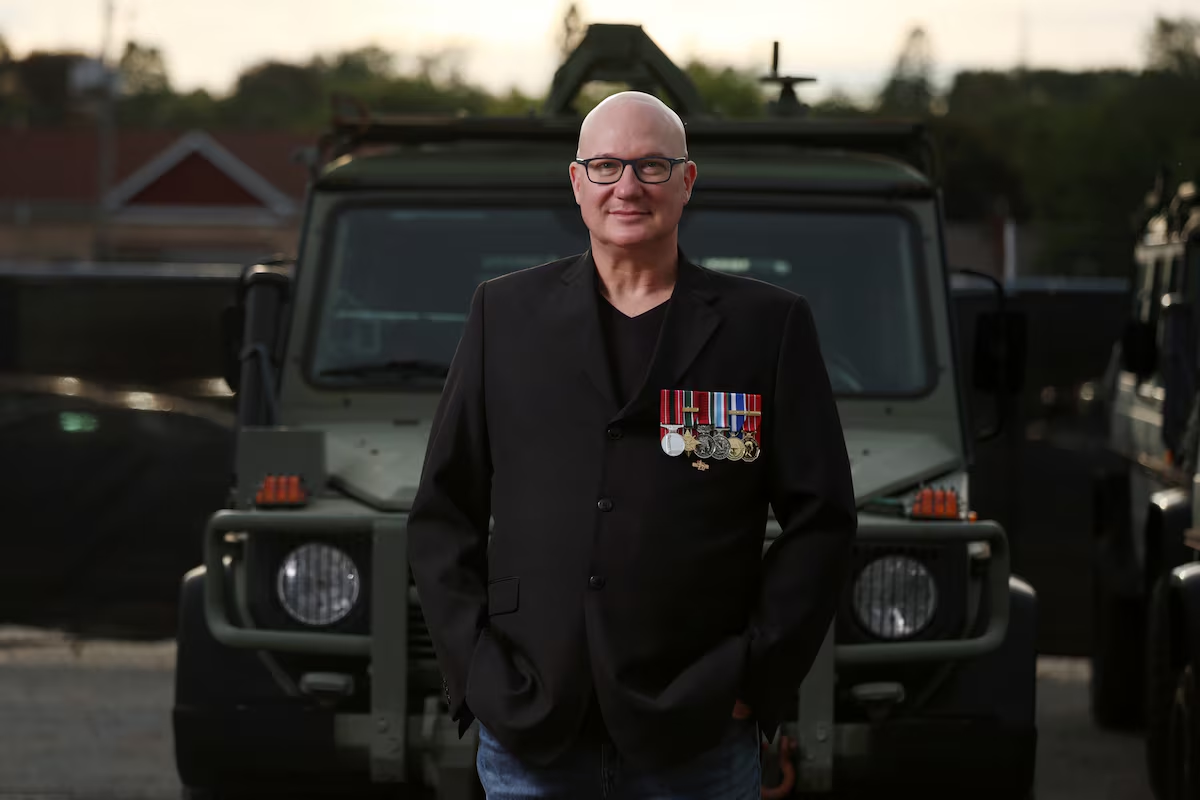
Open this photo in gallery:
Former Canadian Armed Forces master corporal Jeff Rainey was among 30 Canadians wounded in the Kandahar region in Afghanistan after an American warplane accidentally strafed them on Sept. 4, 2006.Dave Chan/The Globe and Mail
As the 30-millimetre shells from American warplanes rained down, Jeff Rainey tumbled down the hillside where he and other Canadian soldiers had gathered.
“It felt like somebody hit my leg with a sledgehammer and then I rolled over some more, and then I got hit in the back,” the master corporal remembered.
He saw another soldier, Bruce Moncur, with an open skull injury. Despite his own wounds, Mr. Rainey did his best to bandage Mr. Moncur.
They were in Afghanistan, on Sept. 4, 2006, during the largest Canadian combat operation since the Korean War. Mr. Rainey’s platoon was preparing to attack a Taliban position but instead was mistakenly strafed by its ally.
Now, two decades later, Mr. Rainey and other soldiers will attend a weekend gathering marking the 20th anniversary of Operation Medusa, an offensive that saw some of the fiercest gunfights Canadians faced in Afghanistan.
Open this photo in gallery:
Soldiers from 4 Platoon, Bravo Company, burst into a suspected Taliban stronghold in Panjwai District on Sept. 11, 2006.Graeme Smith/The Globe and Mail
This year’s reunion comes amid unprecedented acrimony between Canada and the United States, two countries whose military once fought side by side in Afghanistan.
“I cannot believe that we are seeing this,” Mr. Rainey said, describing the American political stance as “a ridiculous anomaly.”
Mr. Moncur says he holds no grudges against the American pilot who fired on his platoon because it was an accident. His feelings are however different when it comes to present-day American policies.
“It’s harder to forgive a deliberate act of aggression rather than an accident like shooting your own side,” he said.
Another veteran, David Goldenberg, recalled the goodwill between Canadians and Americans deployed in Afghanistan. “We did it because it was the right thing to do. So now you sit here 20 some years later … and you’re scratching your head, going ‘This does not make sense’ and it’s sad.”
The three were among more than 40,000 Canadian military personnel who served in Afghanistan in support of the U.S. after the Sept. 11, 2001, terrorist strikes.
After 9/11, Canada’s military stepped into the global fight on terror as it headed for war in Afghanistan
In the summer of 2006, the Canadian military deployed to Kandahar region, where coalition forces came under the command of a Canadian general, David Fraser.
Mr. Goldenberg, then a warrant officer, landed in Kandahar in August with a military psychological operations team, doing outreach with the local population.
Mr. Rainey and Mr. Moncur, who was a corporal, arrived around the same time, with 8 Platoon, Charles Company, one of the sub-units of the 1st Battalion of the Royal Canadian Regiment.
Within weeks, the regiment was called to spearhead Operation Medusa, to clear the Taliban from the Pashmul area, west of Kandahar City.

Operation Medusa: Objective Rugby
Operation Medusa was a major Canadian-led NATO offensive conducted in Kandahar province, Afghanistan, from Sept. 2 to 17, 2006. During the operation, Charles Company of the 1st Battalion, Royal Canadian Regiment, which consisted of 7 Platoon and 8 Platoon, was tasked with capturing a heavily defended Taliban strongpoint known as the White School, designated Objective Rugby. The battle for Objective Rugby was intense and costly, resulting in the deaths of five Canadian soldiers.
The company takes a hillside called Masum Ghar.
The company crosses the Arghandab River, riding in armoured LAV III and G-Wagon vehicles.
*The Canadian combat engineers brought bulldozers
to breach some of the obstacles.
8 Platoon begins clearing buildings nearby.
7 Platoon vehicles approach the White School when the enemy opens fire. Sgt. Shane Stachnik and Warrant Officer Richard Nolan are killed.
As the soldiers retreat, a casualty collection point is set up beside a Zettelmeyer wheel loader, which is struck by a Taliban rocket, killing Private William Cushley and Warrant Officer Frank Mellish.
A coalition plane mistakenly drops a 1,000-pound bomb into the scene but it doesn’t explode.
The company returns to the foot of Masum Ghar.
At dawn as they prepare to attack again, 8 Platoon is mistakenly strafed by two U.S. A-10 Thunderbolt warplanes, killing Private Mark Graham and wounding 30 others.
MURAT YÜKSELIR / THE GLOBE AND MAIL, SOURCE: IN THEIR OWN WORDS : CANADIAN STORIES OF VALOUR AND BRAVERY FROM AFGHANISTAN, 2001-2007. CANADIAN DEFENCE ACADEMY PRESS, 2013.; GOOGLE EARTH

Operation Medusa: Objective Rugby
Operation Medusa was a major Canadian-led NATO offensive conducted in Kandahar province, Afghanistan, from Sept. 2 to 17, 2006. During the operation, Charles Company of the 1st Battalion, Royal Canadian Regiment, which consisted of 7 Platoon and 8 Platoon, was tasked with capturing a heavily defended Taliban strongpoint known as the White School, designated Objective Rugby. The battle for Objective Rugby was intense and costly, resulting in the deaths of five Canadian soldiers.
The company takes a hillside called Masum Ghar.
The company crosses the Arghandab River, riding in armoured LAV III and G-Wagon vehicles.
*The Canadian combat engineers brought bulldozers
to breach some of the obstacles.
8 Platoon begins clearing buildings nearby.
7 Platoon vehicles approach the White School when the enemy opens fire. Sgt. Shane Stachnik and Warrant Officer Richard Nolan are killed.
As the soldiers retreat, a casualty collection point is set up beside a Zettelmeyer wheel loader, which is struck by a Taliban rocket, killing Private William Cushley and Warrant Officer Frank Mellish.
A coalition plane mistakenly drops a 1,000-pound bomb into the scene but it doesn’t explode.
The company returns to the foot of Masum Ghar.
At dawn as they prepare to attack again, 8 Platoon is mistakenly strafed by two U.S. A-10 Thunderbolt warplanes, killing Private Mark Graham and wounding 30 others.
MURAT YÜKSELIR / THE GLOBE AND MAIL, SOURCE: IN THEIR OWN WORDS : CANADIAN STORIES OF VALOUR AND BRAVERY FROM AFGHANISTAN, 2001-2007. CANADIAN DEFENCE ACADEMY PRESS, 2013.; GOOGLE EARTH

Operation Medusa: Objective Rugby
Operation Medusa was a major Canadian-led NATO offensive conducted in Kandahar province, Afghanistan, from Sept. 2 to 17, 2006. During the operation, Charles Company of the 1st Battalion, Royal Canadian Regiment, which consisted of 7 Platoon and 8 Platoon, was tasked with capturing a heavily defended Taliban strongpoint known as the White School, designated Objective Rugby. The battle for Objective Rugby was intense and costly, resulting in the deaths of five Canadian soldiers.
The company crosses the Arghandab River, riding in armoured LAV III and G-Wagon vehicles.
The company takes a hillside called Masum Ghar.
*The Canadian combat engineers brought bulldozers to breach some of the obstacles.
A coalition plane mistakenly drops a 1,000-pound bomb into the scene but it doesn’t explode.
8 Platoon begins clearing buildings nearby.
7 Platoon vehicles approach the White School when the enemy opens fire. Sgt. Shane Stachnik and Warrant Officer Richard Nolan are killed.
The company returns to the foot of Masum Ghar.
As the soldiers retreat, a casualty collection point is set up beside a Zettelmeyer wheel loader, which is struck by a Taliban rocket, killing Private William Cushley and Warrant Officer Frank Mellish.
At dawn as they prepare to attack again, 8 Platoon is mistakenly strafed by two U.S. A-10 Thunderbolt warplanes, killing Private Mark Graham and wounding 30 others.
MURAT YÜKSELIR / THE GLOBE AND MAIL, SOURCE: IN THEIR OWN WORDS : CANADIAN STORIES OF VALOUR AND BRAVERY FROM AFGHANISTAN, 2001-2007. CANADIAN DEFENCE ACADEMY PRESS, 2013.; GOOGLE EARTH
Charles Company had to take a Taliban strongpoint known as the White School. Four Canadian soldiers of the Princess Patricia’s Canadian Light Infantry had died there during a firefight on Aug. 3.
Before departing, they were advised to call home but weren’t allowed to reveal anything about the mission. Mr. Moncur phoned his aunt to say he loved her. She replied that she loved him, too. He repeated his words with more emphasis but she didn’t pick up on the insistent tone in his voice.
On Sept. 2, Charles Company occupied a rocky height known as Masum Ghar, across a river from the White School. They had been assured that there would be several days of heavy artillery and air strikes before the infantry would start the assault. However, on the morning of Sept. 3, the troops were told to get ready to attack.
Both Mr. Rainey and Mr. Moncur recalled that the soldiers were unhappy about the order. The coalition had already dropped pamphlets telling civilians to leave so the enemy was certainly alerted to the impending attack. “Any reasonable person would have known that this was not going to go well,” Mr. Rainey said.
Their general, Mr. Fraser, later justified the earlier start by saying that the Taliban were so deeply dug in that “two or three more days of aerial bombardment would have accomplished little.”
The morning of Sept. 3, Charles company forded the Arghandab River. Most of the men rode on LAV III armoured vehicles and combat engineers brought bulldozers and wheel loaders to breach the berms and ditches.
Open this photo in gallery:Open this photo in gallery:
From left: Warrant Officer Nolan, Sergeant Stachnik, Warrant Officer Mellish and Private Cushley. All were killed in Afghanistan on Sept. 3, 2006.Supplied
They made their way through tall fields of marijuana. On the left, 8 Platoon dismounted and started clearing a cluster of buildings. On the right, 7 Platoon approached the White School.
“As soon as we walked in far enough, they shot a green pen flare into the air, and that’s when all hell broke loose,” Mr. Moncur said.
The Taliban opened up with small arms, rocket-propelled grenades and recoilless guns on 7 Platoon’s vehicles, killing Sergeant Shane Stachnik and Warrant Officer Richard Nolan.
The Canadians fired back, retrieved their wounded and set up a casualty collection point.
Mr. Moncur recalled that, as bullets ripped through the marijuana fields, the stalks caught fire and it smelled of burning cannabis. He and Warrant Officer Frank Mellish came over to assist at the casualty collection point.
Mr. Moncur saw Mr. Mellish’s self-assured demeanour amid the fighting and that gave him the confidence to open the rear hatch of his LAV and fire his C9 squad machine gun.
Suddenly a rocket flew by his head, singeing his chin and shoulder. It hit the casualty collection point, killing Private William Cushley and fatally wounding Mr. Mellish.
“There’s bodies sprawled everywhere … I’m standing there and I’m watching these guys writhe and move around in pain and screaming,” Mr. Moncur said.
Adding to the chaos, a coalition plane mistakenly dropped a bomb on them. It bounced on the ground like a spiked football but didn’t explode.
Open this photo in gallery:
Hank Stachnik wipes away a tear while sitting in front of his son Sergeant Shane Stachnik’s casket at his internment ceremony at the National Military cemetary in Ottawa on Sept. 11, 2006.Tom Hanson/The Canadian Press
The Canadians started to pull back. Mr. Rainey tried to board a LAV and nearly stepped on a friend, Corporal Derick Lewis, who had been shot in the arm and was lying on the cabin’s floor. Mr. Rainey ended up retreating on foot with his machine gunner.
The shootout lasted five hours and Mr. Moncur went through three boxes of ammunition, about 600 rounds.
The next day, Sept. 4, would bring the American attack as they prepared for another assault on the White School. Mr. Moncur wasn’t hungry but sat down for breakfast to give him energy for combat.
Suddenly he was tossed into the air. “I felt like I was being electrocuted. Like I had touched a socket.” His body bent “like an accordion” when he landed, then he blacked out.
When he regained consciousness, his right arm was thrashing about, like a fish taken out of water.
His arm was flailing because the left side of his brain had been hit. “Then the blood started to just pour like a faucet, and now I’m panicked, and I’m trying to catch the blood … my hands were absolutely overflowing.”
He crawled toward Mr. Rainey, who was also injured. He heard someone yell, “Who threw ammunition in the fire?” because they hadn’t realized yet that they had been shot by their own side.
The accidental strafing by the American A-10 attack plane killed one man, Private Mark Graham, and wounded 30 others, including the company commander, Major Matthew Sprague.
Mr. Moncur believed he was going to die and started thinking of his loved ones. A Chinook helicopter airlifted him to an army base for emergency brain surgery. He and Mr. Rainey were among the wounded flown to the Landstuhl military hospital in Germany.
Open this photo in gallery:
A reservist corporal from the Royal Regiment of Canada, relaxes after an intense firefight in which Canadian and U.S. troops defend a cluster of mud-walled farms and houses in Panjwai District on Sept. 8, 2006. It was the first ground seized by NATO forces in Operation Medusa.Graeme Smith/The Globe and Mail
Across the river, Mr. Goldenberg and the psy-ops team were manning a road checkpoint and they saw the strafing from afar, then heard the radio call “check fire, check fire,” as the pilots realized their mistake.
With Charles Company having lost a third of its personnel, including its commander, the rest of the unit was regrouped into an ad hoc force with various other troops, including American soldiers, a Canadian reconnaissance squadron and the psy-ops team. The new unit, called Task Force Grizzly, was commanded by a U.S. National Guard colonel, Steve Williams.
“We worked with them, we ate with them, we sat with them … we had a common goal,” Mr. Goldenberg said about joining force with Americans.
The offensive resumed with a push from the north by another Canadian company before Task Force Grizzly recrossed the river. By Sept. 17 Medusa ended with the remaining enemy fighters having fled the area.
While the Taliban no longer engaged in head-on combat, 12 more Canadian soldiers died that fall from ambushes, improvised explosive devices or suicide bomber attacks.
A month after the start of the offensive, the psy-ops team got permission to return to their base. Riding two G-Wagon vehicles, they joined a resupply convoy heading for Kandahar City. The team’s commander, Lieutenant Jason Demaine, was in a G-Wagon with a driver, Corporal Piotr Burcew.
Mr. Goldenberg was in the second G-Wagon, a few vehicles behind. As they entered Kandahar City, the convoy started slowing down.
Open this photo in gallery:
David Goldenberg, a warrant officer at the time of Operation Medusa, now works for the Durham Regional Police Service.TANNIS TOOHEY/The Globe and Mail
Suddenly there was an explosion and Mr. Goldenberg saw a gigantic ball of flames ahead. “You’re stunned for a moment because it’s just like, what, what was that?”
A suicide bomber on a motorcycle had detonated himself next to Mr. Demaine’s G-Wagon. The vehicle crashed into a ditch but its two occupants managed to walk out of the fiery wreck.
The other Canadians cordoned off the area but now had to pry away from the burning vehicle a stash of anti-tank rockets, which risked blowing up amid the civilians who had gathered at the scene.
“A number of us ran back and forth from the vehicle and removed the sensitive equipment, removed the ammunition, removed the hand grenades,” Mr. Goldenberg said.
Later that month, back in Canada, Mr. Rainey had been discharged from hospital and he took over his unit’s casualty management section. He had post-traumatic stress disorder and he was frustrated by the red tape preventing wounded soldiers from getting better care. He also felt guilty being home while his comrades still fought in Afghanistan. “It was like this miasma around me … it ruined me.”
Mr. Moncur, meanwhile, needed months of physical and occupational therapy before he regained the ability to read, write and speak without slurring his words. It took him a decade to get Veterans Affairs Canada to recognize that he qualified for a 100 per cent disability pension.
Mr. Goldenberg joined the Durham Regional Police Service. Mr. Moncur became a teacher and campaigns to get federal officials to recognize Canadian soldiers whose acts of bravery weren’t properly acknowledged.
Mr. Rainey, who is a power engineer in Alberta, still thinks about the way the war ended in 2021 when the U.S. military withdrew, leaving behind their Afghan allies and letting the Taliban return to power: “What were we there for?”
Open this photo in gallery:
Bruce Moncur speaks during a news conference on Parliament Hill on April 15 as former chief of defence staff General Rick Hillier (left) and Conservative MP Airdrie-Cochrane Blake Richards look on.Adrian Wyld/The Canadian Press