
Open this photo in gallery:
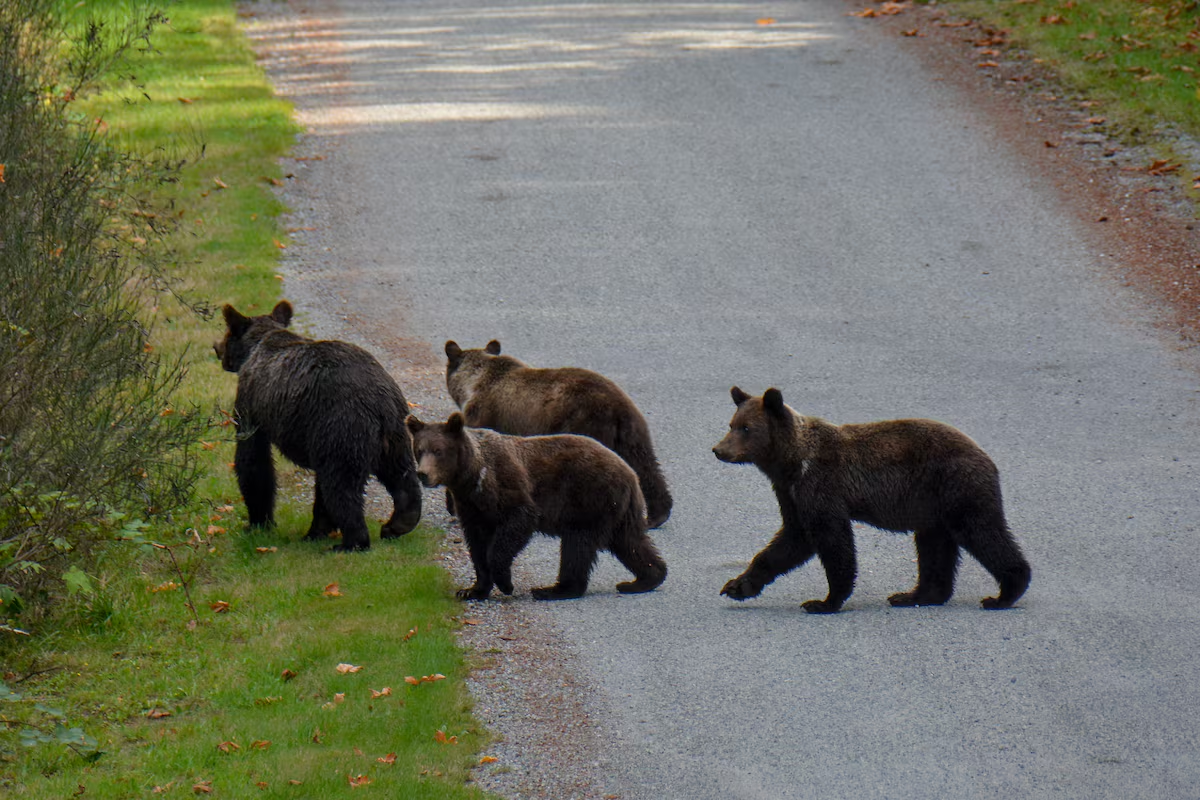
A family of grizzly bears – a mother and her three yearlings – roams through Madeira Park, B.C., a coastal B.C. town unaccustomed to the animal’s presence.Briand Le/The Globe and Mail
Around noon on Thursday, the elementary school at the heart of a quiet coastal town issued a shelter-in-place order. Staff kept students inside. A road to the local marina was blocked off.
Phone lines and Facebook groups erupted with warnings: Strangers with fierce reputations had come to town and residents worried about a confrontation.
But it soon became clear that the newcomers – a mama grizzly and her three yearlings – wanted little to do with humans. They gorged on apples before galumphing down the highway.
Their appearance has left an uneasy feeling in Pender Harbour, British Columbia, a community of roughly 3,000 people. While Pender is comfortable with its teeming black bear population, grizzlies are novel.
Provincial maps list the species as eradicated in this region, which is located a 40-minute ferry ride and a twisty one-hour drive north of Vancouver. But the bears refuse to abide by cartography. For all kinds of possible reasons – wildfires, climate change, a hunting ban – B.C. grizzlies are pushing back into territory where there is no living memory of their presence.
Not everyone is welcoming the new arrivals. While many residents are preaching coexistence by removing attractants and bear-proofing properties with animal-resistant garbage cans, electric fences and even wolf hair, others want the family relocated before someone, or something, gets hurt.
“I really hope the conservation officer can relocate them,” said Lesley Durrant, who runs a bed and breakfast overlooking a bay where the family has been spotted. “They won’t do well in this community.”
In the first week of August, the mama bear led her yearlings down to the shellfish-rich Oyster Bay. There, they crunched clams and oysters in full view of dozens of waterfront residents.
Open this photo in gallery:
A sign warning of a bear in the area is shown in Squamish, B.C., in 2022.Amy Smart/The Canadian Press
On Aug. 14, Tammy Trefry, who runs a local animal rescue service, alerted the community on Facebook and urged everyone to give the family space. She also passed along tips for grizzly encounters. Don’t bang pots or yell like you might with black bears, she says, just stay calm and let grizzlies move on.
The very next day, Amelia Dunn was outside feeding her two pigs, when she looked up and saw the mama grizzly and three yearlings trotting straight toward her.
“My first instinct was ‘Oh my god, they know it’s feeding time. They’re coming to eat me. They’re coming to get the pigs.’”
Then, she recalled reading Ms. Trefry’s advice.
She had two bowls in her hands. Rather than banging them together like she might have for black bears, she dropped them to the ground, made sure the bears could see her, and calmly repeated “Off you go, bears. Off you go.”
The bears stood up, assessed Ms. Dunn for a few seconds, and then walked back from where they had come.
“She wanted nothing to do with me,” Ms. Dunn said about the mama bear. “She was gone. She’s not here to take down a bunch of humans.”
Ms. Dunn then contacted Ms. Trefry, who arrived armed with an array of eclectic deterrents: wolf hair, Pine-Sol, strobe lights, air-filled garbage bags and a static-blaring radio.
“She had some really good ideas,” Ms. Dunn said. “We never saw the bears again.”
Not everyone has been so receptive. People have sicced dogs on the bears, and others have refused to set up electric fences or remove fruit, Ms. Trefry said.
Generational habits are hard to change. When Andy Pestraschuk saw the grizzlies early Thursday morning, he banged a pot to keep them away from his livestock. It worked. “They freaked out and took off towards the water,” he said.
Decades ago, B.C. paid bounties for killing large carnivores. It wasn’t until the 1960s that the province started regulating grizzly hunting with a tag and limited-entry restrictions. In 1975, the U.S. listed them as a threatened species, prompting concerns of overhunting in B.C.
In 2017, the B.C. government banned trophy hunting of grizzlies.
“The population is coming back,” said Evelyn Kirkaldy, who leads the Sunshine Coast Bear Alliance and lives in Pender Harbour. “We really wiped them out at the turn of the century.”
She says many communities would quietly dispatch bears, an approach she calls “SSS,” or shoot, shovel, shut up. But those days are largely gone.
Open this photo in gallery:
A grizzly bear eats a salmon in Mussel Inlet on B.C.’s Central Coast, in Kitasoo Xai’xais territory.Alex Harris/Supplied
The hunting ban is just one possible reason the species is moving in. In the nineties, the government reintroduced elk, which can attract the apex predators, to the area. Recent low snowpacks have made for poor berry foraging, pushing bears into settled areas. There are also constant wildfires forcing populations into unfamiliar terrain.
Whatever the reason, the Pender grizzlies decided to vacate the harbour in late August, walking about 15 kilometres north before swimming to sparsely populated shores.
“That was a big relief,” said Sergeant Dean Miller, local field supervisor for the BC Conservation Officer Service. “But I always suspected that they might be back, just like the bear that swam over to Texada Island last year.”
That bear, popularly known as Tex, has become an infamous cautionary tale. The young male was relocated multiple times after wandering near downtown areas of two other area towns, Gibsons and Sechelt. Each time, it returned to populated areas and reportedly began stalking people. In May, 2025, it swam at least five kilometres to Texada Island, where it was eventually shot and killed by farmers who said Tex was attacking their dairy cows.
They later pleaded guilty for failing to promptly report the accidental or protective killing of wildlife, and were fined $6,000.
Sgt. Miller’s suspicions were correct. This week, several people photographed the family marching south along the S-bends of Highway 101 toward Pender’s main commercial hub, Madeira Park.
On Thursday, they turned up on Madeira’s shores, where they feasted on apples at a marina and seemed generally unfazed by human onlookers. Even though they eventually marched out of town, Sgt. Miller said their return is worrisome.
“Obviously, the level of human habituation has increased in just two weeks,” he said by phone as he drove to check on the grizzlies on Thursday. “That just shows the trajectory of where these bears are going, and getting these apples – and who knows what else – from yards.”
With the bears so close to a school, some locals on Facebook called for conservation officers to relocate the animals.
Sgt. Miller said the process would require complex logistics and the involvement of provincial biologists.
There are other options. Conservation officers “destroyed” 24 grizzlies last year and have so far killed three in 2026 for public safety reasons, according to provincial figures.
“Shooting them is such a lazy human approach,” said Ms. Dunn, who had the close encounter. “Heaven forbid that humans have to adjust.”