
Open this photo in gallery:
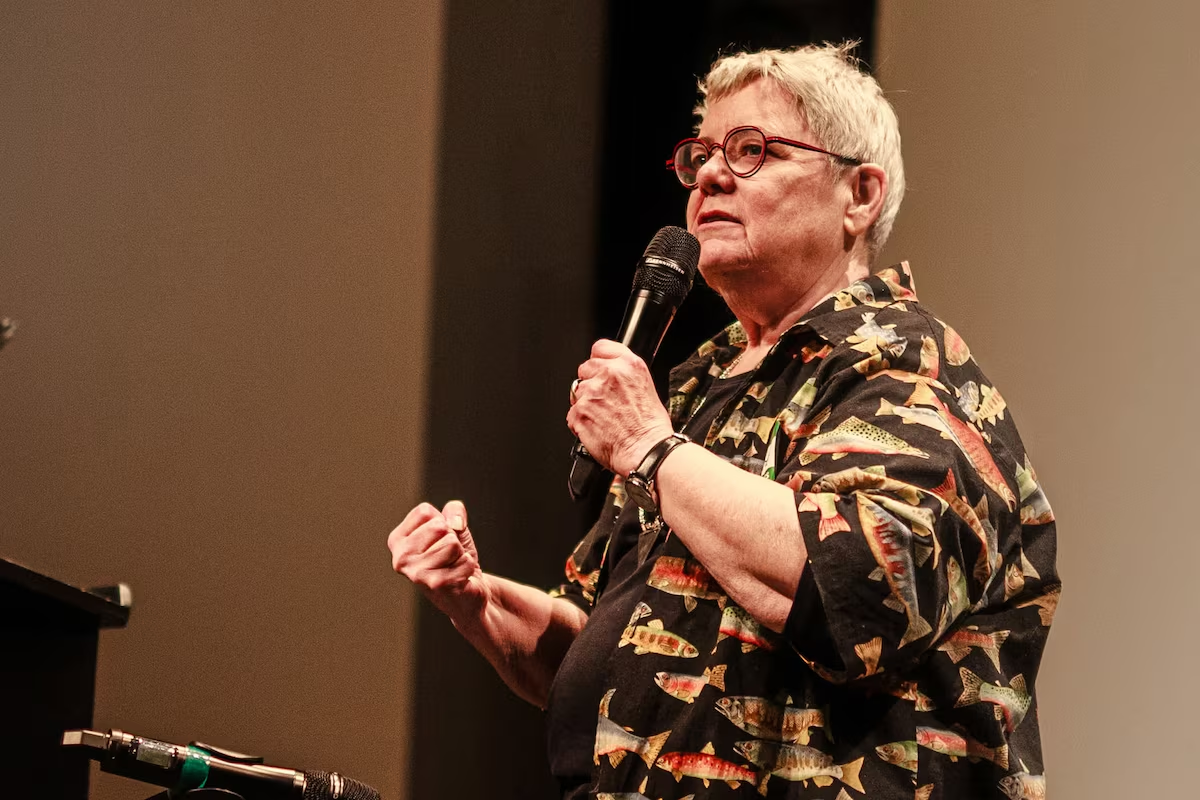
Outside the courtroom, barbara findlay conducted countless anti-oppression workshops, energized numerous advocacy and equity groups and was a generous mentor to scores of law students and young lawyers, efforts that continued well after her retirement in 2019.Catherine Mateo/Supplied
As a teenager in the 1960s, barbara findlay was institutionalized against her will for being a lesbian. She transformed that bewildering experience of betrayal and erasure into fuel that powered a 50-year legal career dedicated to serving underdogs and outsiders. findlay (who wrote her name in lower-case letters and eschewed honorifics) is considered one of the most influential jurists in Canada, playing an outsized role in advancing queer and trans rights in this country.
Outside the courtroom, findlay conducted countless anti-oppression workshops, energized numerous advocacy and equity groups and was a generous mentor to scores of law students and young lawyers, efforts that continued well after her retirement in 2019. A breast cancer survivor, findlay struggled in recent years with myalgic encephalomyelitis and other chronic conditions. She died with medical assistance on Aug. 22 in Vancouver. She was 77.
Long-time Vancouver Centre MP Hedy Fry remembers findlay as a woman of steely determination and formidable intellect. “I think her biggest achievement was getting justice and human rights for people who were vulnerable, especially beginning with the 2S-LGBTQ community,” Ms. Fry says. “But also she worked very strongly with Indigenous peoples and Indigenous women. She was just a fighter for justice.”
“She was way ahead of her time,” past president of the Canadian Bar Association Steeves Bujold says. “What she thought was right was at least two, three decades before it became mainstream. She was a visionary.”
Open this photo in gallery:
Following a short stint on the law faculty at UBC, findlay set up her own private practice in 1992 with the explicit aim of serving the queer and trans community.Belle Ancell/Supplied
Born May 4, 1949 in Regina, findlay was raised in a working-class, Presbyterian family. According to the 2015 documentary In Particular, findlay was a precocious straight-A student. Elsewhere she described her young self as socially awkward and desperately lonely. At the age of 17, she moved to Kingston, Ont., to attend university. That’s when she was institutionalized.
“I said to my psychiatrist, ‘Either there’s something wrong with me or there’s something wrong with the world. And I’m hoping it’s me, because that’d be easier to fix’,” findlay told CBC Radio in 2016. “I was wrong; it was the world.”
So findlay set out to change the world.
After graduating from Queen’s University, findlay moved to Vancouver in 1970 to pursue a graduate degree in sociology at the University of British Columbia. It was a heady time of youthful revolt and critical thinking. findlay described her study of radical feminist thought as foundational to her emerging understanding of the world and how to make it more equitable. Anti-racism work soon expanded that understanding.
“I came to the law on purpose,” findlay said on a CBA podcast in 2023. “I had discovered feminism in 1970 … and I looked around for something that would enable me to have power to make change. And I picked law for that reason.”
At first findlay practised labour law and worked for legal aid in Vancouver for 10 years, working closely with the Native Programs department, trying to advance Indigenous access to the law and support the development of Indigenous-led legal policies.
Following a short stint on the law faculty at UBC, she set up her own private practice in 1992 with the explicit aim of serving the queer and trans community.
“When I opened my legal practice in 1992 the law relating to queers was a desert. There was, for example, no family law regime relating to queers at all, period. We were invisible.”
findlay began to green the desert, slowly building up case law that advanced the rights of queers, trans folk and others. In 2001, for example, arguing before the B.C. Human Rights Tribunal, findlay secured the right of two lesbian moms to appear on their child’s birth certificate. Other breakthroughs would follow including the legal recognition that families can have more than two parents.
“She was very invested in access to reproductive health care, not just in the early abortion battles, but in access to IVF, which is the way that many queer families are made,” says friend and lawyer Adrienne Smith. “barbara’s work making a legal regime clarifying parentage for people who have had assisted reproduction is amazing. She really wrote the model for a parenting agreement involving more than two parents. It was a tremendous advance in family law.”
Arguably her most famous case was one that ended in defeat, but findlay refused to see it that way.
In 1995, Kimberly Nixon filed a human rights complaint against Vancouver Rape Relief Service for denying her employment opportunities because she was a trans woman. findlay took up the case two years later, embarking on an epic 10-year legal battle that went all the way to the Supreme Court of Canada. The B.C. Human Rights Tribunal ruled in Ms. Nixon’s favour in 2002, but then she lost subsequent appeals. In 2007, the Supreme Court dismissed Ms. Nixon’s final appeal on narrow grounds.
In findlay’s view, with her focus on community engagement and media exposure, they had lost the battle but won the war. Ms. Nixon agrees.
“I could see in the early days the media was like a sideshow or circus,” Ms. Nixon says. “Then over time the media evolved: They believed me, they trusted me and they supported me. On a societal level it was really interesting to see that evolution of support.
“The greatest honour to me is that, now, 90 per cent of women’s organizations are trans-inclusive because of barbara and I,” Ms. Nixon says. “They could see that everything I did was based on truth. That’s stronger than the law. It really means so much more to me, that they changed, not because they had to but because it was the right thing to do.”
Open this photo in gallery:
Kimberly Nixon, left, with barbara findlay on Dec. 7, 2005.Nick Didlick/The Associated Press
findlay was an intelligent and passionate lawyer. And she could be scrappy. “She’s fierce,” Ms. Nixon says. “You did not want to be on her wrong side.” Ms. Nixon laughs as she recounts one of her favourite stories about findlay involving an encounter with a reporter who was trying to cast doubt on Ms. Nixon’s gender. “barbara just fired back, ‘Well, Kimberly’s birth certificate has an F, so F you.’ That’s my all-time classic.”
Perhaps as influential as findlay’s case law work was her activism inside the legal profession. In 1992, when there were scarce few out lawyers, findlay founded SOGIC (Sexual Orientation and Gender Identity Community) within the B.C. chapter of the Canadian Bar Association, bringing together LGBTQ lawyers to raise their visibility among their colleagues and to share strategies and support in their fight to advance queer and trans rights in the courts. She co-founded a national group in 1996. SOGIC-affiliated lawyers brought forth a series of landmark cases en route to securing marriage equality first through the courts in Ontario in 2002 and B.C. in 2003 and then federally through legislation in 2005.
“It’s very, very difficult to convey the suffocating silence of being queer in the legal profession, and in the law, in the early 90s,” findlay told The Every Lawyer podcast in 2024. “Our initial SOGIC meetings in Vancouver were accessible by a back entrance, so that people wouldn’t be identified as queer for coming to the meetings.”
Currently, the national queer and trans CBA group, now known as SADGA (Sexual and Gender Diversity Alliance), has hundreds of members across the country – the group’s vice-chair just happens to be the child of the two lesbian moms findlay represented back in 2001.
Co-founding Lawyers Against Transphobia in 2019, findlay has been sounding the alarm on trans rights in recent years. She was particularly concerned with the rising use of the notwithstanding clause in the Charter of Rights to override equality protections, as happened in Saskatchewan and Alberta.
“The wave of right-wing hatred from the United States is splashing over into Canada,” findlay said in 2024. “The dangers to trans folks cannot be overstated.” To findlay, trans rights are the proverbial canary in the coal mine. If using the notwithstanding clause to override trans rights becomes normalized, findlay argued, then everyone’s rights are in jeopardy. findlay’s long history of community organizing speaks to this moment.
“There’s an entire generation now of lawyers and judges steeped in the Charter and the values of the Charter,” findlay said. “That is an amazing protective factor in the face of transphobic attack.”
Both inside and out of the legal profession, findlay had a special gift for connecting people, reaching across differences of identity, experience or understanding that often divide us. Smith, who does not use honorifics and goes by they/them, fondly remembers how findlay befriended them while they were still in law school. “She decided we would be friends and that wasn’t optional. She just called and scheduled lunch, and then, you know, 15 years went by.” They marvel at how many people they know through findlay’s community-building efforts. Ms. Nixon, too, says findlay was more than her lawyer, she was a friend. “She loves each one of those she represented,” Ms. Nixon says.
findlay’s community building was animated by what she called “cultural humility,” a unique combination of joy and skepticism. Her 2023 comments about becoming a trans advocate exemplify this. “One of the things that I find so fascinating about learning about trans stuff is how exciting it is to learn that things I took for granted were in error, and learning to see the world differently, entirely differently than it was taught to me. There’s no greater intellectual fun as far as I’m concerned than to find and unearth and set aside the assumptions that I was educated on.”
barbara findlay leaves her partner of 35 years, Sheila Gilhooly, her chosen family and a community across the country who call her friend. That community – sprawling, diverse, raucous and passionate about social justice – is perhaps findlay’s greatest legacy.
You can find more obituaries from The Globe and Mail here.
To submit a memory about someone we have recently profiled on the Obituaries page, e-mail us at obit@globeandmail.com.