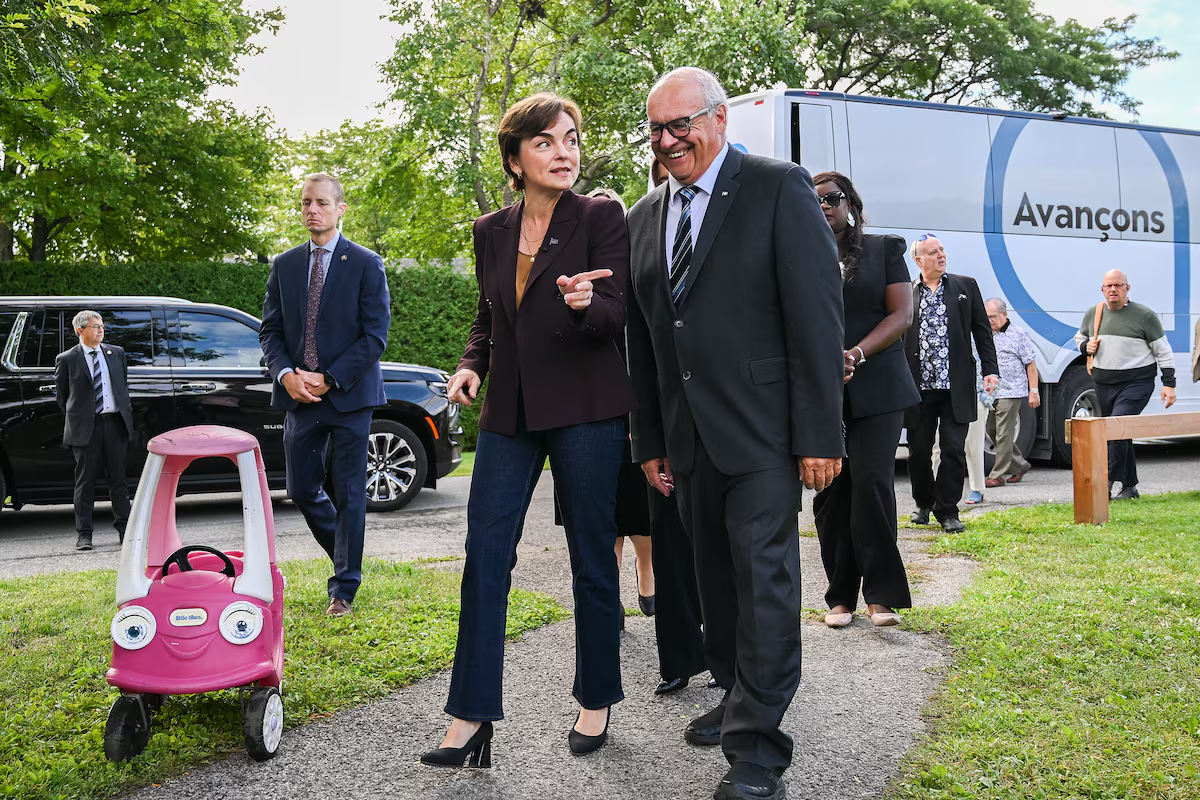

Open this photo in gallery:
Coalition Avenir Québec Leader Christine Frechette arrives for a daycare announcement alongside candidate Mario Laframboise during an election campaign stop in Lorraine, Que., on Saturday. Quebec votes in a provincial election on Oct. 5.Graham Hughes/The Canadian Press
With one month to go before Quebec’s provincial election, parties on Saturday pitched voters on health care, government spending and daycare, while their leaders also debated the prospect of another referendum on Quebec independence.
CAQ Leader Christine Fréchette promised to expand access to reduced-fee daycare, while accusing Parti Québécois Leader Paul St-Pierre Plamondon of hiding his commitment to hold a referendum.
Speaking at a news conference Saturday morning in Lorraine, north of Montreal, Fréchette claimed St-Pierre Plamondon avoided the word “referendum” at a major PQ campaign rally in Quebec City the previous night.
Opinion: Look to Quebec, not Alberta, to find the biggest threat to Canadian unity
“Yesterday, he gathered his supporters. Not once did he use the word referendum,” she said. “That’s hiding things from Quebecers.”
Fréchette also argued this is the worst time to hold a referendum, pointing to the trade conflict with the United States, and she also accused her rivals of not talking enough about U.S. President Donald Trump’s tariffs.
“We’re in an economic war with our main trading partner, and for the other parties, it’s as though it were a minor news story,” she said.
Open this photo in gallery:
Parti Quebecois Leader Paul St-Pierre Plamondon, flanked by candidates of the region, speaks at a news conference in front of the National Assembly, in Quebec City, on Saturday.Jacques Boissinot/The Canadian Press
However, St-Pierre Plamondon rejected Fréchette’s accusation he was avoiding referendum talk, saying he uses “popular consultation” and “referendum” interchangeably.
“I’ve used the word at times. I use popular consultation, referendum,” he told reporters in Quebec City. “Popular consultation and referendum mean exactly the same thing.”
Fréchette on Saturday also pledged 25,000 additional reduced-fee daycare spaces at a cost of $750-million over four years. But only 5,000 would be entirely new spaces.
PQ Leader accuses Ottawa of election interference to help Coalition Avenir Québec
Of the 25,000, 15,000 were part of previous commitments, while another 5,000 would come from converting existing unsubsidized spaces into subsidized ones.
The CAQ would also offer newly qualified daycare workers a $10,000 bonus if they commit to working for at least two years in a subsidized daycare or early childhood centre.
Open this photo in gallery:
Quebec Liberal Party Leader, Charles Milliard, visits a used bookstore during an election campaign stop in Levis, Que., on Saturday.Karoline Boucher/The Canadian Press
Liberal Leader Charles Milliard accused Fréchette of playing with the numbers during a campaign stop in Lévis, across the St. Lawrence River from Quebec City.
“This isn’t 25,000 new spaces being announced this morning. It’s a maximum of 5,000 spaces,” he told reporters.
The Parti Québécois, meanwhile, proposed a series of measures aimed at accountability at the highest levels of government, including freezing the salaries of legislature members, cabinet ministers and heads of Crown corporations until Quebec returns to a balanced budget, which the party expects in 2028-29.
Opinion: As Fréchette cozies up to Carney, the Quebec election is becoming a toss-up
The PQ would also require candidates selected to lead Crown corporations to appear before a legislative committee, set performance targets for their CEOs and review executive bonuses.
“We can’t ask the public and broader public sectors to go on a certain diet while we don’t set an example ourselves,” St-Pierre Plamondon said.
At a campaign stop in Chicoutimi, about 200 kilometres north of Quebec City, Québec solidaire co-spokesperson Ruba Ghazal proposed 400 primary-care access points inspired by Quebec’s CLSC community health centre model, at an estimated cost of $1.8-billion a year.
Open this photo in gallery:
Québec Solidaire spokesperson Ruba Ghazal speaks during a campaign stop in Montreal on Thursday.Christinne Muschi/The Canadian Press
The party would open 200 during a first mandate and another 200 during a second. Ghazal said the centres would make it easier for Quebecers to enter the health system and help relieve pressure on emergency rooms.
Conservative Leader Éric Duhaime, meanwhile, unveiled his party’s digital plan in Inverness, about 100 kilometres southwest of Quebec City, aimed at making nearly all Quebec government services available online.
His party says the plan would save $3.45-billion in administrative costs over five years. It also calls for reducing regulatory requirements by 30 per cent over four years and using artificial intelligence in government operations with human oversight.
“The Quebec government has to enter the 21st century, and quickly,” Duhaime said.