
Open this photo in gallery:
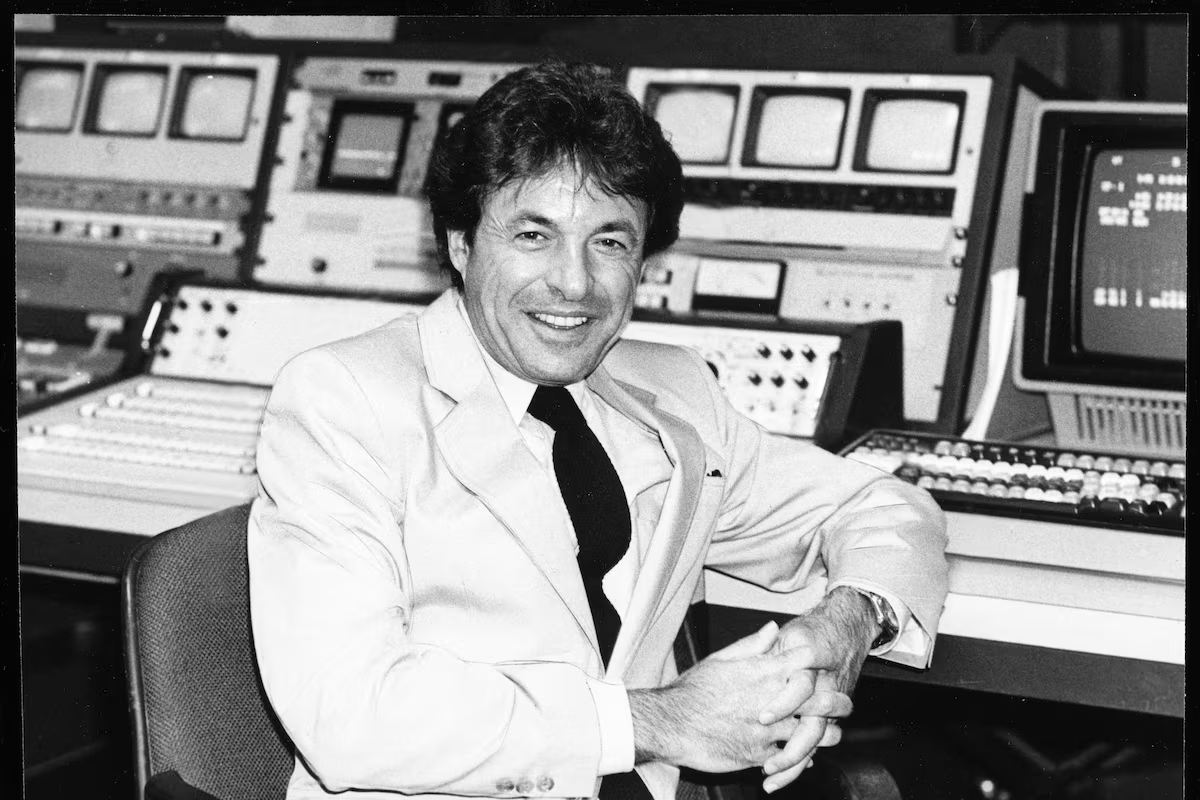
Producer Perry Rosemond died in Toronto on Aug. 20.JACK DOBSON/The Globe and Mail
In the mid-1950s, when Perry Rosemond was a student at the University of Manitoba, his interest in campus theatre was hurting his academic marks but winning such good reviews that director John Hirsch invited him to join the newly launched Manitoba Theatre Centre in 1958.
A year later at age 22, Mr. Rosemond hatched a new plan that ultimately changed his life.
“I would drop out of law school. I would go to join my Catholic actress girlfriend in Toronto, and I would become a huge television star,” he deadpanned to an audience of retired Toronto executives in 2018 before delivering his punchline. “Well, one can only imagine my Jewish parents’ surprise and delight. ‘Now why didn’t we think of that?’”
In 1959, he headed to Toronto with one of his Manitoba Theatre Centre castmates, 28-year-old Gordon Pinsent, a displaced Newfoundlander who was boarding at the Rosemond home while moonlighting as a dance instructor after a stint in the Canadian Army.
Canadian actor Tedde Moore was part of a family of outstanding creative artists
In Toronto, the pair rented rooms at a University of Toronto fraternity and launched their professional careers. Mr. Pinsent’s first part was as a corpse in a TV show after Mr. Rosemond was promoted from dead body to a two-line role and a new actor was needed for the slab.
But the friends’ acclaim on the stage in Winnipeg did not lead to easy success in Toronto, and Mr. Rosemond returned home alone to the Manitoba Theatre Centre a year later after credited roles in two CBC television series, Hudson’s Bay and General Motors’ Theatre. Unable to live off his acting, he took a job with Winnipeg’s CBC station as a television producer/director for $4,200 a year.
His duties included producing both Winnipeg metro news and a popular weekly country and western variety show called Red River Jamboree that was beamed across Canada. While the work schedule was gruelling, it proved to be good training for a career spent working on big-time variety programs and sitcoms.
Open this photo in gallery:
Mr. Rosemond and Knowlton Nash, longtime CBC foreign correspondent and host of The National, in the Air Farce studio.Air Farce Productions Inc.
Over the next 55 years, he worked with such stars as Dean Martin, Johnny Cash, Donny and Marie Osmond and David Steinberg, and gave breaks to dozens of gifted young comedians including Martin Short, John Candy, Howie Mandel and Mike Myers. Millions of Canadians regularly tuned into his 1970s hit series, King of Kensington, and, later, The Royal Canadian Air Farce, which ran on CBC-TV for 16 seasons. In 2003, he was named to the Order of Canada for his contribution to CBC television.
Mr. Rosemond died in Toronto on Aug. 20 at the age of 89.
Born Nov. 15, 1936, to Max and Mona (Magid) Rosemond in Winnipeg’s ethnically diverse North End neighbourhood, Perry Rosemond was raised in a bustling household shared with a dozen cousins, aunts and uncles.
His father’s family had immigrated from Russia and his mother’s came from Ukraine. The couple worked together in Winnipeg’s thriving garment trade. He used to joke that his parents were so poor when he was born that they couldn’t afford to give him a middle name.
As their business grew, the Rosemonds were able to send their only child to university. After earning a Bachelor of Arts degree, he dropped out of law school in his first year.
By the time CBC’s hugely popular Red River Jamboree ended in 1965, Mr. Rosemond was back in Toronto looking for work at CBC Television. His first success there was an innovative current affairs program hosted by teenagers called Through the Eyes of Tomorrow that ran from early 1966 to 1969. Topics included birth control, LSD, the Ku Klux Klan and John Lennon.
As King of Kensington turns 50, it shows the challenge of keeping classic Canadian TV in circulation
Busy as always, he served as executive director of Mr. Dressup in 1967 and, in 1968, produced Children of the World in co-operation with UNICEF, portraying humanitarian projects through the eyes of children in 11 different countries. An episode of that series, The Trumpet, won the UNICEF Prize at Japan’s prestigious educational broadcasting awards in 1968. In 1972, Mr. Rosemond became the first executive producer of the Canadian segments created for CBC’s edition of Sesame Street.
Despite being told by his agent, Sandy Werner, that “you won’t make a dime” with documentaries, Mr. Rosemond dabbled with news and documentary programs throughout his career. Between 1967 and 1969, he directed nine episodes of CBC’s Telescope biography series including a profile of his old friend Mr. Pinsent, who had stuck with acting and starred in Quentin Durgens, M.P. for four years, launching himself into Canadian stardom.
In that same period, Mr. Rosemond worked as a segment producer for CBC’s The Way It Is, where he collaborated with hosts Barbara Frum, Peter Desbarats and Patrick Watson. The big-budget Sunday night newsmagazine folded in 1969 after two seasons.
Open this photo in gallery:
Mr. Rosemond and Tom Jones.Courtesy of the Rosemond family
A decade later, he directed several episodes of PBS’s Steve Allen’s Meeting of Minds where four actors portraying important historical figures from different eras, such as Karl Marx and Catherine the Great, discussed current affairs. The program won an Emmy for outstanding informational series and several acting/writing nominations. Mr. Allen also won a personal Peabody Award.
Perhaps Mr. Rosemond’s best-loved series was a sitcom he created for his early theatre mentor Mr. Hirsch, who had become CBC’s head of drama in 1974. Both he and Mr. Hirsch knew Winnipeg’s North End well, so the multiethnicity and themes of King of Kensington were familiar territory.
Running from 1975 to 1980, the series starred Al Waxman who had grown up in Toronto’s Polish-Jewish community. To gain a wider audience, they set it in Toronto’s Kensington Market rather than Winnipeg. (Mr. Waxman and Mr. Rosemond already knew each other. They attended the same acting workshops in 1959 and appeared together on a General Motors Presents production of The Apprenticeship of Duddy Kravitz.)
Although Mr. Rosemond used to claim the show’s premiere “got the worst review in the history of TV Guide,” King of Kensington quickly became a Canadian television icon for its portrayal of Larry King, a well-meaning neighbourhood mensch who befriended everyone.
Fifteen years after it ended in 1980, The Globe and Mail’s John Haslett Cuff wrote, “King of Kensington was a traditional domestic comedy, exceptional only in that it was overtly Canadian, full of topical references and marked by a geographical and cultural specificity that was fresh and endearing to domestic viewers.”
Mr. Rosemond’s role as producer and occasional director of the series’ 111 episodes did not prevent him from taking on production jobs on other successful television productions. Constantly flying between Toronto and Los Angeles, he produced and directed ABC’s gala 50th anniversary special in 1979 that featured a range of the network’s stars from Tony Bennett to John Travolta, 24 episodes of The David Steinberg Show (the uber successful comic was another North Winnipeg alum), 19 episodes of Donny & Marie (1975 to 1979), and about half a dozen episodes of comedian Norm Crosby’s The Comedy Shop (1978 to 1980) that introduced many young standups to a large American audience.
Lloyd Robertson, former CTV News chief anchor, dies at 92
One of his proudest innovations was bringing live theatre to television. In 1983 he taped Cold Storage, a successful Broadway play starring Martin Balsam and Len Cariou, at Toronto’s Ryerson Theatre. When The Globe’s Rick Groen watched rehearsals, Mr. Rosemond explained, “The constant is that there has to remain some element of theatricality in the televised production. … As you can see, we’re groping with the genre.”
But the 47-year-old director still had his theatrical chops, and the production won him an ACE Award from the National Cable Television Association for “excellence in national performance and craft.” He proudly displayed the trophy in his living room for the rest of his life.
On one of his countless flights between Canada and L.A., he met Toronto-born realtor Nora Niddery who was unhappily stuck in the plane’s smoking section. His charming manner overcame Ms. Niddery’s aversion to his smouldering cigarette and the pair married in the early eighties. They moved back to Toronto in 1985 when Mr. Rosemond began a five-year stint as president of Molstar Productions, a sports and entertainment consortium led by brewer The Molson Companies Ltd.
Open this photo in gallery:
Nora Niddery, left, and Mr. Rosemond married in the early eighties.Courtesy of the Rosemond family
His most prominent program was Hockey Night in Canada to which he added the 26-year-old referee Ron MacLean as a level-headed counterbalance to the more abrasively flamboyant Don Cherry.
Ms. Rosemond remembers her husband’s love of sports, explaining with a laugh, “Perry liked anything that had a ball. … We were always right at the glass with the pucks smashing it.”
Even as a sports producer, Mr. Rosemond found time to dabble in comedy, launching the American sitcom Starting from Scratch with Connie Stevens in 1988, and then co-creating (and writing) a British spin-off, Close to Home, the following year. He also found time to sit in at Mark Breslin’s crowded and smoke-filled Toronto comedy club, YukYuk’s.
“It was pretty hard to be involved in comedy and not know Perry Rosemond,” says Mr. Breslin, who expanded his original 1976 Church Street cellar into a national comedy club franchise. “He was a legend. … He was one of the greatest variety producers in the golden age of TV.”
Mr. Rosemond was particularly fascinated by the young comic actors on stage at Second City. In 1979, he produced a failed pilot for the Second City Comedy Show with host John Candy. Mr. Candy, along with Martin Short and Andrea Martin, also made appearances on episodes of The Comedy Shop and The David Steinberg Show. As well, Ms. Martin, Eugene Levy and Mike Myers appeared in King of Kensington, and in the early 90s, Mr. Rosemond directed SCTV cast member Joe Flaherty in 15 episodes of Maniac Mansion.
Mr. Rosemond’s greatest comedy challenge was the adaptation of CBC’s beloved 20-year-old radio program, Royal Canadian Air Farce, for television. A New Year’s Eve TV special in 1992 proved that he could work with the tight-knit, four-person troupe and the show was launched in fall 1993, running for 15 years with Mr. Rosemond at the helm. Its weekly audience never fell below one million viewers.
Andrew Coyne: The cozy world of Hockey Night in Canada and the CBC hasn’t existed for some time
“He faced the challenge of coming into a tight group,” founding member Don Ferguson recalls. “We trusted him and he later said it was the best gig of his career.
“He was good at analyzing the script and had a fabulous eye for the core of comedy. His laughter was genuine.”
Calvin, Mr. Rosemond’s second son, born in 1991 in Toronto, appeared on stage with the cast in Grade 2 and later became a grip and worked in catering. “No one knew we were related but I never heard a negative word. Everyone just admired him. … They said he was the best director they ever worked with,” he says.
Mr. Rosemond and his earlier wife Annie Rosemond had a son, Michael, born in 1971 in L.A. Mr. Rosemond leaves his wife, Nora; his two sons (both lawyers); and a grandson, Maxwell.
You can find more obituaries from The Globe and Mail here.
To submit a memory about someone we have recently profiled on the Obituaries page, e-mail us at obit@globeandmail.com.