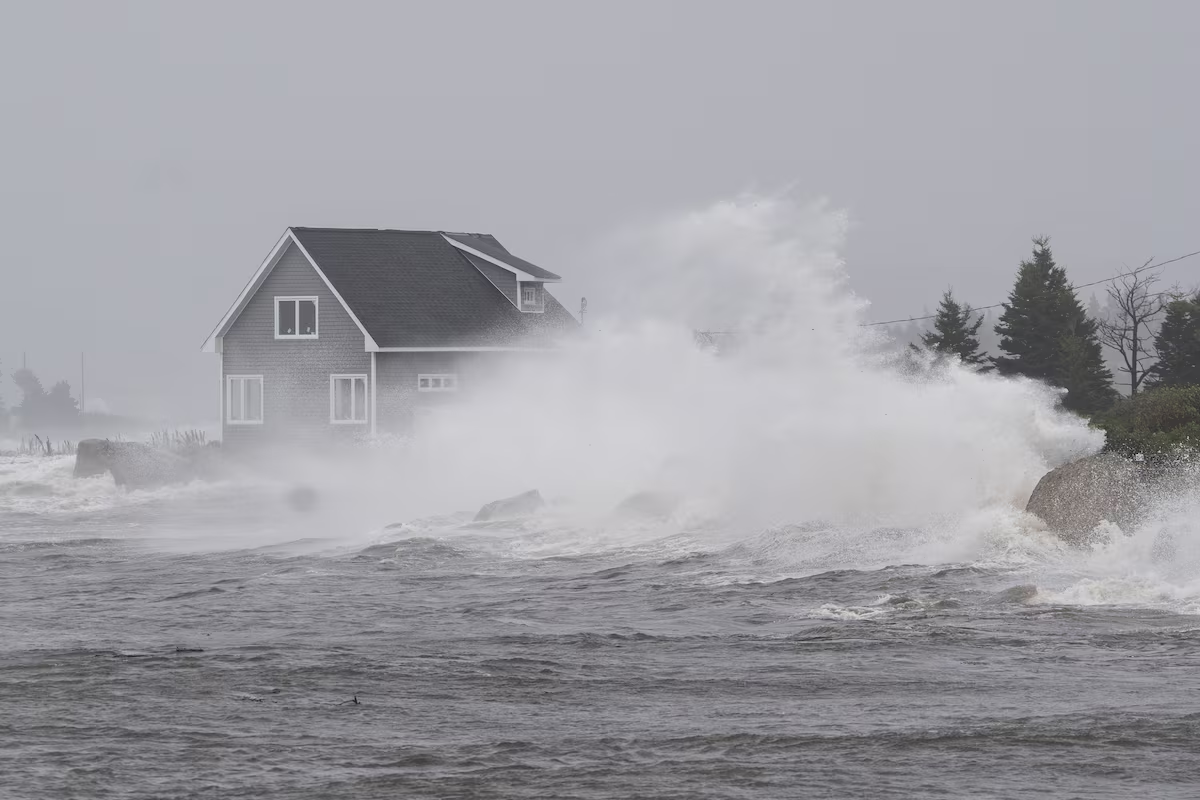

Open this photo in gallery:
Storm surge causes large waves to crash in front of a home near Indian Harbour, N.S.Darren Calabrese/The Globe and Mail
Canadians are feeling the effects of climate change to a greater degree and facing more serious consequences than federal scientists projected less than a decade ago.
That’s the message in a comprehensive federal report released on Thursday. It details how climate change is physically transforming the country and how those trends are likely to become more pronounced in the future, from floods, wildfires and heat waves to vanishing glaciers and permafrost.
A striking feature of the report is the high degree of certainty that ties so many diverse effects to fossil-fuel emissions as the primary driver of climate change.
“Warming temperatures have driven wide-ranging, interconnected, and sustained changes across Canada,” the report notes unequivocally in one of its headline statements.
Running nearly 1,500 pages, Canada’s Changing Climate Report 2026 is the country’s definitive statement on the physical state of the climate. Only the second such document ever issued by the federal government, it is the product of more than 100 experts working over a three-year period.
But unlike its predecessor, whose release in 2019 was widely publicized and accompanied by minister-led press conferences and technical briefings to help the public grasp its implications, the second edition was quietly posted online ahead of a late-summer holiday weekend.
The report arrives at a sharply different political moment. In late June, Prime Minister Mark Carney conceded Canada will not meet its 2030 greenhouse-gas emissions targets.
A statement from Environment Minister Julie Dabrusin’s office did not address the report’s findings. It said the government is committed to reaching net zero by 2050 through “a pragmatic and durable approach,” citing clean-energy investments, $2.1-billion committed to the National Adaptation Strategy and a new goal of $13-billion in international climate finance over five years.
The minister was not available for an interview.
Even so, the report requires little interpretation: Much of what was anticipated in 2019 has now come to pass, plus more that was not yet on climate scientists’ radar then.
Open this photo in gallery:
Prime Minister Mark Carney and Environment and Climate Change Minister Julie Dabrusin arrive to take part in an announcement in Wakefield, Que., in March.Sean Kilpatrick/The Canadian Press
Canada has warmed about two degrees since 1948 and Northern Canada about 2.6 degrees. Since 1970, the country has warmed nearly twice as fast as the global average, and the Canadian Arctic three times as fast. Precipitation is up 9.7 per cent nationally since 1949, and 18.9 per cent in the North. Human influence, the report finds, is the only explanation for the collective changes observed.
“We have fundamentally altered our climate system, and even if we do succeed at limiting warming to a certain threshold, there are parts of our environment that will continue to change,” said Chris Derksen, director of the Climate Modelling Research Division at Environment and Climate Change Canada.
Some of the changes are fixed: Sea level rise, glacier melt and permafrost thaw will continue even if temperatures stabilize. Western Canada’s glaciers will largely disappear by the end of this century. Other changes are a choice. Under current global policies, Canada warms five degrees above preindustrial levels by century’s end. Under a scenario with no climate policies, warming reaches 6.9 degrees and the area burned by wildfire climbs 287 per cent. Under net zero, warming stabilizes after 2050 and reaches 3.5 degrees.
Extremes are where warming is already being felt, and the rarer the event, the more it changes: A once-in-50-years heat extreme occurs nearly four times as often at two degrees of global warming. Droughts and flash floods will become more frequent and severe. Fire seasons are already longer.
“Every increment of warming will cost us more in damages,” Dr. Derksen said. “It will cost us more to adapt to those changes.”
And on comparable scenarios, the warming now projected for Canada is greater than the last assessment estimated.
Open this photo in gallery:
Wildfire smoke fills the sky as vehicles drive on the Princeton-Kamloops Hwy between Princeton and Merritt, B.C., in August.Paige Taylor White/Reuters
This week, a United Nations Environment Programme report concluded the world will cross 1.5 degrees of warming within the next few years – the tougher of the two limits nearly 200 countries, including Canada, set in Paris a decade ago.
If the 2019 edition made the predictions, then the 2026 report provides the receipts. The inaugural report warned of more intense heat, heavier rain, deeper drought and worsening fire risk. Canada then experienced the 2021 B.C. heat dome, the floods that levelled the province’s highways that November, years of drought on the Prairies and the record 2023 fire season. The current edition puts those risks in plainer language – heat extremes, flooding, drought, fire weather – and adds marine heat waves.
Summer sea surface temperatures have risen everywhere in Canada, but most sharply in Atlantic Canada and Hudson Bay, by as much as 2.5 degrees. Off Nova Scotia, marine heat wave conditions have persisted more than 100 days annually on the Scotian Shelf almost every year since 2012. The ocean is also acidifying and losing oxygen below the surface.
The report is clear that Canadians are stuck with some of these changes, said Sabine Dietz, executive director of CLIMAtlantic, one of five regional climate service providers. However, she said, “every point of a degree that we can bring the temperature back down or we can reduce the increase, we will benefit from it.”
Christina Caron and Glen Hodgson: Not addressing climate change costs the economy more. When will we finally get this?
That Canada can see these changes coming at all is a function of its own capacity. Dr. Derksen said his department runs one of roughly 15 Earth system models in the world.
And while much of what Canadians can expect from the climate over the next 10 to 20 years is largely a given because of past choices, the scenarios diverge more widely when projected further into the future.
“We made a lot of effort to show that end-of-century climate changes are still very much dependent on political decisions that are made now,” said Damon Matthews, a professor and climate scientist at Concordia University in Montreal who was co-lead author on the chapter of the report that deals with future projections.
Similar to the UN Intergovernmental Panel on Climate Change physical science volume, the report describes the changes under way and what the models project, but stops short of prescribing what to do about them.
“The big question is, so what? So what do we do with this?” said Alain Bourque, head of Ouranos, the Quebec climate services consortium whose scientists contributed to the assessment.
Purple haze: Heat waves threaten lavender fields in France
That question is also the agenda of Adaptation Canada 2026, a national conference in Toronto later this month where the report’s authors will meet practitioners.
For Mr. Bourque, the answer must involve policies that drive toward carbon neutrality. Short of that, the report lays a foundation for those seeking to understand the effects on individuals and communities.
“Canadians and Ontarians must prepare for a hotter future and act now to avoid the worst impacts,” said Ewa Jackson, director of the Ontario Resource Centre for Climate Adaptation.
“Ultimately, warming in Canada will stop only when global emissions reach net zero,” said Sherilee Harper, a professor and Canada Research Chair in climate change and health at the University of Alberta. “Until then, every fraction of a degree we avoid will quite literally save lives.”