
Open this photo in gallery:
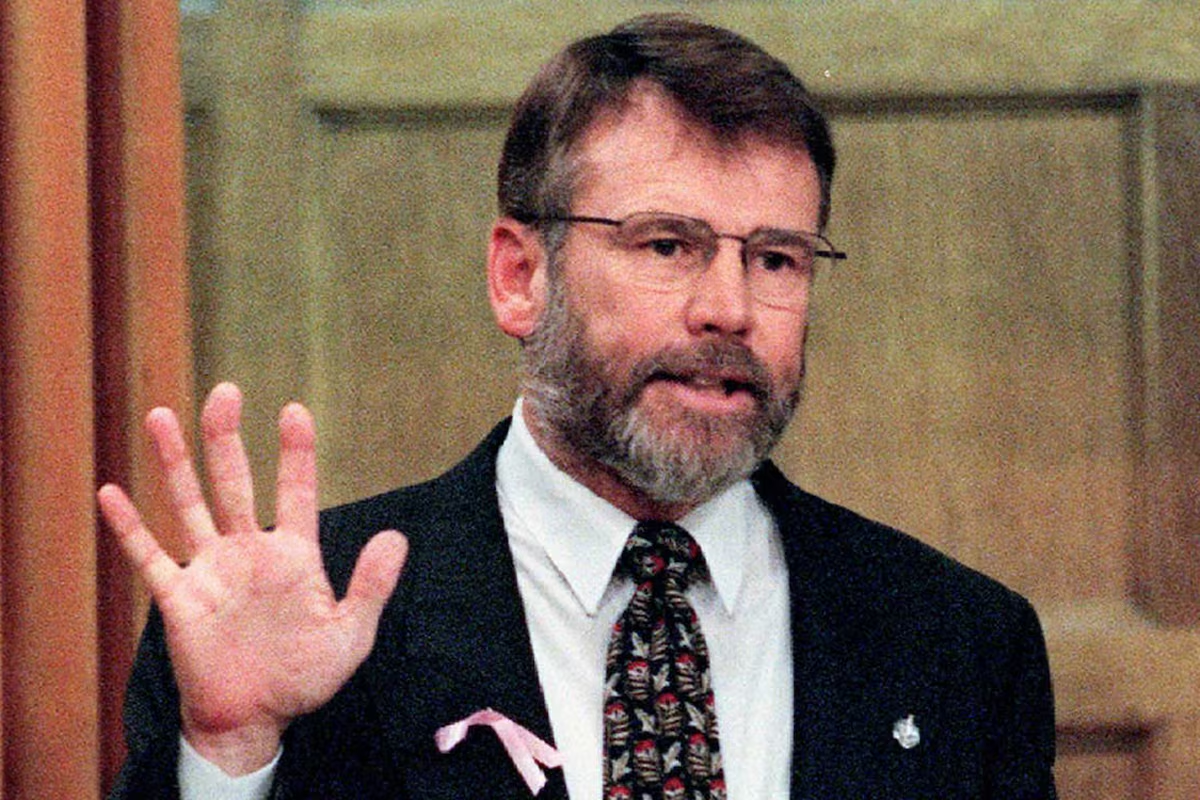
New Democratic Party MP Dick Proctor during Question Period in Ottawa in 1998.Tom Hanson/The Canadian Press
A chatty traveller bending the ear of his seatmate on a flight caught the attention of a man sitting across the aisle.
The prolix passenger was Andy Scott, the federal solicitor-general, who maintained an apparently voluble conversation with his seatmate about matters of public interest.
The nearby eavesdropper was former reporter Dick Proctor, an NDP member of Parliament, who furiously scribbled verbatim notes from a conversation he could scarcely believe.
He would use the notes to challenge the minister during Question Period, accusing him of having prejudged the outcome of an inquiry into security at an Asian Pacific Economic Cooperation (APEC) summit in Vancouver in 1997. Mr. Scott categorically denied having done so. Furious Liberals decried the ethics of sharing the contents of an overheard conversation. Mr. Scott, who at first denied being able to remember even the gender of his seatmate on the flight, questioned Mr. Proctor’s veracity.
In the end, Mr. Proctor, who has died at 85, was vindicated when the resulting furor led to Mr. Scott’s resignation from cabinet eight weeks after the flight.
What happened on Air Canada Flight 8876 from Ottawa to Fredericton on Oct. 1, 1998, would be settled when the seatmate, Frederick Toole, a well-regarded New Brunswick lawyer, swore an affidavit for the RCMP’s Public Complaints Commission into APEC security.
As it turned out, Mr. Toole was a fellow Liberal and an acquaintance of about 15 years when they were seated together on the flight. He had told the solicitor-general he had seen disturbing images during an APEC protest of an older RCMP officer, who turned out to be RCMP Staff-Sergeant Hugh Stewart, using pepper spray on peaceful protestors.
“To this, Mr. Scott said, ‘Oh, Hughie,’ or ‘Oh, you mean Hughie,’ and commented to the effect that ‘Hughie’ might have to take ‘a,’ or ‘the,’ ‘hit’ or ‘fall’ for that,” Mr. Toole stated in his affidavit.
Mr. Proctor also overheard the two men discuss the RCMP’s investigation of the sale of Airbus airplanes to Air Canada in 1988. He said he overheard Mr. Scott describe former Newfoundland premier Frank Moores as being “crooked as a snake.”
Both Mr. Scott and prime minister Jean Chrétien accused Mr. Proctor of fabricating the story.
Open this photo in gallery:
Former prime minister Jean Chrétien delivers remarks during a keynote address in Ottawa in 2023.Spencer Colby/The Canadian Press
Outside the House, Mr. Proctor declared Mr. Scott to be a liar, goading him into launching a defamation suit so the matter could be settled under oath.
Meanwhile, various privacy and government experts weighed in, most saying it was unacceptable for a minister to be so indiscreet as to be overheard in the first place.
When he resigned, Mr. Scott told a news conference that his inflight conversation “made me vulnerable to accusations that I had prejudged the outcome” of the inquiry. He also insisted he could not remember his seatmate though “it may seem hard to believe.” Mr. Scott was reappointed to cabinet six years later in a different portfolio by prime minister Paul Martin.
Mr. Proctor had a long career as a journalist, union organizer and strategist and aide to such NDP luminaries as federal leaders Ed Broadbent and Jack Layton, Saskatchewan premier Allan Blakeney and Ontario opposition leader Stephen Lewis. He liked to joke that he wrote speeches for Mr. Lewis, widely regarded as the greatest orator of his generation, before adding a knowing “nobody writes Stephen’s speeches.”
Mr. Proctor also worked as a publicist for the Canadian Union of Public Employees and as a researcher for the National Union of Public and General Employees. He was based for several years in Cuernavaca, Mexico, where he ran a Canadian Labour Congress project to assist independent trade unions throughout Latin and South America.
After the NDP took a drubbing in the 1993 federal election, he decided to contest a seat for the party in the next federal election. He defeated seven other contenders to win the party’s nomination for Palliser, a new riding encompassing Moose Jaw and part of Regina. “Dick Proctor is moving from the shadows to the limelight,” the Regina Leader-Post reported.
He then defeated Alene Tanner of Reform and controversial lawyer Tony Merchant of the Liberals in the 1997 general election even while acknowledging “I’m not a household name.” He won re-election three years later before losing the seat in 2004 by 132 votes to Dave Batters of the Conservatives.
While in the House, Mr. Proctor served as his party’s critic for labour and agriculture.
Years later, he acknowledged a preference for the backroom.
“Public speaking is something I have never really been enamoured with,” he once said. “I have preferred to be the one loading the gun rather than pulling the trigger.”
John Richard Proctor was born in Toronto on Feb. 12, 1941, to the former Jacqueline Adele Jolly, known as Jackie, a cashier at the time of her marriage, and Clement Hudgin Proctor, an assistant superintendent with North York Hydro in the township’s Willowdale neighbourhood. (The elder Mr. Proctor died suddenly at the age of 59 in 1969 when accidentally electrocuted while installing a fuse box at a factory in Whitby, Ont.)
When the boy was 10, the family moved to a dairy farm in Prince Edward County, where Dick handled farm chores, joined the local 4-H club and attended classes in a one-room schoolhouse. He was high-school quarterback and part of a record-setting 440-yard relay team. In winter, he was a top goal-scoring forward for area hockey teams, including the Wellington Juvenile Dukes and the junior Picton Merchants.
Open this photo in gallery:
Mr. Proctor recovering in his Regina home from minor injuries he sustained after the motorcycle he was driving hit a rough patch of highway in 1998.The Canadian Press
Mr. Proctor studied journalism at Carleton University in Ottawa, playing hockey for the varsity Ravens. He also contributed to the student newspaper. During his tenure as news editor, he published an unsolicited opinion article written by the school’s interdenominational chaplain suggesting sex out of wedlock was not necessarily sinful. The article included the sentence: “If premarital sexual intercourse is all right in Samoa it can’t be so bad in Ottawa.” The subsequent controversy landed on the front page of the city’s two dailies.
Mr. Proctor then worked for the Edmonton Journal in the summer of 1965 before becoming a sports reporter for the Toronto Telegram the following year after graduating with a journalism degree. He eventually became the newspaper’s Action Line columnist, handling thousands of requests and complaints as a readers’ ombudsman who promoted tenant’s rights and advised on such matters as the proper way to register a purebred dog.
As a sports reporter for The Globe and Mail for four years, Mr. Proctor’s assignments included junior hockey, football’s Toronto Argonauts and the Indianapolis 500 car race.
In 1977, he travelled to Moscow with the Don Mills Flyers, a team of teenagers whose roster included future Hockey Hall of Fame defenceman Larry Murphy. While overseas, he filed stories about players and their parents likely violating Soviet currency laws by trading rubles on the black market and selling blue jeans, T-shirts and other clothes to local teenagers. He noted a set of a jean jacket, pants and coveralls sold for 220 rubles, almost five times as much as the spending money the Soviets had gifted each player as spending money for the entire tour.
“Not only are such transactions illegal,” he wrote, “but that represents far more money than most players declared when they cleared Soviet Union customs last week.”
Years later, Jim Bronskill of Southam News reported the Canadian embassy in Moscow spied on Mr. Proctor during that Cold War exhibition tournament, obtaining a copy of his Globe article after he sent it to the Reuters news agency in London for transmission to Canada.
“You always think it was the other guys that were doing all the spying, and we weren’t,” Mr. Proctor told Mr. Bronskill in 1999. “But I guess two can play the same game.”
Mr. Proctor also contributed articles to the Hockey News, circumventing a Globe ban on freelancing by using the pseudonymous byline Mike Gamble, thus making his bylines Proctor and Gamble after the prominent consumer goods company.
He retired to Victoria in 2005. He died there on Aug. 13 about six weeks after getting a diagnosis of cancer. He leaves his second wife Merran (née Moreau), a former deputy labour minister in Saskatchewan, whom he married in 1986. He also leaves a son and a daughter from their marriage, as well as a son and three daughters she brought to their union; six grandchildren; four great-grandchildren and a brother and a sister. An earlier marriage for Mr. Proctor ended in divorce without children.
Oddly enough, Mr. Proctor had an earlier instance of noteworthy airplane eavesdropping many years prior to overhearing Mr. Scott’s conversation.
“I sat on an airplane flying from Ottawa to Toronto once and I heard two insurance guys talking about a rate increase they were going to be suggesting to a company in North Gower, which is just outside Ottawa,” he told Anne McIlroy of the Globe in 1998. “And one of them made the point that they were going to demand x as the rate, but would settle for y.
“When I got off the plane I phoned the company and I told them I had heard this.”
You can find more obituaries from The Globe and Mail here.
To submit a memory about someone we have recently profiled on the Obituaries page, e-mail us at obit@globeandmail.com.