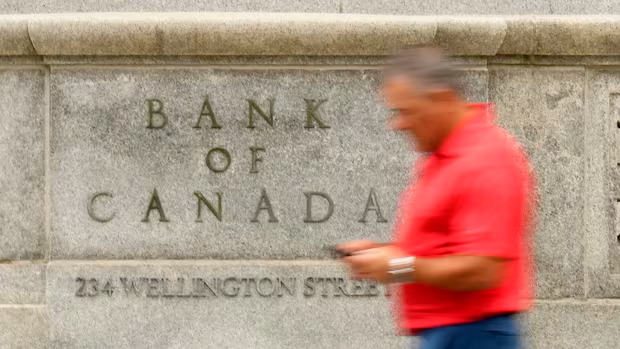
Bank of Canada Governor Tiff Macklem says inflation risk is on the rise, with higher energy costs topping Canada’s incoming dollar-for-dollar tariffs on U.S. goods as the biggest potential driver of rising prices for consumers and businesses.
Macklem’s remarks on Wednesday came after Canada’s central bank held its benchmark interest rate steady at 2.25 per cent, as widely expected by economists. The central bank lowered its policy rate to its current level in October of last year. This latest announcement marks seven consecutive times it has left its trend-setting policy rate unchanged.
“The counter-tariffs, and indeed the U.S. tariffs … will add costs for some businesses,” Macklem told reporters in Ottawa. “These tariffs are very steep, but they are applied to a relatively narrow base.”
The bigger issue, he said, is the war in the Middle East.
“The conflict has re-escalated. Oil prices are back up,” Macklem said. “The longer that drags on, the bigger the risk that it starts to spill over to the prices of other goods and services.”
In its decision, the bank said recent data confirms its prediction for a “broadening recovery” in the economy. However, policymakers also said the war and U.S. tariffs raise the risk of higher inflation.
U.S. benchmark oil prices have soared about 13 per cent since the bank’s last announcement in July. The U.S.-led war in Iran has intensified in recent weeks, resulting in slower tanker traffic through the Strait of Hormuz, a critical maritime passageway for oil to reach global markets.
WATCH | Inflationary impact of counter-tariffs expected to be ‘relatively modest’:
Inflationary impact of counter-tariffs expected to be ‘relatively modest’: Bank of Canada governor
Bank of Canada governor Tiff Macklem says the central bank will update its estimates, but as of now officials assess the ‘inflationary impact of those counter-tariffs is fairly modest,’ adding that the situation in the Middle East remains the ‘bigger issue’ for inflation.
At the same time, the Canada-U.S. trade war has escalated significantly since the bank’s prior meeting in July.
Last month, U.S. President Donald Trump imposed 50 per cent tariffs on about $28 billion worth of Canadian products. Starting Tuesday, Canada will match those levies with dollar-for-dollar tariffs on $27.6 billion of comparable U.S. goods.
Last week, the federal government rolled out a $7.5-billion expanded economic relief program for impacted workers and businesses. The new supports are on top of the nearly $25 billion in tariff support it implemented over the past 18 months.
Inflation is ‘too high’: Macklem
Canada’s inflation rate rose to three per cent in July, as hostilities in the Middle East trickled through to Canadian gas pumps.
“That’s too high,” Macklem said, noting the bank’s primary goal of achieving two per cent inflation. “It’s very concentrated in gasoline, in oil prices, which are a direct effect of the conflict in Iran.”
Derek Holt, vice president and head of capital markets economics at Scotiabank, says Macklem has put a lot of weight on the bank’s next set of economic forecasts due in October.
“There is a lot more information to digest between now and Oct. 28, such as data on inflation and jobs and GDP, plus energy market and trade developments, but the BoC very clearly cracked open the door by enough to increase flexibility to tighten as soon as the next meeting if everything co-operates,” Holt said in a research note.
He predicts 75 basis points worth of rate hikes starting in the fourth quarter of 2026.
‘Uncertainties over trade’
CIBC chief economist Avery Shenfeld said Wednesday’s hold was no surprise “amidst the fog of a trade war.”
“Newly heightened uncertainty over trade relations clouds that picture too much to be definitive about what lies ahead,” Shenfeld wrote in a research note published after the decision.
“The bank did judge that the direct impact of the latest tariff round would not be large, but cited the uncertainties over trade as being a further drag,” he added.
“It didn’t mention the downside implications of a failure to lower the existing tariffs on autos, metals and lumber that most economic projections were assuming would take place.”
Shenfeld says he sees little prospect for a rate change in either direction in 2026, noting both the oil and trade war situations could shift significantly in the months ahead.
What’s happening in the bond market?
While Canada’s central bank has direct control over short-term borrowing costs, longer term rates are set in the bond market. In the U.S., treasury yields have soared to multi-year highs as investors demand more compensation, due in part to expectations for the U.S. Federal Reserve to raise its short-term benchmark rate.
“We are seeing some spillover of global bond yields into Canada,” Macklem said on Wednesday, noting Canada’s yield curve sits well below yields on U.S. treasuries.
“I think it’s important to distinguish between volatility and dysfunction or instability when prices and yields are moving, because investors are repricing risk,” Bank of Canada Senior Deputy Governor Carolyn Rogers told reporters.
“The vulnerability that we have talked about in our previous financial stability reports really comes when you get leveraged investors unwinding their positions quickly, and liquidity starts to dry up,” she added. “That’s the risk we worry about. We don’t see that happening right now.”
The benchmark 10-year Government of Canada bond yield increased above basis points to 3.80 per cent on Wednesday, reaching its highest level in over two years.
A Reuters poll of economists taken on Aug. 22 found all 35 participants expected policymakers to leave the bank’s key rate in place on Wednesday. The Bank of Canada’s next rate announcement is scheduled for Oct. 28.