
Listen to this article
Estimated 2 minutes
The audio version of this article is generated by AI-based technology. Mispronunciations can occur. We are working with our partners to continually review and improve the results.
In the latest push of its Buy Canadian Policy, the federal government is spending more than $4.7 billion for Via Rail to acquire and maintain 313 new passenger rail cars from Alstom Canada.
This will be the first time in four decades that Via Rail passenger cars will be built entirely in Canada. Much of its existing fleet was built in the United States.
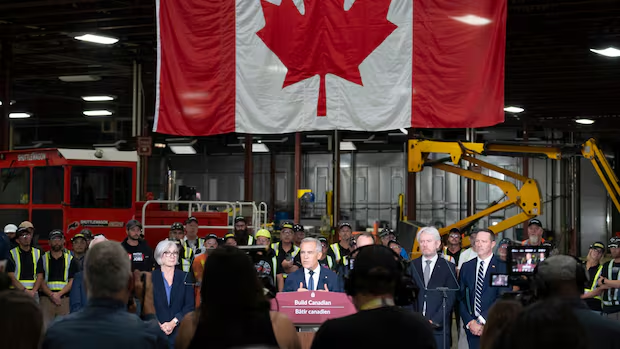
“They’ll be Canadian electricians that install the wiring, Canadian machinists that will make the precision parts, Canadian welders will build the steel frames from Canadian carbon steel,” Carney said at the Alstom Plant in Thunder Bay, Ont., on Thursday morning.
“That work reaches well beyond the factory floor into communities across our country.”
These cars will be manufactured and assembled in Thunder Bay and La Pocatière, Que., with design and engineering work taking place in Saint-Bruno-de-Montarville, Que.
The government projects the project could generate more than $1.6 billion for the economy and support nearly 700 jobs across Ontario and Quebec.
 Prime Minister Mark Carney speaks at the Alstom Plant in Thunder Bay, Ont. on Sept. 3 after announcing a $4.7 billion contract to build 313 new passenger cars for Via Rail. (David Jackson/The Canadian Press)
“We’ve announced the contract of the decade,” said Michael Keroullé, president and CEO of Alstom Americas.
“This is actually kind of the first time we get the opportunity to work with the national railroad, with Via Rail. But more importantly, we are replacing cars that are now 70 years of age, very old, long overdue in terms of replacement.”
The announcement comes on the heels of another big project underway at the plant, which will handle the final assembly of new subway cars for the Toronto Transit Commission (TTC) — each of which will include 55 per cent Canadian content.
More to come.