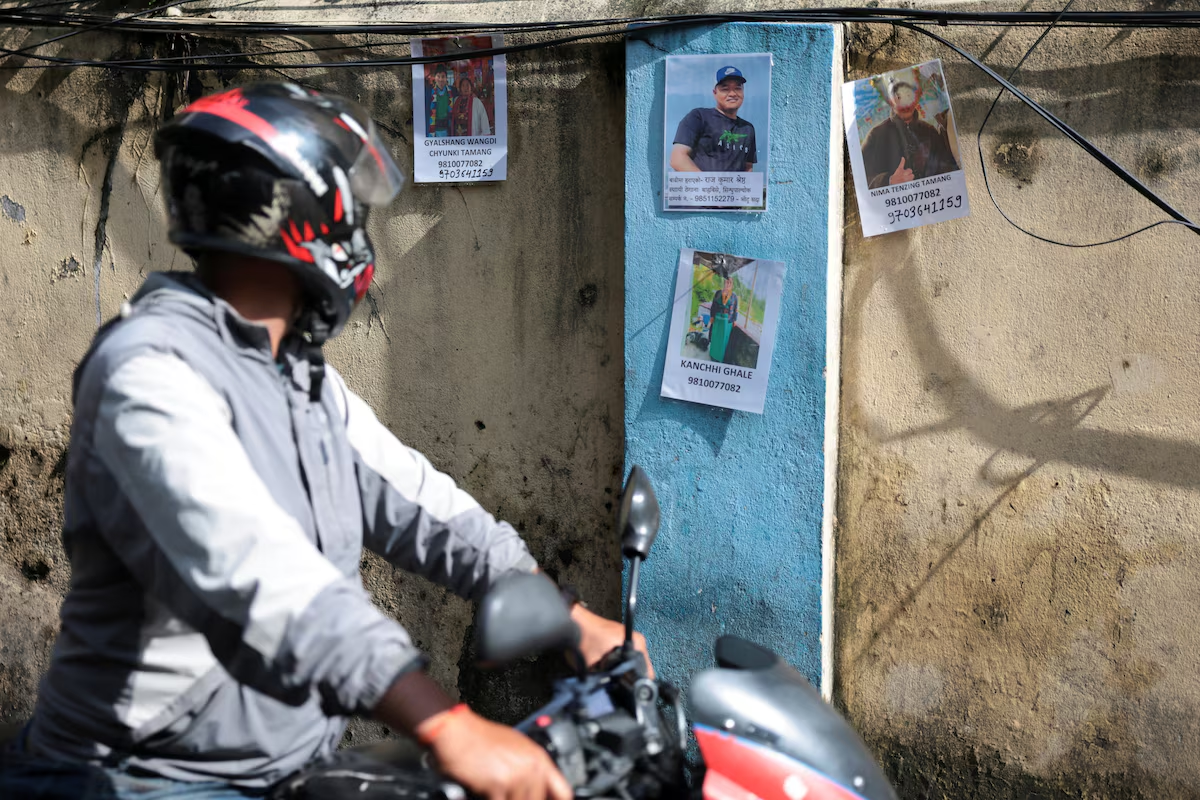

Open this photo in gallery:
A man looks at pictures of missing people following flash floods and a mudslide, at the Trauma Center in Kathmandu, Nepal, Friday.Athit Perawongmetha/Reuters
It was supposed to be a happy day for the Patel family.
Wednesday was Ishan Patel’s thirty-second birthday and his family had filled their group chat with celebratory messages. He was on a trip to the Himalayas with his mother Shilpa, his father-in-law Umeshkumar, and wife Akanksha, who’d all sent him birthday wishes at around 8:22 a.m. His sister-in-law, Mukti Patel, had watched the messages come pinging in from afar in Richmond, Virginia, and sent her own as well.
Less than 15 minutes later, at about 8:40 a.m., a flash flood swept through the area where the family had been staying in northern Nepal. All four are Canadian citizens living in the United States and are currently missing.
A massive glacial collapse triggered the flash flooding early on Wednesday in Nepal’s remote mountainous region that borders Tibet. It caused a torrent of rock, ice, mud and debris to cascade downriver, sweeping through bridges and vehicles and pulverizing many buildings.
The news has left Ms. Patel struggling to understand what happened, and desperate for information about whether her family is alive.
“My family is, they’re my greatest blessing. They’re the best thing that’s ever happened to me. They’re the best part of my life,” Ms. Patel said.
Open this photo in gallery:
An aerial view shows debris and mud covering an area following flash floods on Friday in DevGhat village, Nepal.Ritesh Shukla/Getty Images
On Friday, Foreign Affairs Minister Anita Anand said at least 32 Canadians and permanent residents remain missing.
Religious pilgrims from Canada at building swept away in Tibet-Nepal border floods
Nepalese authorities have confirmed 579 people were killed because of the catastrophe. A total of 1,924 individuals remain missing, of which 517 are foreign nationals, Ms. Anand told reporters on Friday. No Canadians have been identified among those confirmed dead, she said.
Canada sent five consular officials who have arrived in the region to support Canadians, Ms. Anand said. “We are ready to send more officials as required,” she said.
Speaking alongside the minister, Randeep Sarai, the secretary of state for international development, said Canada is allocating $5-million toward emergency relief and humanitarian assistance in Nepal.
The new funding will be provided through non-governmental organizations, such as the Red Cross, to “deliver life-saving assistance to those who need it most,” Mr. Sarai said.
“We have also offered to deploy relief supplies from emergency stockpiles by the Canadian Red Cross, should they be requested.”
On the ground, the situation remains dangerous. A massive lake that formed because of the flood began to overflow on Friday, halting rescue work and threatening a second catastrophe in the remote Himalayas, local authorities warned. Rainfall and water flowing downhill could potentially prompt further landslides and flooding, the authorities stated.
China’s Ministry of Water Resources said Thursday the lake held around two million cubic metres (70 million cubic feet) of water and was expected to receive another three million cubic metres (106 million cubic feet) from ongoing rain and water flowing downhill over the next three days. (China considers Tibet to be part of its territory.)
Fears of second catastrophe in Nepal and Tibet as lake formed by flood overflows
Residents fled uphill Friday afternoon amid fears the lake would burst its banks, potentially prompting further landslides and flooding, while rescuers on both sides of the border halted work. Work resumed hours later, however, with China’s state broadcaster reporting flood risk from the lake was deemed “manageable.”
Shanti Mahat, spokesperson for Nepal’s disaster management authority, urged all those in the area, including relief workers, “to exercise high alertness and immediately move to a safe place if they see any risk.”
Rescuers have pulled survivors caked in dark mud and helicopters lifted stranded people to safety after catastrophic floods on the Nepal-China border.
The Associated Press
Earlier, Nepalese rescue teams used helicopters to search for survivors and drop emergency supplies to thousands cut off in towns and valleys, while emergency services – some using sniffer dogs – recovered dozens of bodies swept down into the plains.
The Nepal Tourism Board said 121 foreign nationals have so far been rescued in the affected regions. No Canadians were among those rescued, it said.
Dibga Tamang was among the last people rescued from Rasuwa, near the epicentre of the disaster on Thursday, airlifted along with three others to a nearby army camp.
“All of our people have gone. They are dead,” Ms. Tamang said. “I have no one left waiting for me. Everything and everyone is gone. The end.”
While offers of assistance are pouring in, Nepal has said it does not need help from other nations in search and rescue missions.
“The offer for help is natural. Our security agencies are doing the search and rescue operation. For now we don’t require such help,” foreign ministry spokesperson Lok Bahadur Chhetri said Friday.
Meanwhile, the families of missing Canadians remain desperate for information about their loved ones.
Seema Rawla, who lives in Toronto, and whose brother and sister-in-law Shubhakshi Rawla and Sumit Rawla are among those missing on the Nepalese side of the border, said she tried hiring a private helicopter company to fly near the area since there has been no communication from people in the area or with people from the government. She said the helicopter pilot refused their request because he would not be able to land in the area.
The lack of information about the fate of the missing Canadians has been frustrating for their relatives and friends, especially for those whose loved ones were caught by the flood on the Tibet side of the border. While Nepal has published the names of the missing and those of the people safely rescued, Chinese authorities have released few details.
Open this photo in gallery:
Residents salvage belongings from their destroyed home following flash floods on Friday in Devighat, Nepal.Ezra Acayan/Getty Images
Families have resorted to posting public appeals on social media, looking at lists of missing and rescued victims, sharing contact numbers for local hospitals and searching for ways to geolocate mobile phones.
On Thursday Mukti Patel said she was still waiting for any information about the fate of her family. She said her father, who works in non-emergency medical transport, is an active member of the religious community, often making decorations for his temple. Her sister, a psychiatrist, is an active community leader in professional settings and led youth assemblies at her local temple.
Ms. Patel said her family was shopping for a kind of pearl that was a part of her mother’s and sister’s wedding outfits.
“They had bought several strands, and my dad and sister told me they got a surprise for me,” she said. “They had bought something. They wouldn’t tell me what it is, but they were really excited about it.”
Ms. Patel said she was calling on the Canadian government to provide resources for search and rescue efforts in Nepal and provide a clear channel for communication on updates.
Prior to the catastrophe, Ms. Anand said at least 866 Canadians were registered in Nepal and more than 10,000 in China by Global Affairs Canada.
A 24-hour emergency hotline and intervention centre has been set up in Ottawa.