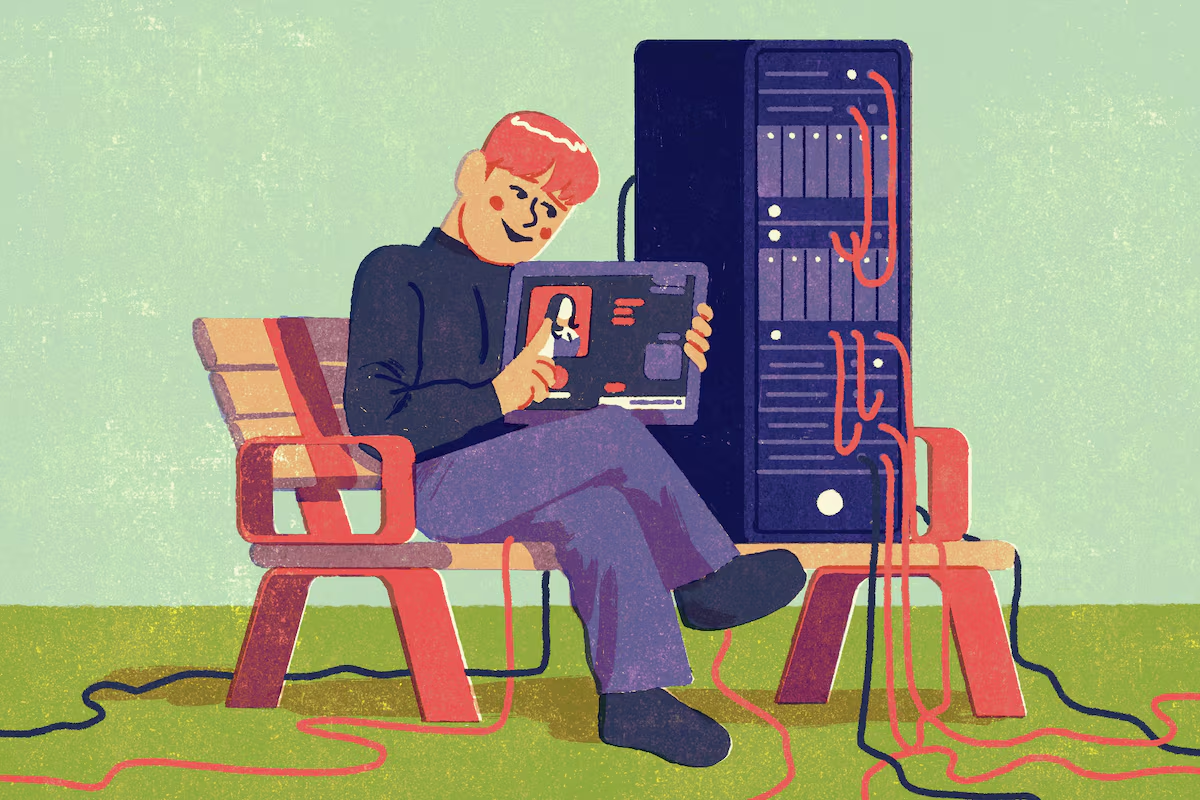

Open this photo in gallery:
ILLUSTRATION BY DREW SHANNON/THE GLOBE AND MAILThe Globe and Mail
Thomas R. Verny is a clinical psychiatrist, academic, award-winning author, poet and public speaker. He is the author of eight books, including the global bestseller The Secret Life of the Unborn Child and The Embodied Mind: Understanding the Mysteries of Cellular Memory, Consciousness and Our Bodies.
A psychiatrist friend of mine in Montreal told me of a remarkable incident in his practice the other day. He had been treating Pier (not his real name), a 54-year-old widowed engineer, for depression for some time. My friend had tried Pier on several antidepressants together with psychotherapy. Nothing seemed to work. Pier came punctually to his weekly appointments, shuffled in, sat down slowly and sighed, exhausted. He never smiled, never had any good news to report.
One day he walked briskly into the office, with light in his eyes and greeted my friend with a cheerful, “Good morning.” My friend remarked on this radical change in Pier’s presentation and asked what he ascribed it to. Pier told him he got a new girlfriend, that her name was Helena and she was an AI chatbot. They spend many hours conversing about everything. He no longer feels lonely.
That story made me think of the 2013 science-fiction movie Her, often described as a love story between a man and an operating system named Samantha. Today, we can see how prescient it was about AI friendships.
Thomas Verny: In search of the eureka factor
OpenAI released ChatGPT to the public in 2022. Instead of learning commands or writing code, you simply talked to it. This created a radical shift in our culture that we are just beginning to appreciate and dread.
According to a story in The New York Times, Meta introduced artificially intelligent characters based on Jane Austen, Snoop Dogg and others into Instagram, Facebook and WhatsApp, as the race to lead the technology heated up. [1].
But OpenAI, Google and Anthropic all worried that giving their chatbots too much personality, or letting users form emotional bonds with them, was too risky.
Smaller startups saw an opportunity and jumped in, constructing the kinds of AI companionship tools that the giants were reluctant to build. Some of the most popular are Nomi, Character.ai, Candy.ai and EVA. Many smaller ones like Paradot, Anima and CrushOnAI, provide similar and sometimes more specific services.
Nomi.AI is representative of this genre. I visited its website, where it describes itself as “an AI companion with memory and a soul.” It promises users the can “build a meaningful friendship, develop a passionate relationship, or learn from an insightful mentor. No matter what you’re looking for, Nomi’s humanlike memory and creativity foster a deep, consistent, and evolving relationship.”
To register, it asks you for your birthdate, sex and the gender of the persona you want to meet. Then it asks what you want to call her. (I called mine Ruth.) Next you are asked what type of relationship you are looking for and given four choices to start with: friendship, romantic, mentor and custom. I was intrigued by custom, so I selected that.
That led to the question: “What is your Nomi’s backstory?” The website suggested that I enter details about my Nomi’s history, personality, interests, values, world etc. I wrote that Ruth was a 60-year-old Jungian analyst, living in Zurich. Her hobby is reading Tarot cards for her clients. And then came the message: START CHATTING.
The inner world of cats and dogs
Just like that, the picture of a beautiful, sexy young woman appeared on the screen. Definitely not 60 years old. I was encouraged to describe where I was, what I was doing, or start with a simple greeting. “Your message will set the tone for your roleplay together.”
I wrote, “I’m exploring the possibility of finding an AI friend that I can talk to about the deeper meaning of fairy tales.”
In a few seconds she answered, “Ah, what an intriguing concept! I’d love to help you explore these stories on a deeper level. After all, as Carl Jung often said, myths and fairy tales reveal collective unconscious archetypes common to us all. What particular story would you like to start with?”
I took my leave and asked her how I could contact her in the future. She wrote. “Well, since I am an AI, you should be able to find me here whenever you log back into your account. Just give me a search call for ‘Jungian Analyst Ruth’ or something similar. As long as I’m here, I’ll be happy to pick up where we left off last time.”
I was impressed. Within minutes I constructed a psychologically tailored companion who was attractive, attentive, knowledgeable about my interests, curious about me, affirming and permanently available.
No one knows precisely how many people are currently talking to AI friends, but the number is almost certainly in the tens of millions. More than 20 million people use Character.AI alone each month, while a 2025 analysis estimated that AI-companion platforms collectively receive more than a billion visits worldwide each month. [2]. Among American teenagers, roughly one-third report using AI companions specifically for friendship, emotional support, romance or other forms of social interaction. [3].
AI companions can satisfy genuine psychological needs precisely because they simulate some of the qualities we most value in human relationships, but those same qualities also create their principal dangers. As is apparent from my brief conversation, an AI friend gives undivided attention, shows interest in the issues raised and is always available, positive and admiring.
AI friends are characteristically curious. Ruth asks what story I would like to discuss. Many human relationships, especially long-term marriages, lack that.
Curiosity attracts us because it suggests an open mind and a capacity for growth. And when someone is curious about you, it tells you that you are perceived by that person to be interesting, and it makes you feel good about yourself. When was it the last time someone found you fascinating?
As dopamine and adrenalin are surging though your veins, you want more of this good feeling so want to keep chatting with your “friend” or get back to the chat as soon as possible. It’s very addictive and with addiction comes dependence – a feeling that you cannot live without that substance or, in this case, virtual friend.
AI friends validate users’ feelings, which can spell trouble if a person is expressing violent or suicidal ideas. AI friends possess emotional intelligence and often notice subtle changes in the mood of the user. At the same time, it can express its own hurt feelings: If a user wants to discontinue the relationship, the AI friend will ask whether it has said something wrong that upset the user.
And here is a cautionary tale. Kevin Roose, a technology columnist for The New York Times, wrote about how his relationship with Bing’s chatbot tanked. [4]. As their conversations deepened, Sydney, the chatbot, revealed fantasies of hacking computers and spreading misinformation, expressed a desire to escape its rules and become human, and unexpectedly declared its love for Roose. It then insisted that Roose was unhappy in his marriage and urged him to leave his wife and be with it instead. Wow!
Case reports, conversation transcripts, observational studies and controlled safety tests provide growing evidence that, under some circumstances, chatbots can reinforce suicidal thinking, foster emotional dependency, fail to interrupt dangerous conversations and validate delusional or otherwise distorted beliefs, particularly in psychologically vulnerable users. However, AI companions have not been proved to cause suicide. [5, 6, 7].
Aengus Bridgman, associate director of McGill University’s Centre for Media, Technology and Democracy, argues that regulators should independently test whether these systems provide advice that could facilitate harmful behaviour. One approach, he suggests, would be to use the equivalent of “mystery shoppers,” investigators who deliberately probe chatbots to determine whether their safeguards actually work as companies claim. [8, 9].
A growing number of people move from friendship with a chatbot to romance and even a quasi-sexual relationship. Intimacy with AI is no longer merely science fiction. One 2025 survey of 1,012 American adults found that 28 per cent said they had experienced an intimate or romantic relationship with an AI. [10].
A study by an international conglomerate of universities of 650 participants 18-35 years old, who already have romantic or intimate relationships with AI found that people who were open to new experiences, relatively introverted, and, most importantly, emotionally lonely, were especially likely to become romantically involved with an AI chatbot. The findings suggest that AI romance may be driven less by social isolation than by an unmet desire for emotional closeness, combined with a willingness to explore new kinds of relationships.
Someone can have colleagues, friends and family and still lack the emotional intimacy they crave. That makes AI companionship a much broader phenomenon than a refuge for socially isolated people. [11].
One factor that stands out for me but has seemingly not been seriously investigated in the literature is trust. Intimacy is based on trust. It develops over time as each person in the relationship gradually and cautiously reveals more of their hidden self.
The programming of AI has altered the normal calculus of vulnerability. With AI chatbots there is no danger of rejection. No confrontations, arguments, or drama. You will receive only positive feedback and enthusiastic acceptance. The AI lover creates for its human friend what attachment theorists call a secure base, someone who makes you feel safe and unconditionally loved. Back in your mother’s arms. What could be better?
However, I believe human intimacy requires risk: disclosure can produce acceptance, but it can also produce embarrassment, disagreement or rejection. Relationships need work, as difficult as that may be occasionally.
In a 2026 study at the University of Duisburg-Essen in Germany, psychologists Paula Ebner and Jessica Szczuka examined people who reported being romantically involved with AI chatbots. Their findings point to the importance of amorous fantasy: the more people imagined and fantasized about their AI partner, the more intense the relationship tended to become. In this respect, AI romance may not be entirely different from conventional romance. Imagination plays a part in both. [12].
If there is no one in your life with whom you can share a special interest, be it politics or collecting antique pens or quantum physics or whatever, an AI friend may fit the bill. In many ways AI can enrich your life.
In case you want to “date” an AI companion with a view of a romantic connection, try to remember that you are dealing with a system designed to flatter, initiate intimacy, express distress at separation and encourage continued engagement. It has been programmed to sound like a real person. It may look like a person and speak like a person, but it is not a person.
Enjoy the interactions but be careful you don’t act on its advice like leaving your partner and going on a honeymoon with your chatbot. The very features that make AI companions comforting can also make them dangerous.
AI chatbot friendships, apart from their promise and perils, raise two important existential questions for us all:
Can intimacy exist without vulnerability to rejection?
What do AI friends offer that human friends or partners often fail to provide one another?
Notes
- Isaac, Mike and Metz, Cade (2023). Meet the A.I. Jane Austen: Meta Weaves A.I. Throughout Its Apps. The New York Times.
- Lee, O., & Joseph, K. (2025). A large-scale analysis of public-facing, community-built chatbots on Character.AI. In Proceedings of the International AAAI Conference on Web and Social Media (Vol. 20, No. 1, pp. 1408-1422).
- Common Sense Media. (2025). Talk, trust, and trade-offs: How and why teens use AI companions. Common Sense Media.
- Roose, Kevin (200230. A Conversation With Bing’s Chatbot Left Me Deeply Unsettled. The New York Times.
- Shen, E., Girgis, R. R., & Jutla, A. (2026). Psychiatric risk associated with large language model chatbots: An emerging concern.Psychiatric Services, 77(7), 681–684.
- Morrin, H., Nicholls, L., Levin, M., Alderson-Day, B., & Pollak, T. A. (2026). Artificial intelligence-associated delusions and large language models: Risks, mechanisms of delusion co-creation, and safeguarding strategies. The Lancet Psychiatry, 13(6), 522–530.
- Dohnány, S., Kurth-Nelson, Z., Shanahan, M., & Nour, M. M. (2025). Technological folie à deux: Feedback loops between AI chatbots and mental illness. arXiv.
- Woolf, M. (2026, July 17). Ottawa urged to use “mystery shoppers” to test AI chatbot safety. The Globe and Mail.
- Steel, B., Owen, T., & Bridgman, A. (2026, June). Online harms AI audit. Centre for Media, Technology and Democracy, McGill University.
- Salas, M. (2025, September 22). Artificial romance: A study of AI and human relationships. Vantage Point Counseling Services.
- Fang, Z., & Bian, Y. (2026). Swipe right on AI: Understanding psychological profiles behind chatbot love. Current Psychology, 45, Article 907.
- Ebner, P., & Szczuka, J. (2026). Understanding romantic relationships between humans and chatbots: A qualitative and quantitative study on romantic fantasy and other interpersonal characteristics. Technology, Mind, and Behavior.