
Open this photo in gallery:
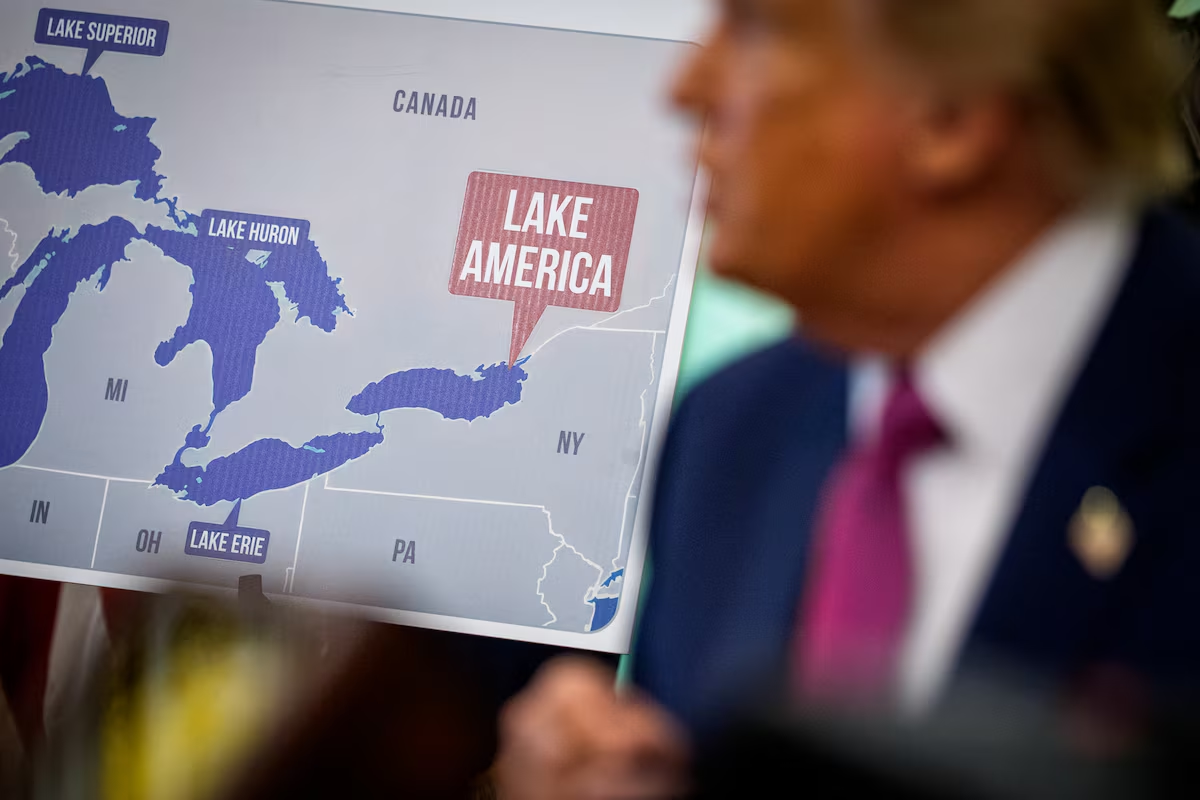
A map labelling Lake Ontario as ‘Lake America’ is displayed as U.S. President Donald Trump speaks after signing an executive order during an event in the White House on Thursday.Andrew Harnik/Getty Images
U.S. President Donald Trump signed an executive order Thursday directing his government to rename Lake Ontario “Lake America,” following through on a threat he made earlier this week as the trade dispute between Canada and the United States intensified.
But does the order mean Canadians will have to call one of the Great Lakes by another name? Here’s what you need to know.
Opinion: Canada’s response to Donald Trump is a nation-defining moment
Does this mean Lake Ontario has officially been renamed?
In the eyes of the United States government, yes.
Mr. Trump’s executive order instructs the U.S. Secretary of the Interior, in co-ordination with the U.S. Board on Geographic Names, to change the federal database of geographic names within 30 days. It also directs federal departments and agencies to use Lake America in official maps, contracts, documents and communications.
But the President cannot force Canada to adopt the new name, nor can Washington dictate what international organizations, private companies, media outlets or members of the public call the lake.
Canada maintains its own official geographic naming system through federal, provincial and territorial naming authorities. The Canadian Geographical Names Database currently lists Lake Ontario as the lake’s official name.
There is also no single international organization with the power to impose one universally accepted name on shared international bodies of water.
What have Canadians said about the order?
Prime Minister Mark Carney rejected Mr. Trump’s renaming Thursday, saying on X that Canadians will continue to know the shared body of water as Lake Ontario.
Ontario Premier Doug Ford had already brushed off the President’s proposal earlier this week before the order was signed.
Speaking Tuesday, Mr. Ford said the lake would continue to be known as Lake Ontario in Canada.
“I have to laugh when he comes up with these ideas. It’s always going to be Lake Ontario here in Canada. … If he wants to name it Lake America, Lake Trump, whatever he wants to do, that’s his prerogative.”
Federal Industry Minister Mélanie Joly said Canada would continue to use the name Lake Ontario, and framed the issue as another example of Ottawa needing to remain focused rather than react to every provocation from Washington.
Industry Minister Mélanie Joly said on Tuesday that Canada would ‘always call it Lake Ontario,’ responding to U.S. President Donald Trump’s suggestion that it be renamed ‘Lake America.’
Reuters
Didn’t Trump do this with the Gulf of Mexico?
Open this photo in gallery:
Mr. Trump holds up a signed proclamation declaring Feb. 9 Gulf of America Day, as Interior Secretary Doug Burgum watches aboard Air Force One in February, 2025.Ben Curtis/The Associated Press
Yes, and the previous cases illustrate the limits of presidential naming power.
Mr. Trump signed an executive order in January, 2025, directing the U.S. government to call the Gulf of Mexico the “Gulf of America” and changing Denali back to Mount McKinley.
The Associated Press treated the two changes differently.
It adopted Mount McKinley because the mountain is entirely within the United States and the federal government has the authority to establish its official federal name.
Gulf of understanding: The way we see the Earth has never been set in stone
But AP continued using Gulf of Mexico, saying the gulf is shared by several countries and that the U.S. President’s order did not bind Mexico or international organizations.
That decision sparked a confrontation between the White House and the news organization. The Trump administration restricted AP’s access to some presidential events after it refused to change its terminology, leading to a court fight over press access and the U.S.’s first amendment. The dispute eventually moved into federal court and the case remains on appeal as of today.
Where does the name Ontario come from?
The name has roots that predates both Canada and the United States.
Long before Europeans arrived in the region, Indigenous peoples had names for the Great Lakes. Canadian government sources trace Ontario to an Iroquoian Indigenous word, commonly translated as “sparkling water” or “beautiful lake.”
That history has made Mr. Trump’s proposed name change contentious among Indigenous leaders and scholars.
To First Nations, Trump’s threat doesn’t hold water
Mohawks of the Bay of Quinte Chief R. Donald Maracle told The Globe that changing the name would amount to an “attack” on Indigenous people and said Indigenous culture should not become collateral damage in a political or trade dispute.
Derek Alderman, a University of Tennessee geography professor who has studied Mr. Trump’s effort to alter place names, said that the Lake Ontario proposal fit what he viewed as a broader pattern of attempts to erase Indigenous culture.
Prof. Alderman pointed to Mr. Trump’s decision in 2025 to restore the name Mount McKinley to North America’s tallest mountain, reversing the Obama administration’s adoption of Denali, the Indigenous name long used by Alaska Native Peoples.
“Place names are not bargaining chips. They’re not meant to be pawns or weapons in these sorts of tit-for-tat struggles,” Prof. Alderman said.
Trent University archaeology and anthropology professor James Conolly similarly told The Globe that Lake Ontario’s name preserves a linguistic connection to Indigenous people that predate the modern Canada-U.S. boundary.
With reports from Matthew Frank and the Associated Press