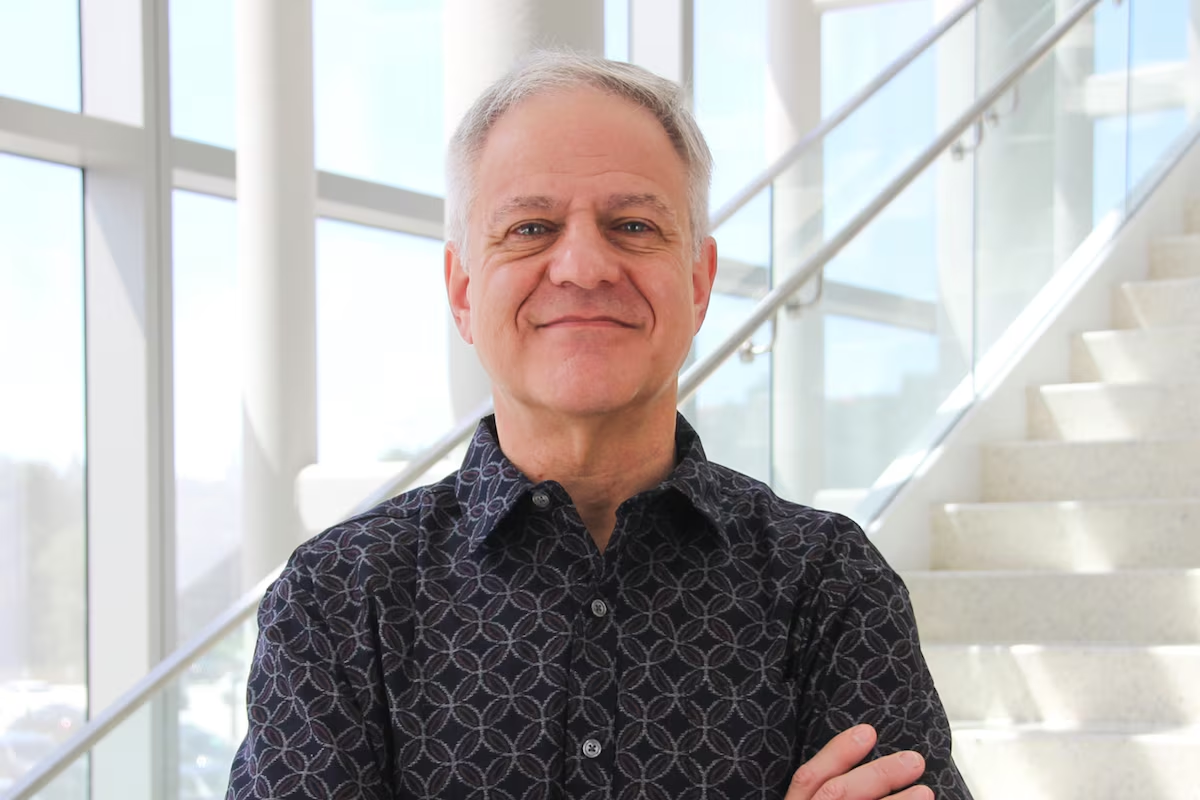

When biomedical scientist Phillip Zamore was deciding whether to leave his post as chair of the RNA Therapeutics Institute at the University of Massachusetts for a job in Canada, he said “pull and push” factors came into play.
“One can’t put too fine a point on the push,” Prof. Zamore, an American, said in an interview. “I’ve pretty much lost my country. None of the things I value about democracy – and most especially the role of science in a democracy – seem to exist at the federal level anymore.”
Open this photo in gallery:
‘It’s just become for me personally scary to be a scientist in America,’ Prof. Philip Zamore says.Supplied
The Trump administration’s undermining of science and its cuts to research funding might have pushed Prof. Zamore into the arms of any country. He considered Europe and Japan. But he chose McGill University and Canada in large part because of a Canadian government initiative that made him an offer that, “truthfully, took my breath away.”
Prof. Zamore is one of 64 world-leading scientists and scholars whose moves to Canada will be announced by Industry Minister Mélanie Joly and Health Minister Marjorie Michel on Thursday, less than a week after trade talks with the United States collapsed, forcing Canada into a trade war with its erstwhile ally.
Although the announcement was in the works before this week, it gives Prime Minister Mark Carney’s government a well-timed opportunity to crow about poaching some of America’s brightest minds.
The 64 researchers will together receive $504-million in federal funding over eight years as the first group of Eddie Goldenberg Research Chairs of Canada, the centrepiece of the Canada Global Impact+ Research Talent Initiative, a $1.7-billion recruiting blitz the Liberals launched late last year.
Opinion: Science and innovation could be central to building a strong Canada
The research chairs were recently renamed in honour of the late Mr. Goldenberg, a former chief of staff to Prime Minister Jean Chrétien who urged Ottawa and Canadian universities to make an ambitious play for disaffected researchers in Donald Trump’s America.
The chairs hail from 13 different countries, but most are leaving institutions in the U.S., including prestigious universities such as Harvard and Stanford, according to a list of the 64 researchers obtained by The Globe and Mail.
They include leaders in medical isotope production and radiopharmaceuticals, molecular imaging, climate resilience, quantum network infrastructure, RNA therapeutics, artificial intelligence and global security, among other fields. One created the pop-up ad, an invention for which he later apologized.
Many are Canadians coming home. But some are Americans with scant connection to Canada who say they were compelled to move north by the promise of stable, long-term research funding through the Goldenberg program.
“This was a once-in-a-lifetime opportunity. I was not actually actively looking to move,” said Kathryn Whitehead, a professor of chemical and biomedical engineering at Carnegie Mellon University in Pittsburgh who will be the Goldenberg Research Chair in Translational Drug Discovery at the University of British Columbia, where the announcement is scheduled to take place Thursday.
Open this photo in gallery:
Eddie Goldenberg, left, shakes hands with former governor-general David Johnston at his Order of Canada ceremony in 2014.FRED CHARTRAND/The Canadian Press
Eight of the chairs went to UBC, more than any other school. Seven went to the University of Ottawa, six to McGill and six to the University of Toronto, including one to support the research of Sara Seager, an acclaimed planetary scientist whose move from the Massachusetts Institute of Technology to U of T was announced last year.
The rest were spread across the country. Other prominent names on the list include Peter Caravan, a Canadian leaving Harvard to become the Goldenberg Chair in Translational Molecular Imaging and Therapy at UBC; Curtis Huttenhower, a computational biologist also leaving Harvard for UBC; Ethan Zuckerman, the pop-up ad inventor and digital media scholar who will be joining McGill as Goldenberg Chair in the Digital Public Sphere; and Kevin Hall, a prominent nutrition and metabolism scientist who is moving to the University of Ottawa.
He quit a leadership role at the U.S. National Institutes of Health last year, saying federal officials censored his work on ultraprocessed foods.
Prof. Whitehead’s expertise is in developing nanoparticles that act as delivery mechanisms for novel medicines. Her husband is from Thunder Bay.
UBC and Vancouver’s burgeoning life sciences industry were the perfect fit, she said, because they’re home to Pieter Cullis, the Canadian biochemist best known for creating the lipid nanoparticles used in mRNA vaccines for COVID-19. She also specializes in women’s health, testing new drug compounds to ensure they work as well on women as on the men who were the subjects of most drug trials in the past.
“My work is not well aligned with the current administration’s priorities,” Prof. Whitehead said, referring to the Trump government. “Women’s health is just not at the top of the list. And RNA therapies – there are some challenges with obtaining funding for that work.”
Canadian researcher Gerry Wright is searching for the next generation of life-saving antibiotics
In Canada, by contrast, she’s secured $1-million a year for eight years as a Goldenberg Chair with an option for a four-year extension, on top of financial, teaching and housing support from UBC.
Chasing grants is by far the most stressful part of her job, Prof. Whitehead added.
“It’s just such a relief that Canada is willing to support the type of work we do at a very high level,” she added.
Ottawa has allocated up to $1-billion for as many as 100 Goldenberg spots. The next group of researchers is expected to be unveiled in the coming months. In May, the government announced 659 awards for international and returning Canadian doctoral and postdoctoral students as part of the recruiting drive.
Ottawa has also committed $120-million over 12 years to an emerging leaders program designed to attract early-career researchers.
Suzanne Lapi and Jonathan McConathy, a married pair of experts in radiopharmaceuticals and nuclear medicine, are leaving the University of Alabama at Birmingham for McMaster University, where they hope to entice more of their promising young American colleagues to join them through the emerging leaders program.
Prof. Lapi is Canadian and Dr. McConathy is American. They were wowed by the size and stability of the research funding available to them as Goldenberg Chairs.
They also said they were relieved to leave behind an environment where the Trump administration’s immigration policies could make it difficult to secure visas for talented graduate and postgraduate students from around the world.
“The roadblocks to being able to have the best of the best in the U.S. is pretty difficult,” Prof. Lapi said.
Prof. Zamore put it more bluntly, saying he feared international trainees he would have liked to recruit to the U.S. recently risked not getting a visa or being deported.
“It’s just become for me personally scary to be a scientist in America,” he said.