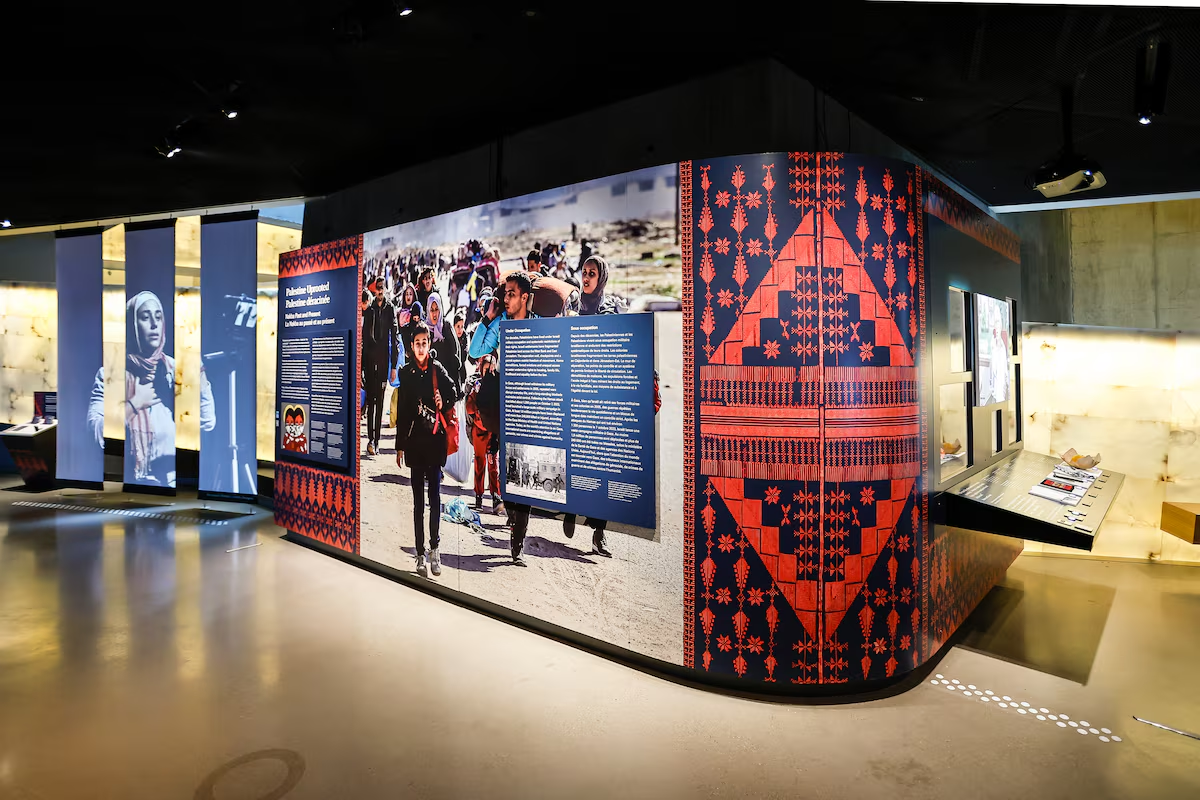

Open this photo in gallery:
The exhibit, Palestine Uprooted: Nakba Past and Present, at the Canadian Museum for Human Rights in Winnipeg.John Woods/The Canadian Press
Multiple trustees at the Canadian Museum for Human Rights raised concerns beginning last fall that a new exhibit on the Palestinian Nakba could damage the institution’s reputation and hurt fundraising efforts. But the board members were rebuffed by management, who told them content curation is not their responsibility, according to internal meeting minutes.
The minutes, obtained by The Globe and Mail, include around 200 pages of records from November, 2025, to this past May. Coupled with interviews conducted separately with one former and four current trustees, they demonstrate that the high-profile museum’s 11-member board was divided over the exhibit from its announcement last year until its launch in late June.
Some board members were particularly concerned about the Nakba display linking historic events of the 1940s to the present-day war between Israel and Hamas. Records show that the apprehension was bolstered by multiple major donors pausing their funding campaigns ahead of the exhibit’s opening. This had caused the Winnipeg-based museum to fall short of its financial targets.
Canadian Museum for Human Rights curator defends Nakba exhibit ahead of opening
The small exhibit, which occupies two walls on the fifth floor of the seven-level museum, has been denounced by many Jewish groups as an attack on Israeli statehood. One trustee has resigned in protest, and the issue has led to wider public blowback, especially in Ottawa, where it has become a frequent topic of debate.
Heritage Minister Marc Miller, meanwhile, has criticized the display’s “regrettable” language about the Israel-Hamas conflict.
Open this photo in gallery:
The Canadian Museum for Human Rights in Winnipeg.Felicia Fonseca/The Associated Press
Several trustees at the museum, a Crown corporation, had proposed delaying the display to allow more time to address what they perceived as the “reputational risk” associated with it. They wanted to invite public consultation on the matter, the minutes confirm. They also wanted the museum to create a policy for what the minutes referred to as “quality control” for such exhibits.
“There was concern from some Trustees that not allowing the public to ask questions was a missed opportunity on the part of the Museum, particularly as it related to the new exhibit, Palestine Uprooted: Nakba Past and Present,” stated a board package from May recapping previous meeting minutes.
At least five formal motions, ranging from a call for postponement to a call for restructuring the display, were presented at meetings in November, February and May. But the minutes reveal that a majority of trustees voted against those proposals.
Board trustees and the museum’s chief executive are all appointed with approval from the federal Heritage Minister. The board is kept separate from the day-to-day responsibilities of content curation, leaving direct oversight and approval of exhibits to management.
The Nakba exhibit, which will remain on display for at least two years, examines what the museum describes as an “ongoing process” beginning in the 1940s, when hundreds of thousands of Palestinian Arabs were displaced from what is now Israel.
Israel has been at war with Hamas since Oct. 7, 2023, when the militant group launched a surprise attack, killing around 1,200 people. Israel’s retaliatory offensive has killed more than 72,000 Palestinians as of May, according to UN officials, and displaced about 90 per cent of Gaza’s population, causing a humanitarian crisis.
Internally, the matter at the museum became especially heated at meetings held from Feb. 25 to Feb. 26, when CEO Isha Khan told board members that they are not her “boss” and that she worried about their trust in her abilities, said five trustees who were in attendance.
The Globe is not identifying four of the trustees because current board members are prohibited from speaking publicly about their work at the museum. Former trustee Mark Berlin, who resigned from the board just a few days before the exhibit opened on June 27, confirmed the account of the February meeting, describing it as “egregious.”
During this meeting, a motion to delay the exhibit was put up for a formal vote after a months-long back and forth during many board sessions, trustees told The Globe.
Those who raised worries about the display were not unsupportive about its intention to spotlight Palestinian displacement; rather, they were concerned about its accuracy and the internal oversight that led up to its announcement, the trustees said.
The minutes from February show that the postponement was voted down, with three in favour of postponing and six against. The documents do not indicate who abstained and who spoke in favour or against the motion.
Open this photo in gallery:
Isha Khan, CEO of the Canadian Museum for Human Rights, said while discussions about the Palestinian exhibit were ‘animated,’ most of the museum’s board supported it.John Woods/The Canadian Press
In an interview, Ms. Khan acknowledged that several meetings about the exhibit were similarly “animated.” Although, referring to the votes on the various motions presented before June, she noted that a majority of the 11-member board repeatedly showed support for the display.
“I think the public reaction to the exhibit, of course, was far more than other exhibits that we’ve opened that have also been contentious for various communities,” she said.
“Ultimately, for me, I did have the confidence of our board; or I would not proceed or we would’ve paused, should the board have directed that.”
Ms. Khan, whose tenure was renewed by Ottawa last fall for a second five-year period, said that during her time at the helm of the museum the board has never been shown the text or content of an exhibit before it went on display. Nor is she aware of any policies or conventions for the boards of other museums to examine or screen exhibits.
Ms. Khan said there are several policies to ensure quality control when approaching contemporary issues. However, she said, after discussions on the Nakba exhibit, the museum is working on distilling those policies into a single document as a future reference. Trustees in February voted in favour of this document being ready for their September board meeting.
On the issue of fundraising, Ms. Khan said museum management continues to monitor the effect on donations. “What I can tell you is that I don’t believe, at this stage, we’ve seen a significant impact on fundraising as a result of opening the exhibit,” she said, though she did not provide specific figures.
The museum receives more than $28-million annually from the federal government to cover its operating costs, as well as around $1-million from donations.
Opinion: The Canadian Museum for Human Rights is right to portray the stories of displaced Palestinians
First announced in November, the mixed-media display on the Nakba – meaning catastrophe in Arabic – was praised by many Palestinian organizations. Independent Jewish Voices Canada, United Jewish People’s Order and the Jewish Faculty Network also issued statements of support. However, the display immediately raised the ire of some prominent Jewish groups.
The Jewish Heritage Centre of Western Canada ended its partnerships with the museum because of the exhibit, stating that it does not appropriately cover the history of Israel’s creation, including the mass displacement of Jews from Arab lands.
Philanthropist Gail Asper, whose family helped found the museum 12 years ago, also condemned the display, suggesting that it could cause further hostility toward Jews in Canada. One of two honorary trustees on the museum’s board, Ms. Asper stood alongside dozens of protesters outside the Winnipeg facility at the exhibit’s public opening in June.
Honorary trustees have no voting rights or decision-making authority on the board; they are rarely invited to attend meetings.
Ms. Asper told The Globe this month that her family is indefinitely pausing its financial support for the museum and she is considering stepping down from her role.
But in a letter sent to the federal government, the second honorary trustee, Cree leader Wilton Littlechild, expressed his “unequivocal support” for the display in late April.
“The history of the forced displacement of the Palestinian people is one that resonates with our own Nations – the Cree and Red River Métis – and with other Indigenous Peoples throughout Canada,” Mr. Littlechild, a residential school survivor and Alberta-based lawyer, wrote in the letter, obtained by The Globe.
“The planned exhibit is a timely opportunity to promote better understanding of a contemporary human rights crisis that is on the mind of all Canadians.”
Open this photo in gallery:
Marc Miller, Minister of Canadian Identity and Culture, said the exhibit’s language was ‘regrettable,’ but would not say if he raised any concerns prior to the opening.Sean Kilpatrick/The Canadian Press
Shortly after the exhibit’s launch, Mr. Miller told The Canadian Press that some of its wording, such as not identifying Hamas as a “terrorist organization,” was regrettable and should be rectified. “Any failure of curation is one that really should be directed to the board that does need to do its job,” the minister was quoted to have said.
Board meeting minutes show that the Heritage Department had been aware of the planned Nakba exhibit for years, but did not clarify what specifically the department knew about the contents of the display, which had been in the works since at least 2022.
The minister declined The Globe’s requests for an interview. He would not address questions about whether he raised any concerns prior to the opening. His spokesperson, Alisson Lévesque, said Mr. Miller was “surprised by allegations that the board could not view the exhibit beforehand.”
Ms. Khan said Mr. Miller’s comments will be considered under the museum’s long-established process for content revision, which may include the creation of an external panel to make recommendations.
She acknowledged the process could take a significant amount of time to review any changes.
Ms. Khan noted that unlike other corporations and non-profits, the CEO of the museum is not hired or fired by the board. That responsibility is held by the Heritage Minister, to whom she reports. Museum bylaws state that the board’s job is to oversee her performance, pay and benefits.
Ms. Khan said she has had to clarify this “dual reporting dynamic” to the board on many occasions to explain her recent decisions, such as those related to the Nakba exhibit.
Opinion: The Canadian Museum for Human Rights’ Nakba exhibit can serve as a site for solidarity
Benjie Nycum, chair of the museum’s board, said debates and disagreements should be expected by “passionate Canadians” hired as trustees.
“Meeting minutes record discussions raised by Trustees, but the raising of an issue and its presence in the minutes does not imply that every member of the Board agreed with the concern or sentiment expressed,” he wrote in a statement. “Ultimately, the will of the Board is captured in the motions that are passed or defeated.”
Mr. Nycum said the board remains committed to its mandate, which “includes sharing the stories of Palestinian Canadians, and uniting Canadians behind a vision for a future where all human beings are born free and equal in dignity and rights.”
Mr. Berlin, the former board trustee who resigned last month, said the situation reminds him of the museum’s crisis in 2020, when public allegations of racism, homophobia and sexual harassment were brought forward by staff members.
Mr. Berlin was part of a three-person board panel who oversaw operations during that turbulent period, which led to the resignation of then-CEO John Young and the hiring of Ms. Khan.
He said museum trustees are meant to represent a microcosm of Canada. “So, even if they say it was a minority of us who had these contentions, then that should’ve given management pause,” he told The Globe.
“Now, unless there’s a change of leadership at the executive level, and until there is a massive overhaul of the board, there are no checks and balances happening here any more.”