
Good morning. We’ve reached the tit-for-tat phase of the trade war. More on that below, along with Ukraine’s Independence Day and Iran’s so-called “economic D-Day.”
Open this photo in gallery:
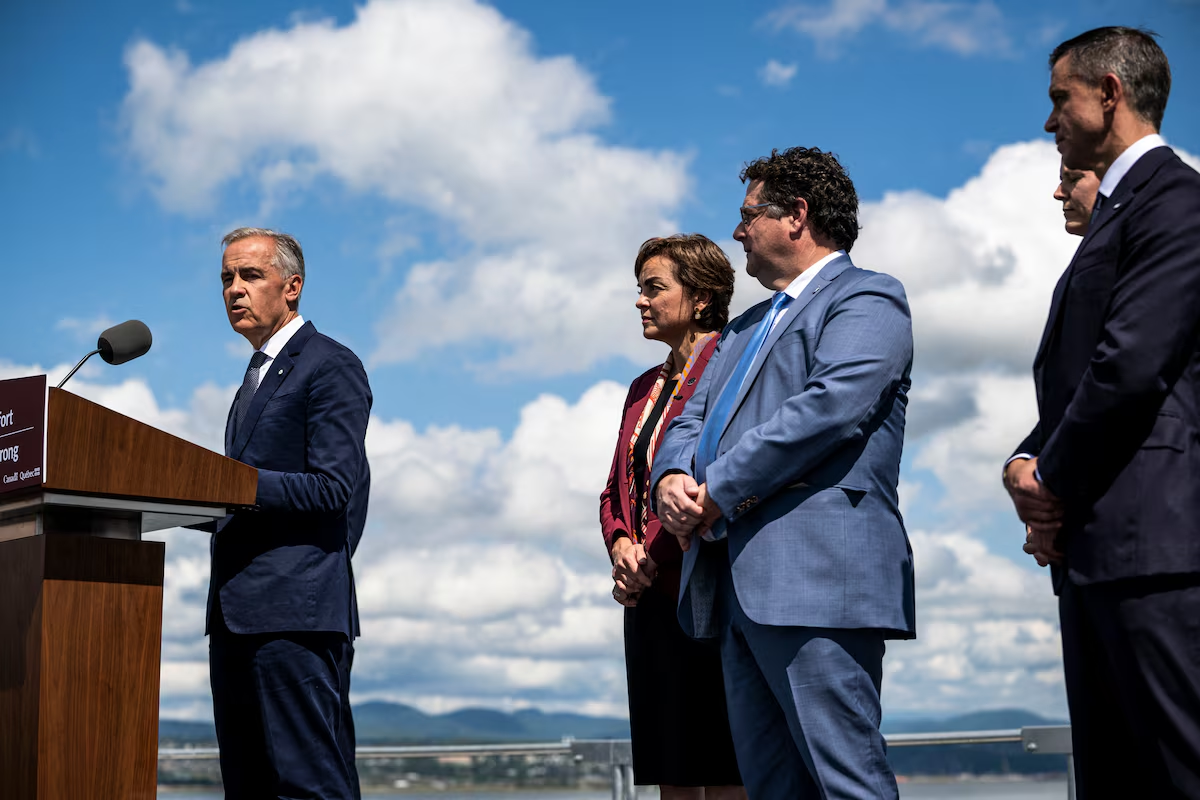
Prime Minister Mark Carney speaks about the trade dispute at the Davie Shipyard in Levis, Que., on Monday.ANDREJ IVANOV/AFP/Getty Images
TOP STORIES
Carney calls latest Trump tariff ‘revealing’
Prime Minister Mark Carney said a new trade deal between Canada and the United States remains possible, while Ontario Premier Doug Ford engaged in a war of words with President Donald Trump and threatened to cut off Ontario’s electricity exports to the U.S. The PM met with his provincial and territorial counterparts yesterday and continues to build a business support package.
Further retribution: Trump said Monday morning that he would double auto tariffs from 25 per cent to 50 per cent as of Jan. 1, 2027, and that these would apply to cars, trucks and auto parts. Auto parts have not previously been subject to tariffs, and shares of major Canadian auto parts companies plunged.
Future fight: The government has yet to release any details of what products will be targeted by retaliatory tariffs, which has revived a guessing game among trade watchers. Consumer products bore much of the brunt when Ottawa first slapped counter-tariffs on $30-billion worth of American goods last year.
Farther south: Mexican President Claudia Sheinbaum is playing down the trade dispute between Canada and the United States, while expressing optimism that Mexico will reach its own deal on tariffs with its northern neighbour.
Keep reading
- Editorial board: Canada’s sovereignty is not negotiable
- Andrew Coyne: The U.S. isn’t negotiating trade with Canada. This is a shakedown
- Robyn Urback: Canadians are fighting for their sovereignty. Americans don’t even realize they’re in a war
Open this photo in gallery:
U.S. Treasury Secretary Scott Bessent speaks at the Treasury Department in Washington, D.C., Aug. 24.Evelyn Hockstein/Reuters
America warns other countries to cut ties with Iran
U.S. President Donald Trump’s pledge to unleash an “economic D-Day” against Tehran turned out to be new warnings for countries to cut off Iran from the rest of the global economy. U.S. Treasury Secretary Scott Bessent unveiled a new round of sanctions as the administration struggles to find an off-ramp nearly six months into an unpopular war.
What to watch: Experts say Washington is wary of Chinese retaliation ahead of expected talks next month between U.S. President Donald Trump and Chinese President Xi Jinping, with any curbs on China’s exports of critical minerals being especially sensitive.
Open this photo in gallery:
People visit Lychakiv Cemetery to pay tribute to fallen soldiers on Ukraine’s Independence Day in Lviv, on Aug. 24.YURIY DYACHYSHYN/AFP/Getty Images
Ukraine gets more support on Independence Day
Britain and France pledged to provide Ukraine with stronger military support at a meeting of allies to mark Kyiv’s Independence Day celebrations. The allies will provide access to classified technology such as long-range weapons and faster deliveries of air defence missiles.
Russia responds: The Kremlin said the use of the classified British technology would “add fuel to the fire” of their worsening relations, after it warned London last week there would be “consequences” for supplying drones to Kyiv.
Open this photo in gallery:
An aquatic science biologist releases an Atlantic salmon back into its tank during a Fisheries Department health audit at the Okisollo fish farm near Campbell River, B.C., in October, 2018.JONATHAN HAYWARD/The Canadian Press
Advocates fear rollback of salmon farm ban
Conservationists and some Indigenous groups and are expressing concern about silence from Ottawa over a plan, proposed by the Trudeau government, to ban ocean-based salmon farms off the coast of British Columbia.
The context: Some fish farms have already closed in B.C., while others remain open. In 2024, Ottawa released a draft transition plan to phase out by June, 2029, open-net salmon farms in B.C., which Indigenous communities and conservationists argue are harming migrating wild Pacific salmon.
The Take
Ottawa is filled with monuments. Some pay tribute to those who served; others to those who suffered. Now the city has a place of peace where Canadians can pause to reflect on those who were persecuted and prosecuted because of the people they loved.
— John Ibbitson, writer and journalist
New LGBTQ monument serves as a reminder to keep standing up to wrongs, John Ibbitson writes.
The Shot
Open this photo in gallery:
Naval communicator S2 Ali Daas works on the bridge aboard the HMCS Max Bernays ahead of deployment to the Arctic while docked at CFB Esquimalt in B.C., on July 3.Chad Hipolito/The Globe and Mail
Ali Daas fled war in Syria to start a new life. Now, he defends a country that has changed a lot in the decade since it welcomed him and his fellow countrymen.
The Wrap
What else we’re following
At home: Montreal’s municipal council adopted a motion of solidarity with the Palestinian people.
Abroad: The U.S. bombed a boat in the eastern Pacific Ocean, killing two people accused of trafficking drugs in the first such attack announced in about two months.
Health: A study shows that Black Canadians who want to donate blood face barriers, despite a critical need for specific blood types to treat sickle-cell disease.
Guidance: From the Ask a Therapist series, here are four strategies to help with loneliness.
Sip: Here are six Canadian wines to drink instead of U.S. labels, recommended by Christopher Waters.
Sing: CBC/Radio-Canada is looking for the Canadian artist who will make history as the country’s inaugural representative at Eurovision.