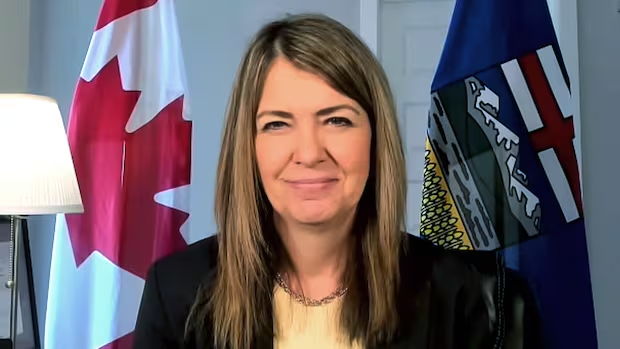
As Canadian premiers on Saturday decried U.S. President Donald Trump’s decision to impose 50 per cent tariffs on a swath of Canadian imports, political analysts say Alberta’s premier took a markedly different tone than her colleagues.
While premiers from most provinces and territories said they backed Prime Minister Mark Carney’s decision to impose counter tariffs on U.S. goods, dollar for dollar, Alberta Premier Danielle Smith said on her regular radio call-in show that she worried about the effects of a trade war on Alberta farmers, furniture makers and apiarists. She encouraged the Canadian and U.S. negotiators to return to the bargaining table.
“I know emotionally it feels good to retaliate, I get that. But . . . when retaliation happens, it means that everybody who is buying products from the United States are now going to face upwards of 50 per cent tariffs,” she said on the 880 CHED show, Your Province, Your Premier.
Smith’s diplomatic tone is driven by her attempt to stay in the good books of the U.S., which is Alberta’s most voracious oil customer, said political scientist Elizabeth Smythe, professor emeritus at Concordia University of Edmonton.
“The U.S. is not going to stop importing those fossil fuels,” Smythe said. “She thinks what she’s doing is the better approach. Now, whether all Albertans agree with that is another story.”
 Ontario Premier Doug Ford speaks to media at a housing development in Hamilton, on Monday, Aug. 24, 2026. (Nick Iwanyshyn/The Canadian Press)
Ontario Premier Doug Ford on Monday said he aimed to get Smith — and other premiers — open to using any counter-tariffs possible to force the U.S. to back off.
“It has to be a Team Canada approach,” Ford said at a press conference in Hamilton, Ont. “Everyone has to be singing off the same song sheet and there can’t be any detractors.”
He said, should U.S. tariffs escalate, Canada must be able to use counter-tariffs on oil and gas and potash exports as a tool
“A couple premiers have a lot of power to protect Canada’s massive power,” Ford said, hinting at Smith and Saskatchewan Premier Scott Moe. “I can’t speak for them, but we need everyone to be on Team Canada and throw everything in the kitchen sink at them.”
Ford and Smith, conservative leaders and frequent allies, had a phone call Monday afternoon.
In a written statement, Smith said she acknowledged the disproportionately steep impact the new tariffs will have on Ontario businesses and offered her support to strengthen the Canadian economy.
However, cutting energy exports to the U.S. “would be extremely harmful to Canadians and is not a viable option,” her statement said.
Alberta premier in delicate balancing act
Political observers say Smith’s relatively tepid tone in response to new tariffs are in sync with her approach since the trade war began last year.
Smith previously went on a charm offensive in the U.S., including a visit to Trump’s Mar-a-Lago home in Florida, and speaking at events featuring right-wing influencers, in what she said were efforts to stave off tariffs.
Strathmore, Alta.-based political analyst Deidre Mitchell-MacLean says the premier’s inner circle finds it challenging to criticize a government they feel politically aligned with.
“We’re seeing every other premier come out with their — let’s say — elbows up and Danielle Smith is not,” Mitchell-MacLean said.
 Deidre Mitchell-MacLean is a political analyst based in Strathmore, Alberta. (Submitted by Deidre Mitchell-MacLean)
However, with an October referendum looming on whether Alberta should remain in Canada or hold a binding referendum on separation, and polling suggesting most Albertans support national unity, Mitchell-MacLean thinks Smith has little leeway to take a strong stance on the issue.
Smith is caught, she says, between a political base that favours the idea of Alberta independence, and wanting to win a provincial general election in October 2027.
Consultant Deron Bilous, who served as a minister of economic development and trade in Rachel Notley’s Alberta NDP government, said there’s little political risk to Ontario’s premier proposing counter-tariffs that would cause his province minimal harm.
“It’s quite easy to negotiate with somebody else ’s poker chips, which is what Doug Ford is doing,” Bilous said.
He said tariffing oil and gas exports would have “massive” implications in Alberta, blowing a multi-billion dollar hole in the provincial budget, and causing the industry to halt any expansion or investment plans in the province.
 Deron Bilous was a cabinet minister in Rachel Notley’s Alberta NDP government from 2015 to 2019. (Emilio Avalos/CBC)
Although oil tariffs may be Canada’s biggest trump card, Bilous questioned the wisdom of playing that card so early when Alberta is so reliant on the U.S. as a customer. Bilous said Smith knows this, which fuels her reluctance to support such a move.
Bilous said he supports Carney’s decision to take other counter-measures against Trump.
“Bullies only respond to people that stand up to them,” Bilous said. “And the challenge with not imposing any kind of counter tariff on him — my fear is that it makes Canada look weak.”
Evan Menzies, vice-president of Crestview Strategy, who has worked for both the United Conservative Party and the former Wildrose Party, said Smith’s diplomatic approach has been effective so far, as Alberta exports remain less affected by U.S. tariffs.
The provincial leader has to maintain positive relationships with any U.S. administration, given the importance of the American market, he said.
Separation referendum is a bigger risk: analysts
While Ford says a lack of unity among Canadian premiers is a liability in U.S. trade negotiations, the analysts CBC News spoke with on Monday are far more concerned about the Oct. 19 referendum as a perceived weakness in the federation Trump can exploit.
Alberta voters will cast ballots on 10 referendum questions on Oct. 19, including a question about beginning a process to hold a binding vote on becoming an independent nation.
“The timing is awkward, for sure,” says Menzies, who added that Smith has been clear she will campaign to remain in Canada.
Bilous said the nuances don’t matter to investors, who shy away from uncertainty.
“If the perception is we don’t know if Alberta is going to stay in Canada, that has immediate economic development and investment attraction impact,” he said.
WATCH | Critics comment on Premier Danielle Smith’s tariff approach:
Why is Danielle Smith taking a different path in Canada’s trade war with the United States?
As the trade war with the United States rages on, many of Canada’s premiers are rallying behind Prime Minister Mark Carney. Alberta’s leader is taking a different path. As CBC’s Sam Brooks reports, some commentators believe Danielle Smith is walking a political tightrope.
Political scientist Smythe says Smith’s approach makes her appear as a Trump sympathizer.
“She’s already got that suspicion around her with this referendum,” Smythe said. “She claims she’s pro-staying in Canada. But if she moves too far in terms of appearing to be weak in her approach to standing up for Canada vis-à-vis the U.S., that’s a problem.”
The Alberta NDP did not make anyone available for an interview Monday, but is holding a press conference in Calgary on Tuesday to call on the government to take steps in response to what it calls Trump’s latest attack on Canadian sovereignty.
“Danielle Smith has approved a separatism referendum to save her political skin from her own separatist base,” NDP leader Naheed Nenshi said in a separate email statement. “This has weakened Canada in front of Donald Trump and the entire world.”
The Opposition is organizing a “Rally the Vote for Canada” tour to encourage electors to vote for Alberta to remain in Canada.