
Listen to this article
Estimated 3 minutes
The audio version of this article is generated by AI-based technology. Mispronunciations can occur. We are working with our partners to continually review and improve the results.
On the night of Aug. 27-28, a partial lunar eclipse will be visible across the country.
The eclipse comes roughly two weeks after the total solar eclipse that was seen across Iceland, Spain and a small portion of Portugal.
While this will be a partial eclipse, it will be a deep one, with 93 per cent coverage at its maximum.
Lunar eclipses occur when the moon moves through Earth’s shadow, called its umbra. Before it enters the umbra, however, it passes through Earth’s outer, dimmer shadow, called the penumbra. However, because it is much dimmer, it’s difficult to see with the naked eye when this occurs.
 This illustration shows the movement of the moon through Earth’s shadow for the Aug. 27-28 partial eclipse. (Sky &Telescope)
Most of Canada will see the entire duration of the eclipse, while Western Canada will see the partial eclipse already taking place as the moon rises.
The great news is that, unlike with a solar eclipse, you don’t need any protective eyewear to watch the event.
Also unlike a solar eclipse, a lunar eclipse takes place over hours, not minutes.
 All (or most) of the lunar eclipse on August 27-28 will be viewable across North and South America. (Leah Tiscione/Sky & Telescope)
When to see it
The eclipse will begin as the moon enters Earth’s penumbra at roughly 10 p.m. ET, but that’s not when you want to go out to start observing.
Instead, the visible part of the eclipse begins at 10:33 p.m. ET on Aug. 27 and ends at 1:52 a.m. on Aug. 28. The deepest part of the eclipse will occur at 12:13 a.m. with almost all of the moon appearing darkened.
This is just one of many astronomical events taking place this month.
“It’s kind of a fun one because … August had so many great things going on for it and still does,” said Elaina Hyde, director of the Allan I. Carswell Observatory York University’s department of physics and astronomy in Toronto.
“We had, of course, the very, very partial solar eclipse back on August 12th. We had the Perseids, which were either fabulous or slightly less fabulous, depending on how cloudy your skies were. And, of course, the Jupiter-Mercury conjunction.”
Will it be a “blood moon”?
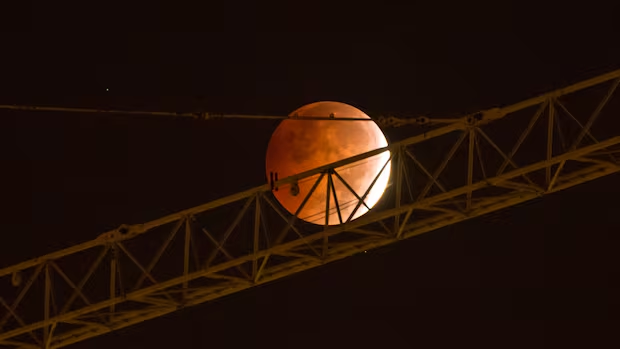
“It’s a partial eclipse, so it’s not going to turn 100 per cent red, but depending on where you are in Canada, it will still be pretty red,” Hyde said.
The great thing about lunar eclipses is that there’s no need for any equipment — just your eyes.
“This is a naked eye object, but if you have binoculars or a small telescope or just a [cellphone] camera with a really good night mode, you should be able to get pretty good pictures,” Hyde said.