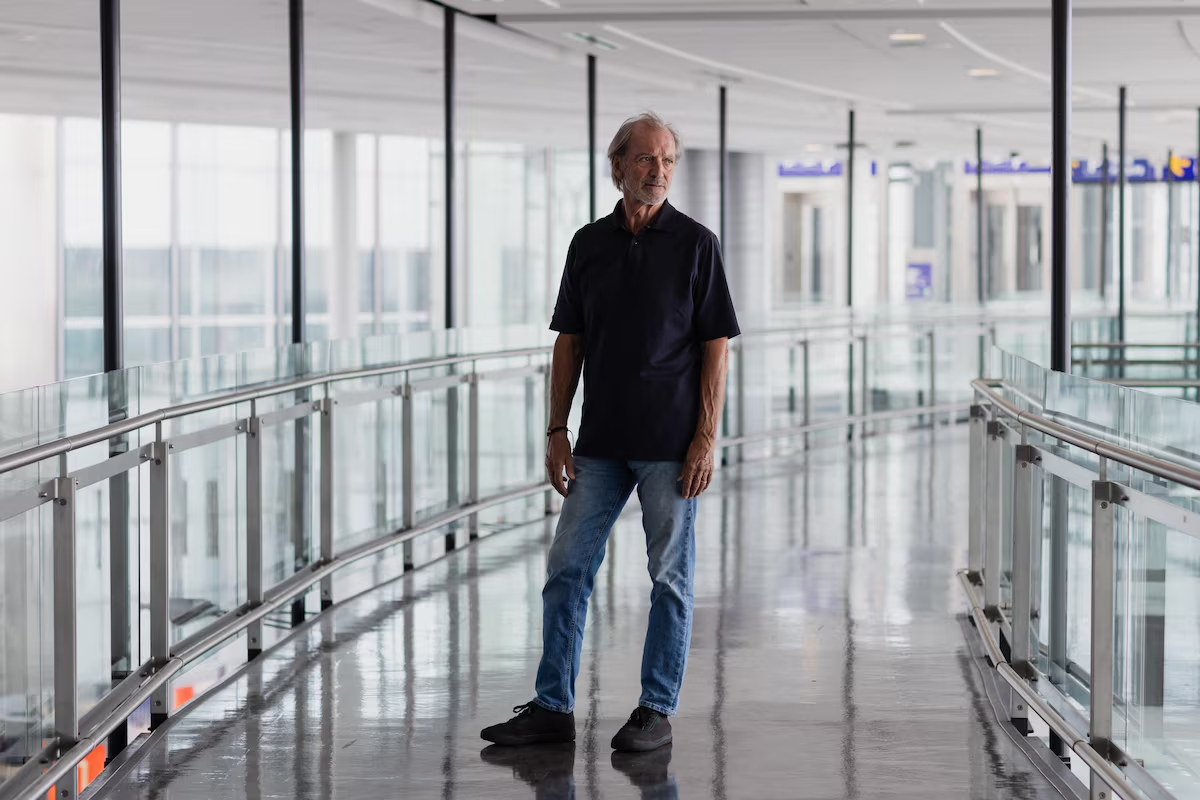
On Aug. 24, 2001, Air Transat Flight 236 ran out of fuel over the Atlantic Ocean on its way from Toronto to Lisbon. At the controls was Robert Piché, a 48-year-old Quebecker with a cool temperament and a past he was desperate to keep secret.
Driven by adrenaline and an instinct to survive, Mr. Piché steered the powerless A330 airliner for 19 minutes to the nearest piece of land. The plane touched down at the Lajes military air base on the island of Terceira, in the Azores, roughly 1,400 kilometres west of Portugal.
All 293 passengers and 13 crew members survived, and Mr. Piché was hailed as a hero. To this day, it’s still the longest glide by a passenger jet.
Landing this Airbus 330 in the Azores made Robert Piché famous. The next year, he and first officer Dirk de Jager got superior airmanship awards from the Airline Pilots Association.
AFP/Getty Images; Evan Vucci/AP
With the fame came momentary dishonour when reporters dug up his personal history and published the details. After an early career as a bush pilot, Mr. Piché fell into drug smuggling. In 1983, after a run from Jamaica, he was caught in an airfield in Georgia, U.S., with cannabis in his cargo hold. He was sentenced to five years in a Georgia prison and served 16 months – an experience he now says is directly tied to the outcome of Flight 236.
Mr. Piché also struggled with long-term dependency on alcohol. In 2007, 10 years before he retired from Air Transat, he created a foundation to support treatment for people with addictions, helping them fight the same demons that nearly tore him down. He also began giving motivational talks.
When I caught up to Mr. Piché in Mont Tremblant, Que., in July, I found a man at peace with his past, but still speaking with surprising rawness and candour. Wearing a pink T-shirt, grey shorts and sandals, his hair now silver and slicked back, he urged me to write a story “with a view of inspiring people.” We’ll leave that to him.
Here’s what the aviation legend had to say, with a few notes of our own.
Open this photo in gallery:
Pearson airport in 2001. Then as now, Air Transat was based at Terminal 3.Tibor Kolley/The Globe and Mail
At 00:52 UTC (8:52 local time) on Aug. 24, 2001, an Air Transat Airbus A330 departs from Toronto Pearson International Airport bound for Lisbon. On board are 293 passengers and 13 crew members, including Captain Piché and First Officer Dirk de Jager, 28. The plane is loaded with about 47 tonnes of fuel – 4.5 tonnes more than the regulated amount required for the planned flight.
How did that day begin?
I had flown into Toronto and was assigned the flight to Lisbon – it’s all done by computer. I tried to get someone else to take it because my wife’s friend was getting married and we were invited. But it didn’t work out. We were supposed to stay two days in Lisbon and then fly back. It started like any other flight. It was routine.

When an Air Transat Airbus A330’s engines flamed out over the Atlantic because of a fuel leak on Aug. 24, 2001, its survival partly depended on a set of aviation rules called ETOPS.* Throughout its route, a plane with twin engines must be close enough to emergency diversion airports that it can get to one in a fixed time, even if an engine were disabled. For the Air Transat flight, the limit was 120 minutes. However, for a large portion of the time, they were within one hour of land. Without ETOPS, a plane might choose a more direct route that could still strand them in danger if something went wrong.
Engines: 2 Rolls-Royce
Trent 772B-60
*Extended-range Twin-engine Operational Performance Standards. **Current livery.
john sopinski/the globe and mail
Source: faa; air transat image

When an Air Transat Airbus A330’s engines flamed out over the Atlantic because of a fuel leak on Aug. 24, 2001, its survival partly depended on a set of aviation rules called ETOPS.* Throughout its route, a plane with twin engines must be close enough to emergency diversion airports that it can get to one in a fixed time, even if an engine were disabled. For the Air Transat flight, the limit was 120 minutes. However, for a large portion of the time, they were within one hour of land. Without ETOPS, a plane might choose a more direct route that could still strand them in danger if something went wrong.
Engines: 2 Rolls-Royce
Trent 772B-60
*Extended-range Twin-engine Operational Performance
Standards. **Current livery.
john sopinski/the globe and mail ,Source: faa; air transat image

When an Air Transat Airbus A330’s engines flamed out over the Atlantic because of a fuel leak on Aug. 24, 2001, its survival partly depended on a set of aviation rules called ETOPS.* Throughout its route, a plane with twin engines must be close enough to emergency diversion airports that it can get to one in a fixed time, even if an engine were disabled. For the Air Transat flight, the limit was 120 minutes. However, for a large portion of the time, they were within one hour of land. Without ETOPS, a plane might choose a more direct route that could still strand them in danger if something went wrong.
Engines: 2 Rolls-Royce
Trent 772B-60
*Extended-range Twin-engine Operational Performance Standards. **Current livery.
john sopinski/the globe and mail ,Source: faa; air transat image
Nearly four hours after takeoff, at 4:38, a component swapped in at the last minute causes a fuel line on the plane’s borrowed right Rolls-Royce engine to crack.
The engine begins to leak fuel at a rate of 13 tonnes an hour into the Atlantic Ocean.
Around 5:00, during a mandatory position check, the crew notices unusual engine oil indications on the right engine.
What was the initial problem?
It started with the oil pressure and temperature. The readings didn’t make sense. If I was a mechanic, I might have understood.
But given that this was something that happens so rarely, even a mechanic might not have figured out the problem right away. The computer system was showing us a fuel imbalance instead of a leak.
Open this photo in gallery:
Portuguese officials inspect the A330 a few days after its landing in Lajes. Both engines were starved of fuel over the Atlantic.Humberta Augusto/The Associated Press
At 05:33, an advisory flashes on screen, and Mr. Piché and Mr. de Jager note a fuel imbalance between the two engines. They transfer fuel from the left engine to the right, a procedure Mr. Piché performs from memory. Twelve minutes later, the plane has 8,500 kilograms less fuel than it should – not enough to reach Lisbon. The crew radioes local air traffic control that it’s short of fuel and diverting to tiny Lajes.
Mr. Piché has logged 16,800 flight hours, Mr. de Jager 4,800. In all that time, neither of the pilots has ever encountered a fuel leak or unexplained low-fuel reading before, either in training or while in the air.
You were never able to confirm that there was a leak, were you?
No. I was thinking that this couldn’t be happening in the middle of the ocean, on the most sophisticated commercial airliner flying at the time. It didn’t make any sense. We should have understood that there was a leak. But the computer – that’s not what it was telling us.
When an advisory warning flashes, you don’t want the fuel page to come up. The pressurization page, the heating system, the electrical, the hydraulics, maybe. But not fuel. You’re in the middle of the ocean. You try to process that as the captain, but your human side says, “Today, we’re going to die.”
People sometimes think I wasn’t scared because I landed the plane. But that’s not the case. When the fuel page came up, I was scared right away.
Open this photo in gallery:
Meleni Tesic, at right with Mr. de Jager and Mr. Piché in 2001, managed the cabin crew on Flight 236.Paul Chiasson/The Canadian Press
Around 5:45, the pilots ask the cabin crew – led by flight director Meleni Tesic – to visually check the wings and engines for a possible fuel leak. As the passengers watch the in-flight movie, Chocolat, a member of the crew shines a flashlight toward the wing. But it’s pitch-dark outside. They see nothing.
If it had been a daytime flight, would the flight attendants have seen the leak?
The passenger sitting behind the right engine would have seen the leak and pressed that call button – ding dong. That kind of observation has saved me in the past, while I was flying on the Lockheed L-1011. We had a double leg, and during one stop, a passenger pointed out to the flight director that something on the wing wasn’t right. One of the airbrakes was detached. If it weren’t for him, we might have flown on. That passenger did us a favour.
So if a passenger on 236 had seen the leak, I would have sent the first officer to check. Then we would have done the procedure for a loss of fuel.
The accident report found that you didn’t follow the fuel-check protocol.
Yes, I was blamed for that.
Did you agree with that conclusion?
Yes and no. I’m an old dinosaur. Young people today would probably react differently, because they rely on computers 100 per cent. I come from an older system. I didn’t come into this world with an iPad in my hands. Like many people in my generation, I had to learn to use computers.
The report also says that if you had accepted the premise that the plane was spilling fuel, then according to the protocol, you would have to descend to 20,000 feet. But at that altitude, you weren’t sure you’d have enough fuel to get much further, since aircraft burn more fuel at lower altitudes.
If I had followed that procedure, we would all be dead. The first officer was telling me the procedure. But I said “no, no, no.” In that situation, altitude becomes my fuel.
Based on the Portuguese island of Terceira, the Lajes air base is still used today by U.S. military aircraft, who find the Azores a convenient place to refuel on transatlantic flights.
AFP/Getty Images; Evan Vucci/AP
At 6:13, the plane’s fuel-starved right engine flames out.
Ten minutes later, Mr. de Jager declares “mayday.” At 6:26, with Flight 236 still 120 kilometres away from Lajes, at an altitude of roughly 34,500 feet, the left engine shuts down, too.
Inside the cabin, the lights go out and everything goes silent, except for the sound of air buffeting the fuselage. “We’re going to die,” one passenger screams.
What was it like in the cockpit?
It was calm, but we were both on edge. The prospect of dying was there. De Jager was more closed off. He was 28 and already a co-pilot on an A330.
Were you aware of what was happening in the cabin?
No. We have a communications protocol – the flight director is in charge back there. And when we have a problem in the cockpit, it’s them we advise. Then, the flight director advises the other flight attendants and the passengers. At the start, the briefing I gave to the director was that she prepare the cabin for a ditching at sea. That was the worst-case scenario. Hope for the best, but prepare for the worst.
Open this photo in gallery:
‘It was calm, but we were both on edge. The prospect of dying was there,’ Mr. Piché says of the mood in the cockpit in 2001.Selena Phillips-Boyle/The Globe and Mail
Meanwhile, in the cabin, passengers alternately gasp, scream and pray. Oxygen masks drop from the ceiling. Through tears, a Portuguese-speaking flight attendant delivers an announcement telling passengers to prepare for an ocean landing.
Some passengers described a lot of screaming. You didn’t hear that?
No. You’re focused pretty hard in the moment. You know, when you get into, I’ll call it the zone, you’re in a bubble. It’s a high level of concentration. Everything kind of slowed down. It’s adrenaline, survival instinct.
What was going on in your head when the second engine stopped?
I remember lowering my head and saying, ‘This can’t be happening.’ Through hard work and determination, I had gotten back to being the captain of a big jet, which I should have been long before I went to prison. I’m on the most sophisticated plane you can fly, and it’s now a glider over the Atlantic, at night, with 306 passengers on board. This can’t be happening. ‘Why me?’ you know?
And when I raised my head, I saw that the plane was reacting well. That’s when I decided to keep my altitude as long as possible.
How do you maintain altitude without engines?
You play with the stall warning. When a plane has no power and you keep it level, it loses speed. And when it loses speed, it will stall. So when there was a warning, I’d drop the nose a little bit to keep one or two knots faster than the warning. It didn’t allow me to keep the plane level, but we didn’t descend fast. Bit by bit, the adrenaline was increasing. Because you tell yourself, ‘I’m not going to crash in the water. I’m going to get to the island.’ And then it became, ‘At worst, I’m going to land in a field on the island.’ It was a gradual realization that I’d be able to get to the airstrip.
How do you control a dead stick?
A journalist once asked Tiger Woods how he could win tournaments with one stroke. He said, ‘On competition weekends, when I’m able to get in the zone, it’s like I become my club.’ Meaning that when he hits the ball, he knows exactly where it’s going to go because his state of concentration is at its maximum. He’s focused on nothing else. So it’s not something you know or you don’t know. I became the plane. Do you understand?
At a certain moment, you saw the runway at Lajes.
The first thing we did was ask the control tower to flash the runway lights. So I could see the island, just a little sliver of light. When I knew I’d get to the airport, it became like one more landing, like the kind I’d been doing for 30 years.
You circled once before landing.
We did a 360. That was to calm my first officer – I didn’t want him to jump on the controls. He kept telling me, ‘We’re too high, too fast.’ But he didn’t know what was going on in my head. I wanted to be too high, too fast, so that I could keep some speed and altitude in case I needed it. From his perspective, landing a normal plane in normal conditions, he could see that we were too high. His reaction was normal.
But he did his job, which is to follow orders. That’s what you learn in the simulator. I always give him an honourable mention because he did what he needed to do. I don’t know if I would have done the same thing in his place, flying with a guy I barely knew. I think I would have jumped on the controls.
I thought you circled to get lower for landing.
That’s what we do normally when we arrive at an airport, and we’re too high and too fast. A big plane is like a 28-wheeler on the road. It doesn’t stop like a Volkswagen stops. You’ve got to slow down. You’ve got to be in the slot.
But were you too high and too fast?
For sure – I had to be. You can’t be too low and too slow. As a captain of a big jet, you’re always 100 miles ahead of your plane. You’ve always got to be planning further ahead. Even if the chances are 90 per cent that you’ll land, you’ve got to prepare for the 10 per cent. You can’t be caught with your pants down at the last minute.
What could you see out the window?
It was still dark. You have to be at the right place at the right time at the right speed. But my speed was too high to keep the nose up and not stall. So I didn’t know when I needed to lose altitude, when I should go down. My concern was lowering the wheels.
The gear doors open, the wheels come down and the door shuts again. But this time, the doors didn’t close, and that would produce drag. So I’d need to come down 2,000 feet per minute to keep my speed and not stall. If I wasn’t high enough, I’d crash 500 feet before the runway. That’s why I wanted to keep my altitude. My worry was the wheels.
Open this photo in gallery:
Passengers had to hurry down the emergency slides in Lajes, in case the plane exploded on the tarmac.Humberta Augusto/The Associated Press
At 6:45, the planes hits the Lajes runway hard, at roughly 370 kilometres an hour, and bounces once.
Passengers are pitched forward as the plane scrapes and grinds to a stop. Some of them begin to cheer and applaud, until the crew starts rushing them toward the exit slides – there’s a fear the aircraft could explode on the ground. But when several small fires ignite near the landing gear, they’re immediately extinguished by crash responders. During the evacuation, 16 passengers and two members of the cabin crew are injured. As for the plane, it shows signs of structural damage to the fuselage and main landing gear.
So when you landed, you bounced, and almost all the tires exploded.
Yes. The wind was coming from the side, and in a big plane like that, when the wind hits from the side, it tends to move. So you’ve got to put it down, touch the wheels, stay in the middle of the runway. All of that is complicated, but it happens fast. And that’s where experience counts. When I bounced once, I said, ‘I’m going to brake on the rebound so the plane sticks.’ As soon as the plane touched down again, I braked. That prevented another bounce, and the tires exploded.
You’ve said prison helped you in that moment. How?
Day and night, you’re dealing with the possibility of a physical attack, a sexual attack. And you can’t let on that you’re bothered by it, either. You’ve got to stay cool, because if you don’t look cool, you become vulnerable. You’ve always got to be ready.
When you landed, you high-fived your first officer.
Yes, and I said, ‘I told you we would land it.’ That’s easier to say after the fact than before.
Open this photo in gallery:
All 293 passengers and 13 crew members survived their glide to Lajes, where they continued the journey to Lisbon via a ferry and another flight.Humberta Augusto/The Associated Press
The dazed passengers stumble into the tiny Lajes terminal, where they wait for several hours before being offered beds in the nearby U.S. Air Force barracks. Before long, they’re shuttled to the ferry docks, where a five-hour boat ride delivers them to another airport, from where they’re taken to Lisbon.
Mr. Piché is the last person to leave the plane.
You received no training for this type of situation.
Correct. Now, I think they have a protocol for something like that. With my past as an offender, I didn’t follow procedure – not because I’m better than someone else or smarter. It’s that I had this survival instinct I developed in prison.
Do you think there’s too much trust in technology now and not enough credence given to pilot instinct?
That’s not for me to say. But I will say that the young first officers I flew with at the end of my career were highly trusting of electronics. Today, it’s about minimizing human decision-making to minimize human error. The statistics tell the tale. In the 1950s, when commercial aviation started, crashes were higher.
Flying a plane when everything is going well, any penguin can do that with a bit of experience. But you’re always waiting for what could happen. And that pending problem happened to me. Being captain of a big jet is a big responsibility. And technology is maybe stripping away that side of it.
What do you say to people who ask why Robert Piché pushed the transfer valve that shifted the fuel to the leaking side of the plane?
Because he’s an old dinosaur. I learned how to fly on the job. When I started to work in aviation, there was no formal training. The boss said to me, ‘Get in, and we’ll show you how it works.’ So you develop reflexes that someone with structured training, good training, who starts flying right away at Air Canada, might never have.
But do you accept the criticism that your decision to hit that switch worsened the situation?
Of course. If I didn’t have that side to me, I should have understood that it was a fuel leak and shut down that engine.
Open this photo in gallery:
David Collenette, federal transport minister at the time of the fuel leak, would announce a $250,000 fine against the airline for improper maintenance.Kevin Frayer/The Canadian Press
Open this photo in gallery:
Under CEO Denis Jacob, Air Transat would co-operate with a three-year-long accident investigation.Marcos Townsend/The Canadian Press
The accident investigation – led by the Portuguese flight authority and assisted by the Transportation Safety Board, Transport Canada, Air Transat and engine maker Rolls-Royce – took more than three years to complete.
It found that several factors contributed to the accident, including a maintenance error by the airline. The report recommended improvements to the leak-detection systems on board all A330 aircraft, along with improved checklists, flight manuals, pilot training, as well as the procedures and regulations governing the replacement of major components.
As for the crew, the report found that they failed to correctly evaluate the situation and follow procedure for a fuel leak. Nonetheless, it noted that Mr. Piché’s skill averted a full-on disaster and saved all 306 lives on board.
Do you think a lot about Flight 236 these days?
I don’t have to think about it – I get asked about it constantly. People on the street, everywhere. It’s been going on for 25 years. I do corporate conferences. We do no publicity for these and people still come.
And what’s your message?
It’s about stress management, handling adversity. How do you make a decision when you know you’re going to die? It’s like in the army; the sergeant who says, ‘We’re going through the wall. And there’s gunfire on all sides, but don’t worry, we’ll make it.’ How do you follow the sergeant? Because he also believes it, because of his experience, adrenaline – all of that mixed together.
Open this photo in gallery:
Quebec’s legislature gave Mr. Piché a medal of honour for his actions in 2002.Jacques Boissinot/The Canadian Press
You said you often ask the question ‘Why me?’ Have you ever come to an answer?
I think it was maybe I was chosen. Why did this not happen to someone who had a more normal past? I’m in anonymous associations a lot because I was an alcoholic. It’s been 24 years. At AA, the worst of those who are there are airline captains. What happened on Flight 236 gives some credibility to my words, to help alcoholics. That’s a piece of the answer. If this hadn’t happened, I’d probably be dead from alcohol. The way I drank was nuts, you know? This was a chance to reclaim what I did in the U.S.
And I didn’t follow protocol in the sky. But as I said, altitude became my fuel. I knew I was going against the industry, especially against Airbus and their procedures. I knew I was David against Goliath. But it wasn’t them sitting in the cockpit. It was me.
This interview has been edited and condensed.