
Listen to this article
Estimated 4 minutes
The audio version of this article is generated by AI-based technology. Mispronunciations can occur. We are working with our partners to continually review and improve the results.
A coroner’s report has found that a 29-year-old man’s death following a police altercation was accidental, but that the technique police used by officers to restrain him was a probable contributor.
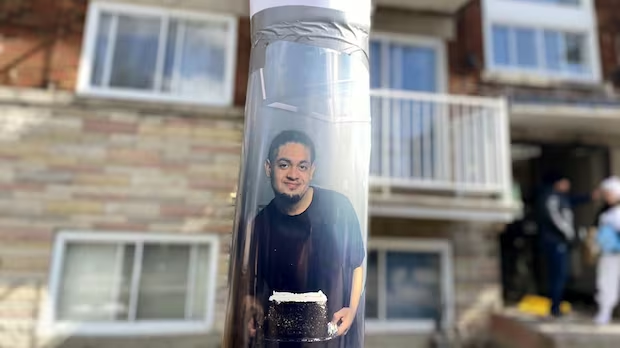
Abisay Cruz died on March 30, 2025 following an altercation that began on the back balcony of an apartment in the city’s Saint-Michel neighbourhood.
He was one of two people who died following separate Montreal police operations within a 12-hour window that weekend. His death and footage that showed parts of the intervention that circulated on social media sparked protests in the neighbourhood and heightened many people’s sense of distrust toward police.
The “hogtie technique,” used by police in this case, refers to a neutralization technique that binds someone’s limbs together behind their back while they lie on their stomach.
Coroner Géhane Kamel concluded that Cruz’s death was attributable to “cocaine intoxication and probable positional asphyxia in the context of a police intervention.”
In reference to the hogtie technique, Kamel wrote: “This restraint method is largely discouraged and is restricted, or even banned by several police or medical organizations, due to its link to the deaths of people in detention as well as serious concerns related to safety and fundamental rights.”
She added that it was “highly likely that the restraint method contributed to the death.”
The report provides a detailed account of Cruz’s last moments and highlights conflicting versions of events provided by his family and the police officers present.
WATCH | What the coroner found:
Coroner cites restraint method by Montreal police as factor in Abisay Cruz’s death
A coroner’s report has found that 29-year-old Abisay Cruz’s death following a police altercation was accidental, but the hogtie technique used by officers to restrain him was a ‘highly likely’ contributor.
5 police officers involved in altercation
In her report, Kamel writes that Cruz was the second youngest of five siblings, described by his loved ones as an affectionate person with a close bond with his family.
In the weeks leading up to his death, Cruz faced deportation to Honduras, which was likely a major source of stress for him, the coroner wrote.
On the day of his death, someone called 911 to report a man, later identified as Cruz, who appeared to be in crisis near the corner of Pie-IX Boulevard and 47th Street.
Kamel points out that the version relayed to her by police suggests Cruz represented an “immediate physical threat.”
But other witnesses reported a different version, with one stating that Cruz was seated with his hands up and seemingly willing to communicate with police prior to the intervention escalating.
Still, Kamel wrote that it was reasonable to believe that there was an immediate threat to the people inside the apartment and Cruz himself.
In total, five police officers were involved in restraining Cruz. Montreal police did not immediately return a request for comment Thursday.
 Friends and family of Abisay Cruz at a vigil following his death. (Paula Dayan-Perez/CBC)
Coroner recommends banning technique
The province’s independent police watchdog, known as the BEI, investigated Cruz’s death, and the prosecution service concluded in March 2026 that no criminal charges would be laid against the officers.
However, Kamel flagged concerns about the police response. Officers kept Cruz pinned face-down for more than two minutes before shifting him to his side, she said.
The coroner also pointed to a lack of leadership from a police sergeant on the scene, writing that the supervisor failed to step in or issue corrective directives as Cruz’s condition deteriorated.
In her report, Kamel called on the SPVM to officially ban the hogtie technique, and advised the police service to equip its officers with naloxone kits and to deploy body-worn cameras for officers responding to people in crisis or handling situations that involve the use of force.
The report also criticizes the response from Urgences-santé. According to Kamel, Urgences-santé was experiencing recurrent service shortages. On the day Cruz died, there was only one advanced paramedic team available for the entire island of Montreal, she said.