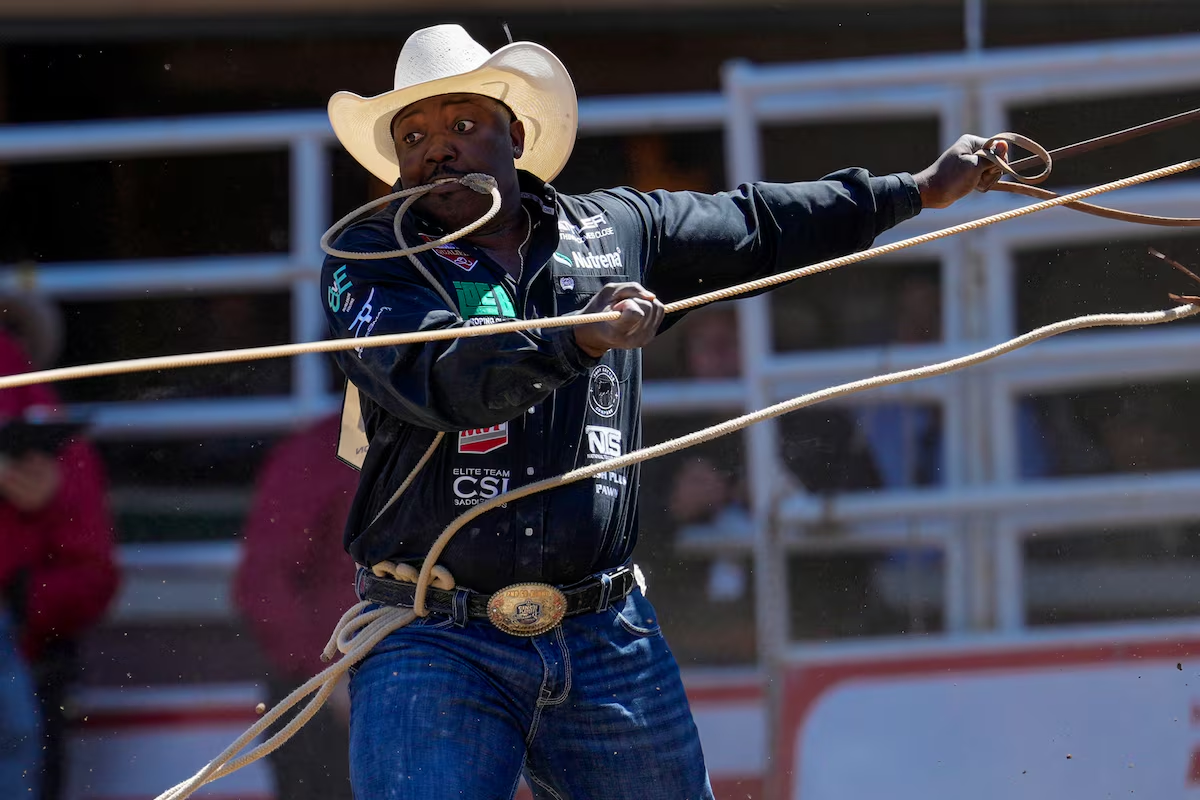

At the Calgary Stampede in July, American calf-roper John Douch came roaring out of the gates on his 12-year-old horse, a black gelding named Tomcat.
Barely any time elapsed as he roped the escaping calf and tied it up, before throwing his hands into the air: 7.4 seconds.
It’s one of the oldest skills in ranching. There is no room for mistakes. And Mr. Douch happens to be one of the fastest in the game. After qualifying five times in a row for the National Finals Rodeo held annually in the United States, he is currently ranked sixth in the world, according to the Professional Rodeo Cowboys Association.
“I love rodeo so much, and I love the history of it, so that’s why I stuck with it,” he said during an interview in Calgary.
The 29-year-old tie-down calf roper from Huntsville, Tex., placed third in the Calgary Stampede’s finals the past two years in a row, clocking an impressive time of 6.6 seconds in 2025. At this year’s Stampede, he placed second in his pool, earning $14,500 to advance to the finals, where he finished third again for an additional prize of $10,000.
Open this photo in gallery:
John Douch has earned more than US$1.3-million on the professional rodeo circuit since 2018, and the recent Calgary Stampede added to that total.
Mr. Douch is a standout star on the rodeo scene, taking time in Calgary to pose for pictures with fans and sign autographs. He’s also one of only two Black cowboys, both American, who competed at the Stampede, among more than 200 competitors from across Canada, the U.S., Mexico and Australia.
To Mr. Douch, representation in a sport he loves so much is important for future generations to see. “[To] have the younger kids watch me and be like, ‘He’s African American, I want to be like him when I grow up,’ I think it’s pretty cool,” Mr. Douch said.
While all-Black rodeos and associations have been on the rise in the U.S., similar opportunities are still lacking north of the border, making the appearance of Black cowboys at Canadian rodeos a rarity.
Yet the Canadian Prairies have a long history of Black cowboys renowned for their skill in both ranching and rodeo. Many came to Canada from the U.S. during the high time of cowboys in the late 1800s, aiming to escape racism and prejudice and chasing the promise of a new life. Around the turn of the century, things began to change.
Where did all the Black cowboys go?
One of Mr. Douch’s rope cases commemorates the last four times he went to the NFR. Sturdy gear and nerves of steel are critical in competitive tie-down roping: Every second counts.
Open this photo in gallery:
Since its debut in 1912, the Calgary Stampede has been a magnet for ropers hoping to earn prestige and cash prizes.Supplied
Rodeo and agricultural exhibitions existed in Alberta from its beginning, as impromptu ways for cowboys to show off and test their skills at ranching and roping. When the province joined confederation in 1905, most settlers were white anglophones.
The Calgary Stampede as a festival was officially born in 1912. American Guy Weadick wanted to add an American-style Frontier’s Day to an existing Calgary agricultural exhibition, as well as a cowboy competition to celebrate “rural heritage and ranching in the west.”
Rodeos as we know them today began at the turn of the 20th century as a decline in real-life cowboys gave way to homesteading and agriculture, said Calgary author, poet and scholar Bertrand Bickersteth.
“What happens is now we want to sort of capture this nostalgia, this livelihood or this lifestyle that most people were not familiar with when the cowboys were actually out on the frontier by themselves,” Mr. Bickersteth said.
Born in Sierra Leone and raised in Calgary, Mr. Bickersteth has written about the history and experiences of Black settlers and cowboys in Alberta, and is working on a book about it. Black cowboys, Mr. Bickersteth said, were always part of rodeo.
“Certainly we know that even in the Calgary rodeos that there were Black people who were there, for sure. There’s just not a clear record of their names or anything like that,” he said, referring to historical records such as memoirs and newspaper articles.
Open this photo in gallery:
Black rancher John Ware – with his wife, Mildred Lewis, and two of their children in 1896 – would leave a lasting impression on Alberta cowboy lore.Glenbow Archives
One of those who competed in early exhibition rodeos before the 1900s would go on to be one of the most famous cowboys in Canadian history: John Ware. He had a “massive reputation” as one of the most skilled cowboys of the era, Mr. Bickersteth said. “He gets credited for being one of the inspirations for the Calgary Stampede.”
Born into enslavement in the U.S., Mr. Ware came to Alberta in 1882. After his emancipation, he became a successful rancher and cowboy in Texas. He came to Canada on a cattle drive that brought him through Montana and Idaho.
Cheryl Foggo, a Calgary community historian, author and playwright, is considered the expert on Mr. Ware’s story. “He very quickly became a valued member of the ranching community as a cowboy, as a hired hand on a number of our biggest ranches,” she said.
Mr. Ware established two successful ranches, the first near Millarville, south of Calgary, where he lived for 12 years before moving his family east to Duchess near Brooks.
Mr. Ware and his wife, Mildred Lewis, lived there with their five children until both died in 1905. Despite only living in Duchess for three years, Ms. Foggo said the family left a “big footprint” in terms of their influence, particularly with their approaches to irrigation and cattle dipping.
In 2022, Mr. Ware was officially recognized by the federal government as a national historic person. But both Ms. Foggo and Mr. Bickersteth said it’s important to remember that Mr. Ware was not the only Black cowboy to settle in Alberta. “If you really know the true story, it tells us that John Ware was here in community with others, that he was by no means the first or only Black person here, and that Black people were part of the fabric of those industries that we think of as the foundation of Alberta,” Ms. Foggo said.
According to the most recent census data from 2021, 4.3 per cent of Albertans self-identified as Black, making them the third-largest racialized group in the province. More than 90 per cent lived in urban areas, mainly Edmonton and Calgary.
Nearly two-thirds of Black Albertans were born outside of Canada and identified as first-generation Canadians, the census data show. Only about 5 per cent described their families as living in Canada for at least three generations.
Ms. Foggo herself is a descendant of Black settlers from the now-deserted Amber Valley, north of Edmonton, who migrated from the American south in the 1910s.
All-Black communities like Amber Valley were essential in Alberta for Black immigrants facing the kind of racism and prejudice they had tried to escape in the U.S.
“[Mr. Ware] knew there was a lot of racism that he faced,” Ms. Foggo said, adding that while the cowboy’s story is held up as a successful example of Black settlement in Canada, the racism he experienced means it can also be seen as a “cautionary tale.”
Open this photo in gallery:
The Mapp and Hinton families, at home in Alberta’s Amber Valley around 1925, once belonged to a large Black community here.Glenbow Archives
The cowboy era ended to make way for homesteading, and with it came a change for Black settlers, Mr. Bickersteth said.
“There was a pretty strong campaign against Black immigration,” he said, citing a federal Order-in-Council issued in 1911 to prevent further Black settlement, stating the “race is deemed unsuitable to the climate and requirements of Canada.”
The Edmonton Board of Trade made a similar resolution that same year, cautioning of the “disastrous influence on the welfare” of the province as a result of Black settlement.
“Essentially they created an atmosphere supported by the general public that prevented the wide-scale migration of Black people from the U.S.,” Mr. Bickersteth said.
Black families became increasingly isolated in the 1910s, he added. “I think that whoever was involved in ranching and cowboying really now no longer has a very strong community base to connect to.”
Open this photo in gallery:
Black cowboys are mostly absent from 20th-century pop culture, even when Hollywood’s western boom was at its peak. This child at a Toronto supermarket in 1953 is living out the exploits of Roy Rogers, then one of cinema’s most famous rodeo men.The Globe and Mail
Mr. Bickersteth said western literature was dominated by dime novels featuring white protagonists. And later, as western movies became prominent, white actors such as John Wayne made it so that the history and presence of other Black cowboys was “eclipsed” in popular culture and how the public imagined the west.
“Those people who inherited those stories then also believed that there was no such thing as Black people here,” he said, adding that what people thought of as western culture was just a “fragment” of the real story.
Mr. Bickersteth said many historical records exist of “unnamed” Black presences, like a young Black jockey subduing a rogue horse at a rodeo, or a newspaper clipping about Mr. Ware and his wife going on a double date with another Black couple and their carriage getting struck by lightning.
“I do think it’s important to actually keep pointing that out, and we can celebrate those presences,” he said.
Open this photo in gallery:Open this photo in gallery:
Over the decades, African-Americans have celebrated their western heritage at events such as the Black Cowboy Festival, held annually in South Carolina.Sean Rayford/Getty Images
While there is little Black presence in Canadian cowboy culture today, across the border, Black rodeo has a different story.
In 1984, Lu Vason launched an all-Black rodeo named after African-American cowboy Bill Picket, to change the narrative of an “all-white” cowboy culture. More than 40 years later, the Bill Pickett Invitational Rodeo still celebrates and honours Black cowboys and cowgirls, touring across the U.S.
Black Rodeo USA has also created a network of rodeos for Black cowboys, expanding from an invitational Arizona Black Rodeo in 2011 to a full tour across nine cities this season.
In Canada, no formal all-Black rodeo or rodeo association exists to date.
Ms. Foggo said rodeo in Canada is similar to stories she was told as a girl about how Black people didn’t belong in hockey.
“People have barriers around certain sports out of a desire to keep Black people out of them, and I believe rodeo is one of those,” she said.
“So many Black athletes in rodeo have pushed back, or have had their own rodeos and demonstrated that we have the skills to do those things.”
After stretching, John Douch is ready to queue up with other competitors in Calgary. ‘I love rodeo so much, and I love the history of it, so that’s why I stuck with it,’ he says.
The Calgary Stampede is just one stop on John Douch’s journey to qualify for the National Finals Rodeo for a sixth time and earn his first gold buckle as a national champion.
“If you win a lot of money here, it’ll help you in the world standards to get to the National Finals Rodeo, and the National Finals Rodeo is like the Super Bowl of football, but just rodeo,” he said.
Mr. Douch has won more than US$1.3-million in his professional career since 2018, surpassing US$127,000 this season alone.
Just before the Stampede, Mr. Douch and Tomcat rode to an arena record in Basin City, Wash.
“I like to ride Tomcat on the fastest starts like this,” Mr. Douch said.
He said he has about eight or nine more years of competing ahead of him. Then he plans to open up a rodeo school for “anybody to be the best they could be.”
Open this photo in gallery:
Mr. Douch’s job is done when the calf is securely tied up.
Mr. Douch said he has been lucky to have the support of mentors, like eight-time world champion and ProRodeo hall of famer Joe Beaver, to help get him to where he is – opportunities he said aren’t always guaranteed for other African-American cowboys.
“Growing up in the South, there’s so many guys that rope good, or do everything and have been good. They just don’t have the funds to get down the road,” Mr. Douch said.
Visibility is key to ensure more Black cowboys get into the circuit, he added, mentioning cowboys he grew up watching, including ropers Bud Ford, Fred Whitfield and Sylvester Mayfield.
Mr. Mayfield’s son Shad also competed at this year’s Stampede, where he failed to qualify for finals after being the 2025 champion for tie-down roping.
“I was watching them on TV and I’d be like, ‘I want to be like those guys when I grow up,’” Mr. Douch said.
“I want to follow the footsteps of them.”
The cowboy way: More from The Globe and Mail
The Decibel podcast
Breakaway roping is a relatively new event where women can make their mark in Canadian rodeo. The Globe’s Jana Pruden spoke with The Decibel about the emerging scene and the women who fought to create it. Subscribe for more episodes.
Out on the range
When wildfires struck, B.C. ranchers called in the cowboy cavalry
Efforts to restore herd of Montana bison stumble into Trump-era politics
The Alberta teen trailblazing her way through professional bull riding