
Listen to this article
Estimated 5 minutes
The audio version of this article is generated by AI-based technology. Mispronunciations can occur. We are working with our partners to continually review and improve the results.
WARNING: This story contains details of violence against Indigenous women, as well as references to racist beliefs and behaviours. Resources can be found at the bottom of this story.
The man convicted of manslaughter in the 2017 death of Barbara Kentner in Thunder Bay, Ont., has been granted full parole with conditions.
The decision regarding Brayden Bushby, who was sentenced five years ago to eight years in prison, was made by the Parole Board of Canada (PBC) on Thursday, according to documents provided to CBC News on Tuesday.
“The board considered all relevant available information including file information, victim information, Correctional Service of Canada’s recommendation and the oral presentation at the panel hearing,” the documents say.
It said releasing Bushby on full parole won’t post “undue risk” and “will contribute to the protection of society” by facilitating his reintegration “back into society as a law-abiding citizen.”
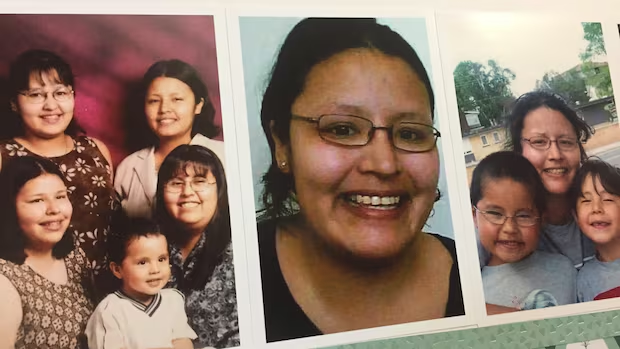
Kentner, 34, died from medical complications in the months after being struck by a trailer hitch thrown at her from a moving vehicle. She was a member of Wabigoon Lake Ojibway Nation, and is remembered by her family as a loving mother, sister, cousin and aunt.
Bushby was sentenced in June 2021. Due to time already served, the prison term was reduced to seven years and 11 months. The now 27-year-old has two children.
 Brayden Bushby, centre, is seen heading into court in Thunder Bay with his defence team, George Joseph, left, and Ryan Green in 2020. (Marc Doucette/CBC)
CBC News has reached out to Kentner’s family and Wabigoon Lake Ojibway Nation for comment and will update the story with any responses.
Bushby was first granted day parole in August 2023. It was revoked in July 2024 after the PBC said he violated various conditions. At that time, Kentner’s sister, Melissa Kentner, told CBC News, “I thought I was going to have a heart attack” upon hearing the news.
He was granted day parole again in December 2025 for six months and denied full parole, and granted three more months of day parole in June 2026 in a community-based residential facility, which the PBC says is also a substance abuse treatment centre.
Full parole allows an offender “to serve part of their sentence under supervision in the community under specific conditions,” according to the government of Canada’s website. “Offenders on full parole typically reside in a private residence.”
‘Lots of drinking and bad decisions’
During Bushby’s pre-release hearing on Thursday, he attributed his offence “to lots of drinking and bad decisions.”
“You denied targeting the victim [Kentner] and maintained what happened was a result of having been drinking for three days and making stupid decisions,” the PBC documents say.
 People gather outside the former Camelot Street courthouse in Thunder Bay as Superior Court Justice Helen Pierce delivered her decision in the manslaughter trial against Bushby in 2020. (Marc Doucette/CBC)
After Bushby was first granted day parole, he got a Confederate flag tattooed on his chest.
“You said you once purchased a truck from the United States with a Confederate flag and liked it. You have a southern heritage and the choice of your tattoo was not about racism,” the PBC documents say.
“You agreed the tattoo was one of your choices, and say you fell asleep during the process and were unaware of the final tattoo until it was completed.”
Bushby was also involved in a minor vehicle collision in March 2024, left the scene and failed to report what happened to his case management team.
“It was also noted that you were suspected to be involved in the theft of a motor vehicle,” say earlier documents from the PBC.
The following month, Bushby was pulled over and found to be under the influence of alcohol.
In August 2025, the parole board said he was referred to work with a Black offender liaison officer after being observed on video surveillance “cutting a swastika into the institutional lawn.”
In discussing this incident, “you said it was not your finest moment and that you were not thinking clearly. You did not fully comprehend or understand what it symbolizes, the connection to the atrocities until you took the programming with the Black Cultural Advisor,” the PBC documents say.
Conditions of Bushby’s release
The PBC acknowledged the many victim impact statements from Kentner’s family and friends as well as Indigenous organizations and representations, which speak “to the impacts of another Indigenous woman losing her life, and the huge impacts on the community given the intergenerational impacts of historical and recent losses and trauma.”
Bushby must follow seven conditions to maintain full parole, including:
- Following a treatment plan/program related to substance abuse, attitude, mental health and emotions management.
- Not associating with individuals known or suspected to be involved in criminal activity and substance abuse.
- Not consuming, purchasing or possessing drugs besides prescribed medication.
- Not consuming alcohol.
- Not entering establishments that primarily sell alcohol.
- Not contacting Kentner’s family, directly or indirectly.
- Reporting all sexual and non-sexual relationships and friendships to his parole supervisor.
Support is available for anyone affected by the issue of missing and murdered Indigenous people. Immediate emotional assistance and crisis support is available 24/7 through a national hotline at 1-844-413-6649.
Mental health counselling and crisis support is also available 24 hours a day, seven days a week through the Hope for Wellness hotline at 1-855-242-3310 or by online chat at www.hopeforwellness.ca.