
Open this photo in gallery:
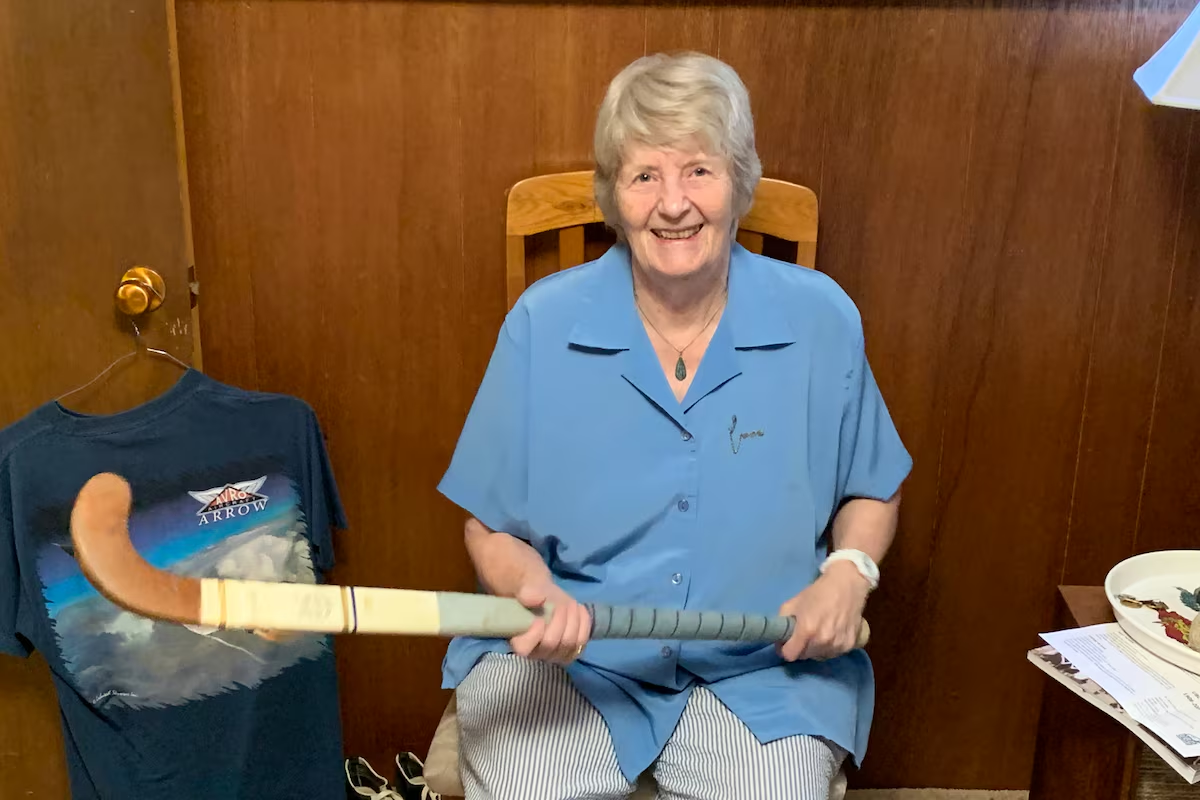
Barb Harris was inducted into the Field Hockey Canada Hall of Fame in 2020, the Burnaby Sports Hall of Fame in 2025 and the B.C. Sports Hall of Fame earlier this year.Field Hockey Canada/Supplied
Until she attended her first practice, Barb Harris had never held a field hockey stick.
A farm girl newly arrived on the University of British Columbia campus, she sought a sporting outlet as relief from studies. When she learned the field hockey team had a travel budget, she decided to try out for the sport.
Ms. Harris, who has died at 91, went on to play for teams representing Canada, as well as becoming one of the most prominent builders of her sport in her home province.
Her university coach was May Brown, who built a powerhouse varsity team before the woeful state of Vancouver’s athletic grounds led her to launch a successful political career on a reformist slate. By her second year, Ms. Harris was a star on the varsity roster, playing right inner and centre forward.
While ice hockey was Canada’s national sport and the version played on grass seemed a colonial remnant, Ms. Harris displayed a goalscorer’s hunger familiar to anyone who ever cheered for the likes of Gordie Howe.
“Because I didn’t start out slowly and learn this is the way you should do this shot or that shot,” she once said, “all I wanted to do was put the ball in the goal.”
Ms. Harris was one of 16 players selected for the Canadian team for the international women’s field hockey tournament in Amsterdam in 1959. Each of the women had to raise at least $400 to fund the trip to the tournament, doing so through raffles, dances, babysitting and collecting empty bottles.
The squad, all from Vancouver, at the time the sport’s centre in Canada, then toured England before the tournament, during which they suffered a humiliating 10-0 loss in an exhibition match against the Globetrotters, a team of experienced English international players.
In the Dutch capital, they defeated France, 1-0, and Switzerland, 2-0, though they would fail to score against Ireland (4-0), Scotland (3-0) and Australia (5-0). They held off the hometown favourites nearly to the final whistle, losing 1-0 to the Netherlands on a goal scored just three minutes from the end at Wagener Stadium.
Four years later in Baltimore, Ms. Harris was named captain of the team. Canada again struggled, losing 3-0 to Australia, 4-0 to Wales and 3-0 to the Netherlands before drawing Switzerland, 1-1, and France, 2-2.
Open this photo in gallery:
Barb Harris, left, had never held a field hockey stick until she showed up to try out for her university team.Field Hockey Canada/Supplied
After her playing days ended, Ms. Harris became a coach and administrator. She organized the field hockey tournament in the Vancouver suburb of Burnaby for the second ever Canada Summer Games in 1973.
She was a key organizer when Vancouver hosted the women’s world field hockey championship in 1979, billed at the time as the largest women’s tournament ever held on the continent. Ms. Harris launched the 79ers Club several years earlier to help cover the costs to hold the championship of the International Federation of Women’s Hockey Associations on the campus where she had first learned the sport.
Barbara Elizabeth Hart was born in Burnaby on April 23, 1935, to Grace Elizabeth Storry and Cecil Gordon Hart, a salesman whose future occupations included cement contractor, sawmill owner and trailer-park owner. Her parents divorced in 1956.
A teacher by training, she taught math, English and physical education at Burnaby South Secondary, where she also coached the girls’ basketball, volleyball and softball teams, as well as grass hockey, a sport for which she not surprisingly had a special affection.
“The players must think every minute of the 70 minutes they play,” she told the Vancouver Sun in 1963, “not just when they get the ball.”
While furthering her education in England (“Britain is traditionally the queen of field hockey,” she once said), she met a fellow Canadian university summer flight cadet at an airbase near Nottingham. In 1965, she married Burton Gregg Harris, who was born on a farm in southwestern Ontario. He went on to become an aeronautical engineer, working on the Apollo program for NASA.
Three years after their marriage, they embarked on a 19-month, 100,000-kilometre journey in a Volkswagen camper through 66 countries on five continents. They later visited the other two continents.
She was inducted into the Field Hockey Canada Hall of Fame (2020) and the Burnaby Sports Hall of Fame (2025). She was named to the B.C. Sports Hall of Fame earlier this year.
She was perhaps best known in her hometown for organizing the annual Terry Fox Run at Swangard Stadium.
Her $75,000 gift was the largest donation ever received by the field hockey program at her alma mater. She made the contribution in 2021 to aid the program in recovering from the effects of the COVID-19 pandemic.
Ms. Harris died at her Burnaby home on July 21. She leaves a grandson, Matthew Harris; a brother, R. Gordon Hart; and a sister, Jeannine Robinson. She was predeceased by her husband, who died in 2019, aged 86, and by her daughter, Gayle Elizabeth Janet Harris, a children’s librarian in the Vancouver suburb of Surrey who also died in 2019, aged 44.
Ms. Harris’s many philanthropic endeavours included supporting research at the B.C. Children’s Hospital on Long QT Syndrome, the heart disease that claimed her daughter. She also donated $100,000 to launch the Gayle Harris Memorial Education Fund, which offers grants to library staff in Surrey to further their education.
You can find more obituaries from The Globe and Mail here.
To submit a memory about someone we have recently profiled on the Obituaries page, e-mail us at obit@globeandmail.com.