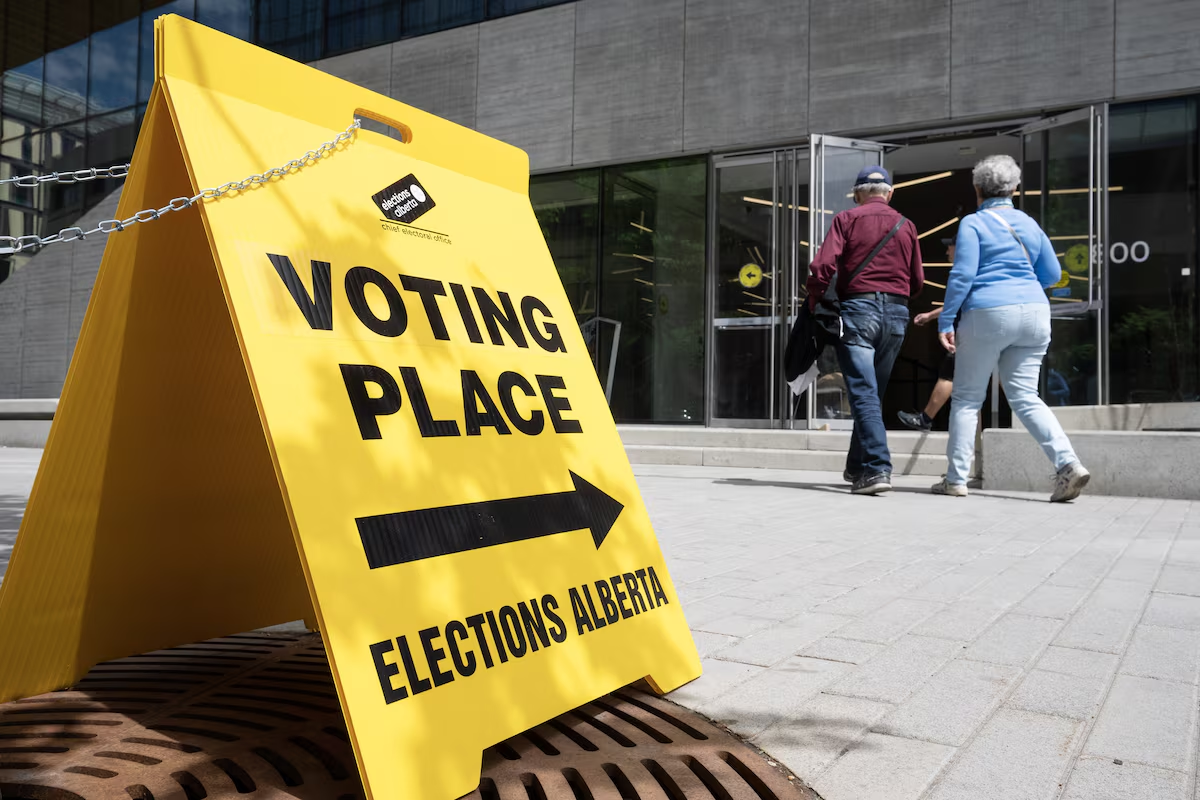

Open this photo in gallery:
Elections Alberta is recruiting experienced staff from elsewhere in the country to help count millions of ballots in the frenetic 48-hour period that will follow the Oct. 19 referendum.Todd Korol/The Globe and Mail
Ahead of the vote that could lay the groundwork for Alberta’s secession from Canada, the province’s elections agency says it is soliciting help from the rest of the country to make sure its Oct. 19 referendum runs smoothly.
Elections Alberta is seeking experienced, skilled staff from its counterparts in other jurisdictions to support the agency during the massive undertaking, which will require millions of ballots to be counted in just 48 hours, spokesperson Maia Hanrahan said in a statement to The Globe and Mail.
The elections staff potentially being pulled from other provinces are in addition to at least 60,000 poll supervisors, ballot box clerks, scrutineers and other workers needed, a hiring push the agency has called “one of the largest referendum recruitment efforts ever undertaken in Canada.” By contrast, roughly 13,000 people were hired for Alberta’s 2023 provincial election.
But as of two weeks ago, the agency had received just 24,000 applications from prospective election workers, Ms. Hanrahan said. Returning officers are already reaching out to successful candidates.
“Obviously, we’re not there, but we’re going to continue that recruitment as long as we need to – right up until the event date,” Jennifer Maskoske, the agency’s director of elections operations, said in an interview.
Russian, U.S. actors are targeting Albertans with pro-separatist content, research shows
The agency said it needs experienced staff from other provinces to “add expert resources” – particularly for the continuous 48-hour ballot count that will follow the 12-hour voting day. Ms. Hanrahan said the cohort of skilled out-of-province workers is separate from the 60,000 people it’s trying to recruit, and that it’s normal for provinces to help each other during major votes.
The massive recruitment push is among multiple pressures weighing on Elections Alberta as it prepares for a flurry of electoral activity, between the fall vote and the province’s next general election, scheduled for Oct. 18, 2027.
On Monday, Premier Danielle Smith’s government added another date to the calendar: a by-election to be held Sept. 14 in the Calgary riding previously held by her former environment minister, Rebecca Schulz.
Elections Alberta started its drive to find the tens of thousands of workers in early June, and chief electoral officer Gordon McClure said earlier this year that up to 90,000 workers could be needed.
The agency has faced a mountain of work since Ms. Smith’s announcement earlier this year of the fall referendum, in which residents will vote on questions around provincial separation, immigration and constitutional issues.
Elections Alberta could actually employ many individuals who stand to be directly affected by the vote’s results, beyond the question on separation. Five of the questions designed by Ms. Smith propose charging temporary residents for health care and education and limiting their access to social support services.
Explainer: What does health care coverage for newcomers cost Alberta?
Ms. Hanrahan said applicants don’t need to be Canadian citizens to work as an election officer. They are only required to be an Alberta resident and at least 16 or 18 years old, depending on the job, and to pass a criminal record check, she said.
Counting the ballots will also be a Herculean task.
Elections Alberta is printing 45 million ballots, as each of the 10 referendum questions will appear on its own sheet of paper. By comparison, the 2023 provincial election required just 2.9 million ballots for Alberta’s entire electorate, plus an extra, unspecified number for damaged or spoiled ballots.
Additionally, the ballots must be counted by hand, since Ms. Smith banned electronic tabulators in 2024, arguing the machines have failed to produce faster results or increase confidence in elections.
When polls close, Elections Alberta will have 48 hours to report unofficial results. If turnout matches that of Alberta’s 2023 provincial election at 1.7 million votes cast, the agency will be responsible for tallying at least 17 million ballots.
Alberta election law doesn’t specify what would happen if the agency failed to meet the 48-hour deadline, the province’s Justice Ministry said.
“We are confident in Elections Alberta’s ability to conduct the referendum as planned,” Heather Jenkins, spokesperson for Alberta Justice Minister Mickey Amery, said in a statement.
Tyler Dawson: Despite what the separatists think, Albertans actually aren’t that mad
A full roster of 60,000 election workers would allow Elections Alberta to provide “seamless delivery” on voting day, Ms. Maskoske said. She declined to speculate on how a shortage of workers would complicate voting day and the count, but she said fewer hands would delay the results.
“We will complete the task that’s before us with the number of applicants that we do get,” she said.
Hiring enough election workers is, by far, an elections agency’s most cumbersome and expensive task, said Lorne Gibson, who was Alberta’s chief electoral officer from 2006 to 2009. The 13,000 workers hired for the 2023 provincial election fell well short of the goal of 20,000, he said.
“There’s not a lot of time left for them to find more workers,” he said.
Workers represent at least half the cost of running an election, Mr. Gibson said. He estimated the final bill for the referendum would be between $120-million and $130-million, including wages, leases for polling stations, printing ballots and other costs.
Keith Archer, a former chief electoral officer in British Columbia, said counting ballots would be the most onerous job on referendum day.
“I suspect people at Elections Alberta are concerned that they may not have the staff to run the referendum campaigns in the way that they’re designed to be run,” Mr. Archer said.