
Listen to this article
Estimated 5 minutes
The audio version of this article is generated by AI-based technology. Mispronunciations can occur. We are working with our partners to continually review and improve the results.
Blue-green algae is being monitored by researchers across Alberta, and the public can follow along from anywhere through a new website.
The Algal Bloom Tracker lets users track those toxic algal blooms at six lakes, with satellite imagery and lake sampling allowing the website to provide near real-time results that can be easily viewed on a free-to-use map.
Rolf Vinebrooke, one of the researchers behind the project, says the map is updated through satellites passing over Alberta lakes on a regular basis and capturing images of the water.
“A satellite image gives you a view of the entire lake so you exactly know what the nature of the bloom is like and what areas to avoid,” said Vinebrook, an aquatic ecology professor at the University of Alberta.
WATCH | How to stay safe on lakes when there’s blue-green algae:
How to stay safe on Alberta lakes when there’s blue-green algae
Freshwater ecologist Rolf Vinebrooke talks with Nancy Carlson about how not all algae blooms are toxic and how researchers are using satellites to learn more about the bacteria.
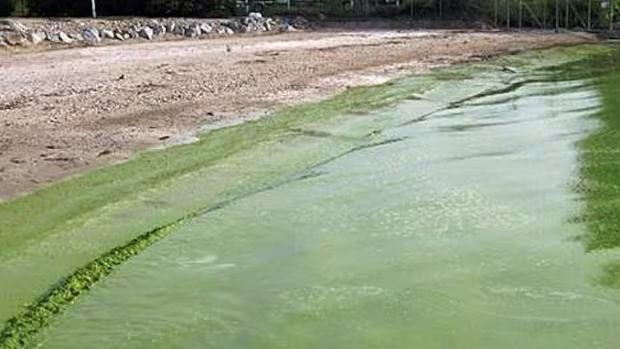
Cyanobacteria, often referred to as blue-green algae, sometimes blooms in large numbers in nutrient-rich Alberta lakes during the summer.
Aside from creating visually distinctive green scum in water, these algal blooms can present significant health risks. Some are capable of producing toxins that can damage liver tissue if ingested, and can also cause neurological damage by interfering with nerve impulses.
“These things are so dynamic,” said Vinebrook. “A bloom can appear in a matter of days, and equally, it can disappear in the matter of days as well.
“People aren’t on a lake every few days sampling, so the satellite actually enables us to track it much more closely than if you did it the traditional way.”
 Lac La Biche, which has been under an Alberta Health Services health advisory due to algae since July 14, pictured on the Algal Bloom Tracker online map. Through chlorophyll concentrations estimated by an algorithm, the map shows where and how intense algal blooms are. (Algal Bloom Tracker/Screenshot)
Vinebrook says people planning to visit or participate in recreational activities at a lake can check the website to see if it currently is or recently has been plagued by a bloom. Users can also look at a lake’s history over the past few years to see if it has a clean track record or a history of frequent outbreaks.
The tracker, currently a prototype that’s been in development since 2017, is only active for six lakes: Ethel Lake, Lac La Biche, Nakamun Lake, Pigeon Lake, Sylvan Lake and Wabamun Lake.
Those lakes — all of which are popular for outdoor recreation — were chosen to represent a gradient of bloom frequency, ranging from Sylvan Lake, which rarely gets blooms and serves as a clean baseline, to lakes with highly frequent blooms, such as Lac La Biche.
Vinebrook says the team is working to expand the tracker to about 50 lakes across Alberta within the next three years.
Blue-green algae advisories in place across Alberta
When an excessive amount of blue-green algae is detected in a lake, Alberta Health Services issues a health advisory.
There are more than 25 currently in effect across the province.
The provincial health agency says people should avoid contact with blooms, including by not swimming or wading in areas where blooms are visible and not drinking or cooking with water from that lake.
WATCH | Blue-green algae advisories issued for 25 Alberta lakes:
Blue-green algae advisories issued for 25 Alberta lakes
Alberta Health Services has issued blue-green algae, or cyanobacteria, advisories for 25 lakes across the province. A biologist at the University of Alberta says the toxins it produces can pose health risks to animals, but rarely to humans.
One of the most recent advisories was issued for Lake Sundance, a private lake in southeast Calgary, on Thursday.
The Sundance Lake Residents Association said on social media that it “will continue to monitor lake conditions and work with Alberta Health Services regarding the advisory and water quality.”
The team behind the Algal Bloom Tracker operates on a separate level from AHS. Official advisories are issued based on physical observations by health workers and water sample testing results.
Instead, the tracker serves as a tool to help the public use common sense when deciding where to swim.
“It’s probably best to go along with that health advisory because even if the blue-green algae aren’t there necessarily on a particular beach they might have been there the day before,” Vinebrook said.
But the researchers are also looking to better understand some of the big questions behind blue-green algae, including whether Alberta’s lakes are getting worse.
Vinebrook says historical satellite data clears this up by showing that while bloom intensities have increased since the year 2000, they have not done so “too dramatically.” Instead, the real change is that the year-to-year variance and unpredictability have become much more pronounced.
WATCH | Blue-green algae is on the rise. Is enough being done to protect our lakes?:
Blue-green algae is on the rise. Is enough being done to protect our lakes?
Blue-green algae blooms are an emerging issue in northwestern Ontario’s waterways. Nathan Wilson, a PhD candidate at Lakehead University, joined the CBC’s Amy Hadley in studio to talk about how our monitoring systems can be improved to keep the region’s aquatic ecosystems healthy.
The project’s website indicates it also aims to help better understand algal blooms.
“Along with these advisories come significant negative impacts to Alberta’s recreation and tourism activities, to real estate values, and to Indigenous communities,” the website reads.
“As a result, knowing when, where, and why harmful algal blooms occur is important to scientists, policy-makers, stewards, residents and recreational lake users.”