
Listen to this article
Estimated 4 minutes
The audio version of this article is generated by AI-based technology. Mispronunciations can occur. We are working with our partners to continually review and improve the results.
A for-profit plasma donation company says it’s temporarily shutting down collection at all its Canadian clinics amid public scrutiny.
Grifols says it’s pausing activities in light of “unfounded attention” focused on paid plasma collection and that it’s ready to resume operations as soon as it’s practicable, in agreement with Health Canada and the Canadian Blood Services.
The pause will go into effect Friday, the multinational company said in a statement Thursday.
Grifols said it informed Health Canada of its decision Wednesday, the same day the federal agency says the company was issued a non-compliance rating at one of its Winnipeg sites, on Taylor Avenue.
An inspection report card summary on Health Canada’s website Thursday said the Winnipeg clinic “did not carry out sufficient corrective and preventive actions when required.”
It also said some operating procedures were not always followed and that records of “staff qualifications, training or evaluation of their competency” were not always sufficient.
Advocates have been calling on the federal government to crack down on the company after CBC News reported two people died after donating plasma at different Grifols clinics in Winnipeg.
A Health Canada inspection recently released under access to information laws found multiple issues with donor screening and supervision. The federal agency says six serious adverse reactions were reported at centres currently operated by Grifols since 2018.
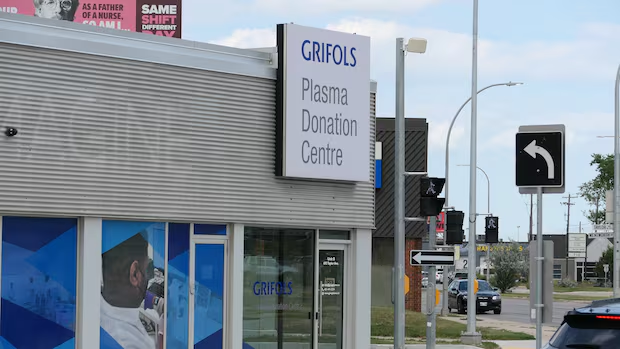
 The Grifols location at 693 Taylor Ave. in Winnipeg. A Health Canada inspection in June found several deficiencies there. (Jeff Stapleton/CBC)
“We see this pattern of poor practices,” said Noah Schulz, provincial director of the Manitoba Health Coalition.
The coalition, along with other advocacy groups, has called for a ban on paid plasma.
Schulz said being for-profit means the company is encouraged to run things “as cheaply” as possible.
“It’s not just media attention with no evidence, no basis,” he said. “The Health Canada inspection reports are there. We know that there are serious problems at Grifols.”
Grifols said Thursday donor safety and the quality of the plasma it collects have never been compromised.
Winnipeg clinic found non-compliant
Publicly listed inspections of licensed blood establishments show the company’s clinics have received “non-compliant” ratings in New Brunswick, Ontario, Manitoba, Saskatchewan and Alberta.
Most recently, the June 23 inspection that resulted in the non-compliant rating for the Taylor Avenue location found problems in how the clinic screened donors for suitability, cleaned and maintained equipment and investigated errors and accidents, among other issues.
International student Rodiyat Alabede died on Oct. 25 after friends say she went to give plasma at the clinic. Health Canada has said it’s found no link between the 22-year-old’s death and the “donation process.”
Katherine Lanteigne, an advocate acting as representative for Alabede’s family, said in a statement “donors in Canada are safe” now that Grifols has temporarily closed its doors but urged Health Canada to “immediately suspend” the company’s operating licences.
A spokesperson for Health Minister Marjorie Michel said in an email Thursday that Health Canada had been working closely with the company to address deficiencies before taking “additional remedial measures.”
The measures included extra terms and conditions to Grifol’s licence, an unannounced inspection and a formal warning saying the identified problems could result in suspension of some operations, the statement said.
“Canadians’ safety must always come first, and we welcome Grifols’ decision to temporarily close its plasma collection sites across Canada,” the minister’s office said after the company announced the temporary closure, adding it won’t impact the country’s blood supply.
Health Canada had imposed conditions on more than a dozen sites operating under the Grifols licence.
The agency has ordered the company to reduce the number of donation appointments, reassess the number of trained workers in all positions, review donor files before updating eligibility and implement more oversight for newer staff, including in-person supervision.
This is on top of mandatory audits to make sure “that any deficiencies identified are documented and investigated.”
Grifols said the pause will allow the company to work with the government and Canadian Blood Services on a plasma collection network “without unnecessary reliance on imported product.”
The Spain-based company has about 400 plasma collection centres outside Canada.