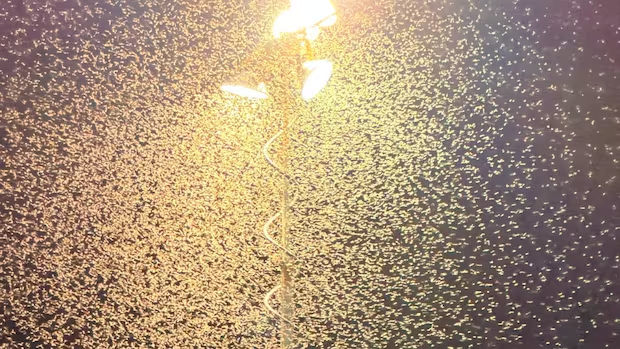
This year’s Pasadena Days-Humber Valley Strawberry Festival in Pasadena included a magical, horrible, strangely beautiful concert event, as spruce budworm moths descended in the thousands.
“It literally looked like it was a blizzard. It was a snowstorm,” said performer Vanessa Newman, a member of the Corner Brook band Merrymaker, who took a sip of water at one point in her set and immediately spit it out, realizing at least one moth was dead in there.
She took it in stride, amazed by the scene.
The moths moved around overhead lights like murmurations of starlings into the night. A white tent was darkened by moths coating the outside.
“They were on our instruments, in our hair, flying in our faces. But you know what? The crowd was great, the crowd stuck around the whole night. Right until the very end it was a really big crowd,” she told CBC Radio’s On the Go.
The three singers in her band “discovered a whole new level of concentration,” she said, as they tried to keep moths from their mouths and eyes.
 Melanie Wells takes a picture over her shoulder at the Pasadena Days – Humber Valley Strawberry Festival main event at Pasadena Place on Aug. 7, 2026. (Submitted by Melanie Wells)
While an irritation to working performers, Newman said it was striking as a natural display.
“It was actually an amazing thing to see. I’ve never seen anything like it,” she said.
A night to remember
It was a very particular moment in time for the insects. Spruce budworm only live about two weeks after reaching the adult stage of their lifecycle, as moths. They tend to mature around mid-July to August.
The sheer numbers in Pasadena are a reflection of the spruce budworm outbreak Parks Canada notes was long expected and “even a few years overdue,” based on cyclical events, before numbers began to tick up a few years ago.
The province is now grappling with the rise, and is expected to be for years yet. Per the federal government, the exact impact of the current outbreak can’t be assessed yet, but trees will continue to die for at least three years after the outbreak has collapsed.
Outbreaks of spruce budworm can run more than a decade. The insect can be particularly damaging as a caterpillar, chewing through tree needles but also buds of new tree growth. After a few years of ravaging by spruce budworm, whole stands of trees can succumb.
 A spruce budworm infestation is ongoing in Newfoundland and Labrador. (CBC)
There are economic considerations there. A notorious outbreak in the 1970s into the 1980s, for instance, destroyed the equivalent of about a 25-year wood supply in Newfoundland and Labrador. There are also forest management and safety considerations, with so much dead wood in the wilderness, acting as fuel for wildfires.
Already, in the current multi-year outbreak, provincial forestry plans governing wood available for harvesting in forestry operations have started to increase what’s available in areas where spruce budworm has returned in number.
Wait and see for next year
“It was here last year as well, especially up in Gros Morne National Park, but this year … it’s just gone crazy,” said Lloyd Hollett, owner of the Newfoundland Insectarium in Reidville in western Newfoundland.
Hollett worked in forestry for more than 20 years prior to opening the roadside attraction. He told CBC his work included watch of spruce budworm in the region.
 Newfoundland Insectarium owner Lloyd Hollett told On the Go natural factors like spring temperatures are likely to have the greatest contribution in eventually knocking back current spruce budworm numbers. (Colleen Connors/CBC )
“I’ve never seen anything like this,” he said.
He’s aware from word-of-mouth the current infestation is well beyond the Humber Valley, with friends up the Northern Peninsula in Port aux Choix recently looking outside and seeing thousands around a light on their property.
“The other night, our windows were completely covered with moths,” he said.
At the same time, he added, noting the moths’ short lifespan, he said he’s noticed a drop in the numbers in his area over the last two days.
Hollett said his only concern from the numbers this year is what it might mean for next year. The spruce budworm outbreaks are typically curbed naturally, with very low temperatures at key points of early development playing a role, for example.
The province has for years attempted a spray program as an attempted early intervention against the outbreak. Despite seeing rising numbers since at least 2018, Parks Canada decided not to spray inside Gros Morne National Park as the current multi-year outbreak began.
In past outbreaks, spruce budworm numbers have surged from west to east. As noted by Parks Canada, forestry scientists say a cycle occurring in waves from Quebec into Newfoundland has happened for millennia.
The insects mostly are attracted to balsam fir, white spruce, ornamental spruce and, to a lesser degree, Hollett said, black spruce.
“Not much we can do about it,” Hollett said, suggesting one person and even one forestry program won’t mark the end of the wave.
As with the arrival in Pasadena, it will require the right, natural conditions.
On the Go reached out to the provincial Department of Forestry, Agriculture and Lands but did not receive a response.
Download our free CBC News app to sign up for push alerts for CBC Newfoundland and Labrador. Sign up for our daily headlines newsletter here. Click here to visit our landing page.