
Listen to this article
Estimated 3 minutes
The audio version of this article is generated by AI-based technology. Mispronunciations can occur. We are working with our partners to continually review and improve the results.
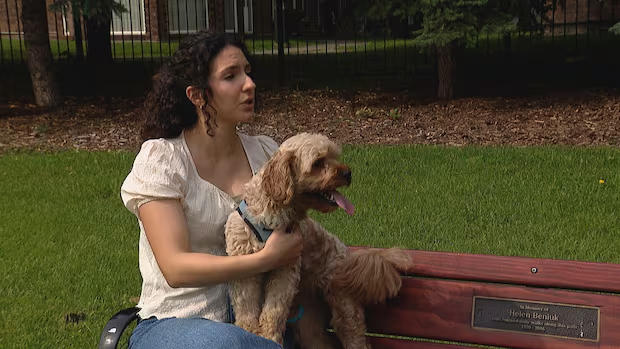
Valeria Vecchio and her dog Clifford were on their daily walk through a park in Edmonton’s downtown area when she noticed something was off with her pup.
“All of a sudden he didn’t want to walk anymore,” Vecchio said about her one-year-old dog, who is a mix of poodle and Cavalier King Charles spaniel.
Clifford became lethargic, his gums and tongue were turning white and he began vomiting. Carrying him home from Railtown Park, located on 110th Street just north of the High Level Bridge, she wondered if he had eaten something that he shouldn’t have.
By the time she called an Uber to go to the vet, Clifford was barely breathing and his heart rate had slowed.
“I was actually shaking his head while we were in the Uber getting to the hospital just to make sure that he wouldn’t fall asleep,” Vecchio said.
At the animal hospital, the vet told her that Clifford may have been suffering from opioid toxicity.
Naloxone was administered and Clifford made a full recovery.
For Vecchio, the suspected diagnosis from the vet wasn’t that surprising.
“It totally makes sense,” she said. “There are a lot of public areas in downtown Edmonton, especially where there is open drug consumption. So I wasn’t shocked.”
A growing problem
Dr. Jami Frederick, the president of the Alberta Veterinary Medical Association and an emergency veterinarian, said opioid ingestion in pets is becoming more common in Edmonton.
“We see it less commonly than marijuana,” she said. “But certainly, especially in the summer months when people are out walking their pets in public areas more often, we’re seeing it more and more.”
Frederick said her team sees opioid toxicity once or twice a month.
She said that the safest course of action is for pet owners to carry a naloxone kit with them when out in public with their pets. But if opioid toxicity is suspected, she advised pet owners to seek immediate medical care.
“Often the naloxone does not work for as long as the opioid works,” Frederick said. “So they may have to have repeat doses, and the safest place to have them monitored and redosed would be at a veterinary hospital.”
In a statement to CBC News, the City of Edmonton said it couldn’t confirm whether the incident was formally reported to the city.
However, it said litter and debris is removed from grass every 10 to 18 days for mowing, and every eight days in high-profile locations.
Going forward, Vecchio said that she will be more careful of where she and Clifford go for their daily walks, avoiding areas that she believes could be at high risk for open drug consumption.
 Clifford, a King Charles Cavalier spaniel and mini poodle mix, sits on a trail in Edmonton’s Railtown Park on Monday, Aug. 10, 2026. (Paul Rampersaud/CBC)
“I think the scary part was hearing the vet say that it happens quite frequently in downtown,” Vecchio said. “Because that makes me think, ‘OK, then what is the safest space to walk my dog?’”
She said she will also be closely monitoring everything that Clifford eats and smells.
“He means the world to me,” said Vecchio. “I love him.”