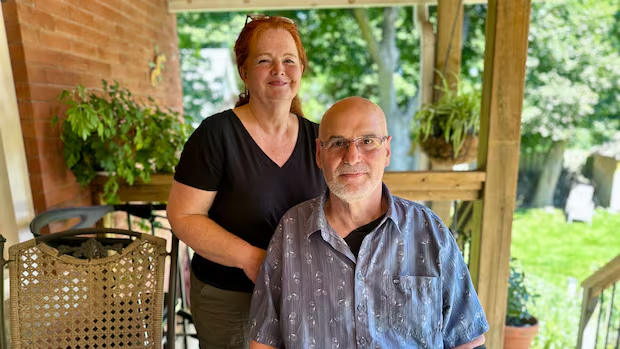
At 60 years old, André Gagné was healthy, working for Canada Post and renovating homes.
Then, a mosquito bite changed everything.
Gagné says he started experiencing flu-like symptoms that kept getting worse, until he completely lost his balance.
“I felt like Gumby. My limbs were dragging and I was running into the walls,” he said. “I told my wife, ‘bring me to the hospital.'”
That’s where he spent the next eight months. It took a while before Gagné was finally diagnosed with West Nile virus, and it nearly killed him. He hadn’t left his home of Milton, which is where he was likely bit by the infected mosquito.
“I lost 70 pounds in about a month because I was paralyzed,” he said. “I couldn’t eat, swallow, my hearing was gone, my eyesight was gone and my eyelids wouldn’t close.”
Gagné was diagnosed with West Nile neuroinvasive disease, which occurs in less than 1 per cent of infected people when the virus enters the central nervous system.
Today he deals with paralysis and memory loss, and has difficulty forming and communicating his thoughts.
“I can’t get dressed anymore and people have to feed me because I don’t have my arm functioning. It’s horrible to not be independent.”
With the arrival of mosquito season, health officials are reminding residents to take measures to protect themselves. While most people experience mild flu-like symptoms or no symptoms at all, some people do experience severe illness, or death. But some residents whose lives have been impacted by the virus believe there should be even more public awareness.
 According to her sister, Carmen Applegath was well-known in her neighbourhood of Leaside, was a successful chef and loved to work in her garden. She died in February 2026 after contracting West Nile encephalitis. (Submitted by Lisa Applegath)
Lisa Applegath’s sister Carmen died earlier this year following a six month battle with West Nile.
“Carmen was an incredible and active women. Even though she was in her mid 60s, she didn’t act like she was in her mid 60s,” Applegath said.
Before the virus, she says her sister was independent, healthy, full of life and a beloved member of her community.
At first, she says, Carmen thought she might have COVID, but her family and friends became concerned when her symptoms weren’t improving and she was losing weight. Doctor visits and blood work didn’t provide answers. After a few weeks her body collapsed and Applegath took her to North York General Hospital, where she ended up in a coma. She said the hospital staff did everything they could to keep her alive.
“I will tell you, it was torturous watching my sister in that state,” she said, adding the outlook for her recovery was not promising.
“She made a decision that she didn’t want to go on. She did not have MAID (medical assistance in dying), they took her off the respirator and she died peacefully.”
Highest number of cases recorded in Ontario in 2025
Toronto Public Health confirmed the first human case of the West Nile virus in the city for 2026 on July 30. It says as of September 2025, there have been a total of 26 cases confirmed in the city.
According to Public Health Ontario, the peak months for reported cases of West Nile virus are August and September, so it’s too early to compare this year’s numbers.
But last year, Dr. Richard Mather, public health physician with Public Health Ontario, says there were 181 cases reported in the province.
“[This] was the highest number of cases that were reported. Prior to that, the highest number was in 2017 when there was 159 cases,” he said.
Toronto, Niagara Region, Windsor and Essex Region were among the areas with the most cases.
Mather says there has not been a regular upward trend over the past decade, but officials continue to monitor the data.
“With rising temperatures it’s anticipated over time there will be more mosquito activity and more cases of West Nile moving forward,” he said.
Dr. Isaac Bogoch, infectious diseases specialist at Toronto General Hospital, recommends residents wear long sleeves, use bug spray and remove standing water where mosquitoes can breed.
He says the vast majority of people who contract the virus will have very few or mild symptoms, but it’s still important to protect yourself.
“It’s not hard to diagnose, we have the appropriate diagnostic tests in Canada,” he said. “Treatment is supportive, we don’t have a dedicated antiviral drug for this, and we do not have a vaccine.”
‘I don’t want my sister’s death to be in vain’
Applegath says Carmen often joked about mosquitos finding her, and says if she was more aware that West Nile existed in Toronto, she would have taken further precautions.
“She didn’t know the risks that she was taking, I didn’t know the risks either,” she said.
“When I talk to people about this, they’re flabbergasted, they have no idea that there is West Nile in the city.”
Applegath says it’s her mission to share Carmen’s story as much as possible, even if just one person listens and it spares them the grief her family went through.
“I don’t want my sister’s death to be in vain,” she said. “We’ve lost an incredible woman and she had a huge community.”
 André Gagné and his wife Lorraine say they have spent over $20,000 out of pocket to help with the recovery including physiotherapy, modifications to their home and personal support workers. They believe there needs to be better support for West Nile patients. (Submitted by André Gagné)
Through intense physiotherapy, Gagné has come a long way from when medical staff suggested he be placed in long term care, but he also still has a challenging journey ahead.
He says at times the medical system has failed him; he’s been denied various rehabilitation programs, and has paid thousands of dollars out of pocket to help with his recovery.
He hopes that changes.
“I hope the medical world learns not to abandon us and just say there’s no treatment,” he said.
“I also want to make sure people have hope. If you get it, and you come through without dying, you can recover with perserverance.”