
Open this photo in gallery:
Western University neuroscientist Adrian Owen at the Interdisciplinary Research Building on campus in London, Ont., in September, 2023.Nicole Osborne/The Globe and Mail
Executive function is at the heart of many of today’s most pressing health topics. Whether the discourse is around ADHD, perimenopausal brain fog or AI’s long-term cognitive impacts, it feels as though everyone is thinking – and fretting – about impairments to our brains’ higher-order processes.
But what exactly are executive functions – and is there anything we can do to strengthen them? These questions are the premise of a new book called Think Before You Think: Understanding and Mastering Executive Function by Adrian Owen, a professor at Western University’s Schulich School of Medicine & Dentistry.
Dr. Owen gained international recognition for his research showing that some patients diagnosed as vegetative or non-responsive still have consciousness and the ability to communicate. His latest book takes him back to the research subject that lured him into the field of neuroscience in the first place.
The Globe spoke with Dr. Owen about executive function and why he thinks everyone should be thinking more … about thinking.
This interview has been edited for length and clarity.
Age of Breakthroughs: In search of the eureka factor
Let’s actually explain executive function. There’s some scientific debate around its definition, isn’t there?
It’s really quite a squishy term and that was another reason for writing the book. I’ve been working on these processes for 35 years and I have a pretty good idea of all the things that I think are our executive functions.
My definition is that executive functions are a complex set of brain processes that allow us to take control of how we make decisions; what we remember and what we don’t; how we make plans; and how we respond in various emotional situations.
Most of the time your brain is on autopilot – and that’s a good thing, because you don’t want to have to decide every time you need to remember something. But there are some occasions when you really want to make a special effort to remember something. Like, where you parked your car at the airport last week, for example.
When you just take a moment to actively or intentionally decide to remember something – that’s you turning on your executive functions.
What does the science actually tell us about whether we can improve our executive function?
Whenever I do a public talk about executive function, there’s always somebody who will say, “Well, what’s one thing I can do to improve my executive function?” This, in many ways, drove why I wrote the book. We’ve done many large public studies, one that we did fairly recently, specifically to look at whether lifestyle choices can improve executive functions. And we looked at everything; whether they smoke, drink, go to the gym, how much video gaming they do, even whether they go to church. And using some super fancy machine learning with about 20,000 people, we show that all of these things barely make any difference. There isn’t a magic bullet.
I think we are all born with the same neural architecture, the same brain, but how we choose to use that differs a lot between individuals. What I try to argue is that simply thinking about your executive functions is probably going to go further in improving them than, say, eating better, exercising more, or brain training.
We live in a world where it’s being made easier and easier for us to just not use our executive functions – and that doesn’t mean that they’re withering away. It just means that we have fewer opportunities to actually do these things that are incredibly powerful.
Open this photo in gallery:
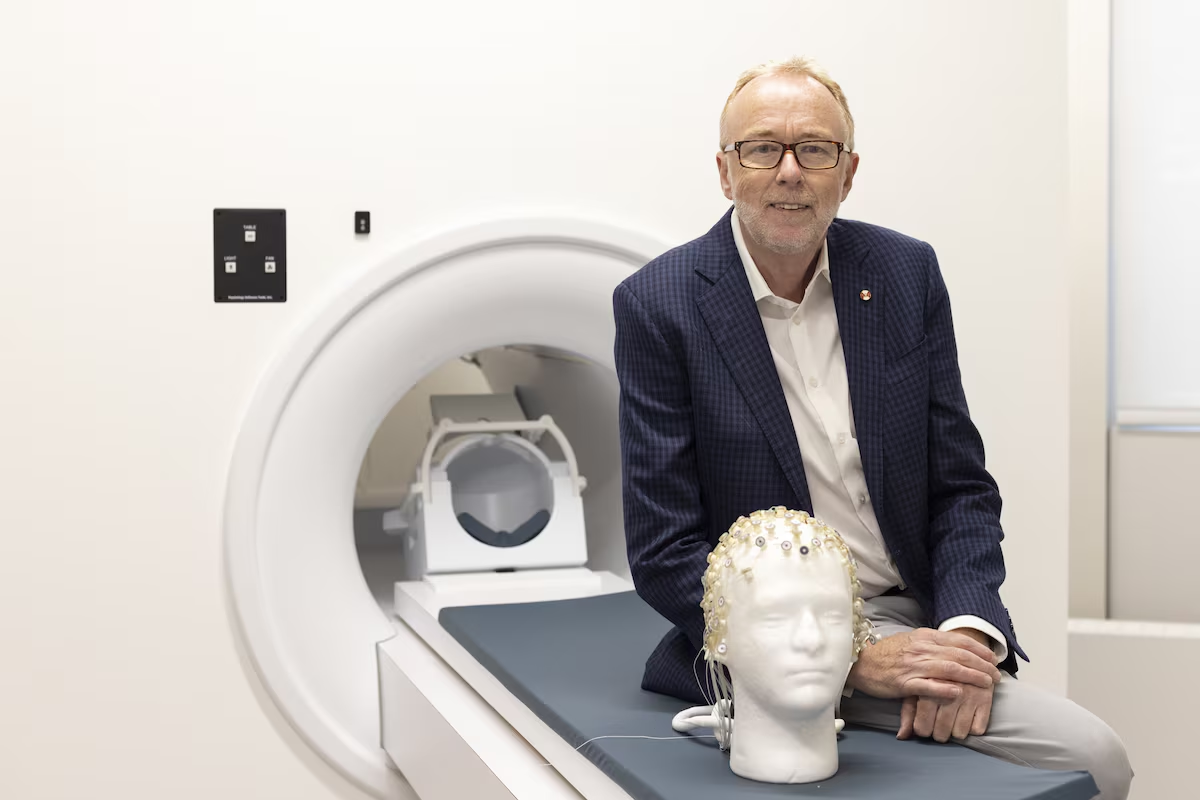
Western University neuroscientist Adrian Owen sits on a mock MRI Scanner with a manikin wearing an EEG cap in the Interdisciplinary Research Building.Nicole Osborne/The Globe and Mail
On that note; there’s a lot of angst around AI and whether it might erode our executive functions. What are your thoughts on this?
My bottom line is that the future won’t belong to people that refuse to use AI. It’s here, it’s very powerful, and in many ways it’s very useful.
I think the future will belong to people who know when not to use AI. Those who can say when something is worth offloading to AI – that might be something as trivial as bashing out an e-mail to someone you don’t really care about – versus knowing when it’s better to use our executive functions.
For example, when making all the big decisions in life; choosing between things that are going to make you happy or less happy. These sorts of decisions, I think, are ones that we should really make ourselves.
You have a 12-year-old son. Are you worried at all about children growing up in an AI world, where they can so easily opt out of using their executive functions?
The important thing is that we teach our children how to use this tool to augment their life, not to take over parts of their life. I have no problem, in general, with my son growing up in a world that’s full of AI. But I do try to make sure that I teach him when it’s beneficial to use AI, and when it’s not appropriate.
I think it’s a bit like wearing reading glasses, right? I wear reading glasses and in doing so, I’m extending my abilities beyond the biological limits of my brain and my body. And I think you can use AI as exactly the same thing; to extend your cognitive ability. Nobody uses a map anymore now that we have GPS, and I don’t think that’s a bad thing. But I think you need to be careful that you don’t start depending on it just to get to your local grocery store.
What is life: The long ascent from matter to mind
How has your research into executive function influenced your choices in daily life – do you use phone notifications, for example? You mention them in your book as something that can be very detrimental to attention.
I have no notifications on any devices. Every time I get a new phone or computer, I turn them all off. If I have notifications on, it’s more or less impossible to do really important stuff that actually requires my undivided attention.
There’s something called a “switch cost,” as you mention in the book.
Yeah. Most people believe that you can do two things at once but neuroscientists are very aware that you actually can’t. You can fool yourself into thinking you can – in the sense that you can talk while you’re driving, for example. But what that is is your attentional system – your brain – switching very quickly between the two things that are going on. And there is a cost; you are going to be slightly less attentive to your driving.
Even if you just read a phone notification and ignore it, you have shifted your attention entirely from what it was you were doing. If you’re watching a TV show, maybe you don’t care. But if you’re trying to write a scientific paper, it matters a lot.
For those who read your book, what do you hope will be their biggest takeaway?
It’s all in the title of the book, honestly. Just think about what you’re thinking. It’s very easy to just live on autopilot but in doing that, you are going to miss opportunities. You can change a lot by just thinking about the decisions you make, why you make them, whether they’re the right decisions.